Trump Iran Ceasefire: Two Weeks, Ten Points, and the Deal That Could Reshape the Middle East
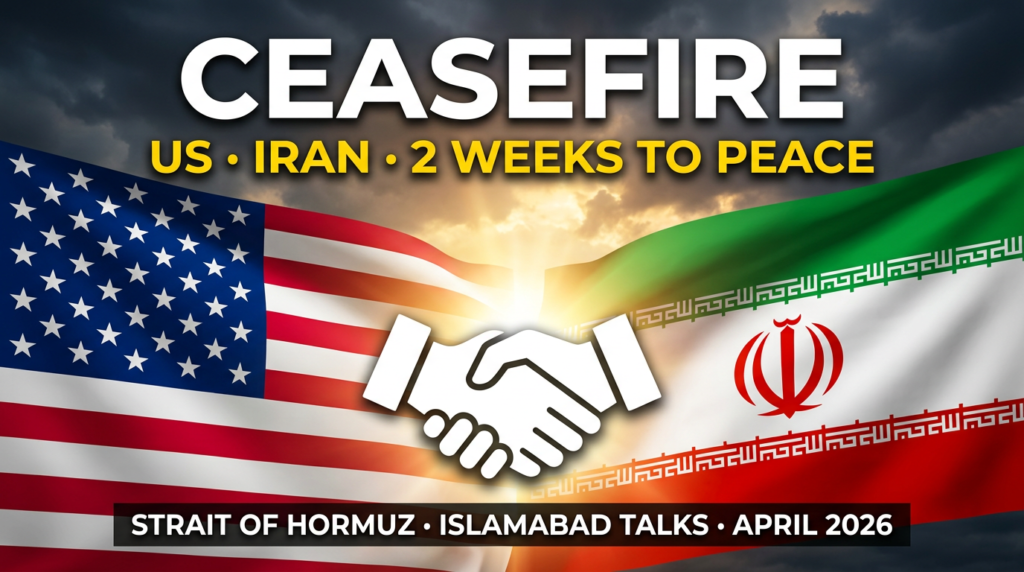
Two weeks. Ten points. One chance to end a war that has rattled global oil markets, pushed gas prices past $4 a gallon, and exposed just how much the world depends on 21 miles of Iranian-controlled water.
The message landed on Truth Social just before 8 p.m. on April 7, 2026, and the world held its breath. President Donald Trump announced he was suspending a planned bombing campaign against Iran — not out of weakness, but on terms. Iran would reopen the Strait of Hormuz. Talks would begin in Islamabad. And for the first time in more than five weeks of war, both sides would step back from the brink.
This is not a surrender. It is, if managed correctly, the kind of results-driven diplomacy that American voters — especially those who believe their government should lead with strength and spend their tax dollars wisely — have demanded for decades. The question now is whether the next two weeks will deliver on that promise.
Support Independent Local Journalism
TheTownHall.News is a non-profit reader-supported journalism. Just $5 helps us hire local reporters, investigate important issues, and hold public officials accountable across Alameda County. If you believe our community deserves strong, independent journalism, please consider donating $5 today to support our work.How America Got Here: A War Nobody Can Afford to Ignore
The United States and Israel launched military operations against Iran on February 28, 2026. Within days, Iran retaliated in the only way it could inflict maximum economic pain on the entire world: it closed the Strait of Hormuz on March 4.
The consequences were immediate and devastating — not just for Tehran’s adversaries, but for ordinary Americans filling their gas tanks. Brent crude, sitting at roughly $72 a barrel the day before the war began, exploded past $120. U.S. gasoline prices surged more than 30%, hitting a national average of $4 a gallon by March 31, with California drivers paying over $5. The International Energy Agency called it “the largest supply disruption in history.”
This isn’t an abstract foreign policy story. It’s a kitchen-table issue. Every family that drives to work, every small business that depends on shipping costs, every farmer watching fertilizer prices climb 40% has a direct stake in what happens in the Strait of Hormuz over the next two weeks.
The Ceasefire Terms: What America Got — and What It’s Asking For
Trump’s announcement wasn’t a blank check. The ceasefire carries clear conditions: Iran must agree to the “complete, immediate, and safe opening” of the Strait of Hormuz. In exchange, the U.S. suspends its planned strikes for two weeks while negotiations proceed.

Iran’s Supreme National Security Council formally accepted. Tehran has presented a 10-point proposal that Trump described as “a workable basis on which to negotiate.” The framework includes Iran committing to never seek nuclear weapons, a cessation of regional conflicts in Iraq, Lebanon, and Yemen, and the reopening of the Strait with agreed navigation security protocols.
In return, Iran is asking for the lifting of all U.S. sanctions and the release of frozen Iranian assets. These are significant asks — and they will require hard-nosed negotiation. But the framework exists. The two sides are talking. And critically, negotiations are set to begin in Islamabad on Friday, April 10, with Pakistan serving as neutral host.
That’s a diplomatic architecture built in days, not decades — and it starts with strength, not concession.
Pakistan’s Quiet Diplomacy: A Reminder That Alliances Still Matter
One of the most overlooked elements of this story is how the ceasefire came together. Pakistani Prime Minister Shehbaz Sharif and Field Marshal Asim Munir personally appealed to President Trump to extend his deadline and allow diplomacy to run its course.
Trump credited them directly in his Truth Social post — and that credit is deserved. Pakistan’s role here is a textbook example of how strategic bilateral relationships pay dividends. This isn’t multilateral bureaucracy at work. It’s the kind of direct, accountable diplomacy that gets results.
Support Independent Local Journalism
TheTownHall.News is a non-profit reader-supported journalism. Just $5 helps us hire local reporters, investigate important issues, and hold public officials accountable across Alameda County. If you believe our community deserves strong, independent journalism, please consider donating $5 today to support our work.“Pakistan’s intervention didn’t just pause a war — it opened a door that five weeks of conflict had kept firmly shut.”
For those who believe in strong national sovereignty and results-oriented foreign policy, this is what responsible global engagement looks like: no open-ended commitments, no sprawling international bodies — just a trusted partner making a timely call.
The Real Cost of Inaction: What a Closed Strait Means for You
Critics on the left have questioned whether military pressure on Iran was justified in the first place. But the economic ledger of a permanently closed Strait of Hormuz tells a story they cannot dismiss.
The waterway carries roughly 20% of the world’s oil and liquefied natural gas. Since its closure on March 4, Gulf oil output fell by an estimated 10 million barrels per day at its peak. QatarEnergy declared force majeure on all exports. Over 4,000 daily flights were canceled across the region. Asian LNG spot prices surged 140%. The World Bank estimated Suez Canal losses at $10 billion.
Goldman Sachs put the U.S. recession risk at 30%. The OECD forecast U.S. inflation reaching 4.2%. Stagflation — the toxic combination of rising prices and stagnant growth that devastated American families in the 1970s — was back on the table.
A government that believes in fiscal responsibility and protecting its citizens from economic harm had every reason to act decisively. The question was never whether to act — it was how to act smartly.
What Critics Get Wrong About This Deal
Some voices will frame this ceasefire as a capitulation — a president blinking under pressure and letting Iran dictate terms. That reading is both premature and strategically illiterate.
Trump explicitly stated the U.S. has “already met and exceeded all military objectives.” The bombing campaign degraded Iranian military infrastructure significantly over five weeks. Iran came to the table not from a position of strength, but because continued war posed an existential threat to its already-collapsing economy — which the IMF projects will shrink by 10% this year, with food inflation running at a staggering 105%.
Walking to the table after achieving your objectives isn’t weakness. It’s exactly what responsible military and fiscal leadership looks like. Continuing a war beyond its strategic purpose wastes American resources and American lives — neither of which any serious conservative thinker should support.
“Peace achieved through demonstrated strength is not a retreat — it’s the mission accomplished.”
The Two Weeks That Will Define the Next Decade
The Islamabad talks beginning April 10 are the moment of maximum leverage — and maximum risk. Iran’s 10-point plan contains provisions that would require careful scrutiny before any sanctions are lifted or frozen assets released. The demand for “full compensation to Iran for reconstruction” is a non-starter in its current form. The sequencing of any nuclear commitments will need independent verification.
American negotiators must hold firm on these points. The ceasefire buys time — but time only has value if it’s used to lock in durable, verifiable commitments, not to paper over unresolved core disputes with vague language.
The American people deserve a deal they can trust — one with transparency, accountability, and real consequences for violations. That’s not idealism. That’s the minimum standard.
Key Takeaway
The US-Iran ceasefire is a serious, results-driven pause in a conflict that was hammering American wallets and threatening global economic stability. It was achieved through military strength, direct diplomacy, and a clear set of conditions — not through appeasement. The next two weeks will determine whether this becomes a historic peace or a temporary reprieve. Either way, the United States negotiated from a position of power — and that matters.
Stay Informed. Stay Engaged.
This story is moving fast, and the Islamabad talks will shape global energy markets, American foreign policy, and the security of the entire Middle East for years to come. Share this article so others understand what’s actually at stake — beyond the headlines. Follow independent journalism that holds all sides accountable. And engage with your elected representatives: they need to hear from citizens who expect strength, clarity, and fiscal sanity in America’s foreign policy.
The next two weeks are not a footnote. They may be the most consequential fortnight of the decade.