Israel Strikes Iran’s Rail Network and Kharg Island as Trump’s Deadline Expires
As Israeli jets destroy bridges and railways across Iran and American forces hammer the country’s key oil hub, the world is confronting a hard truth: the Trump administration’s warnings were never a bluff.
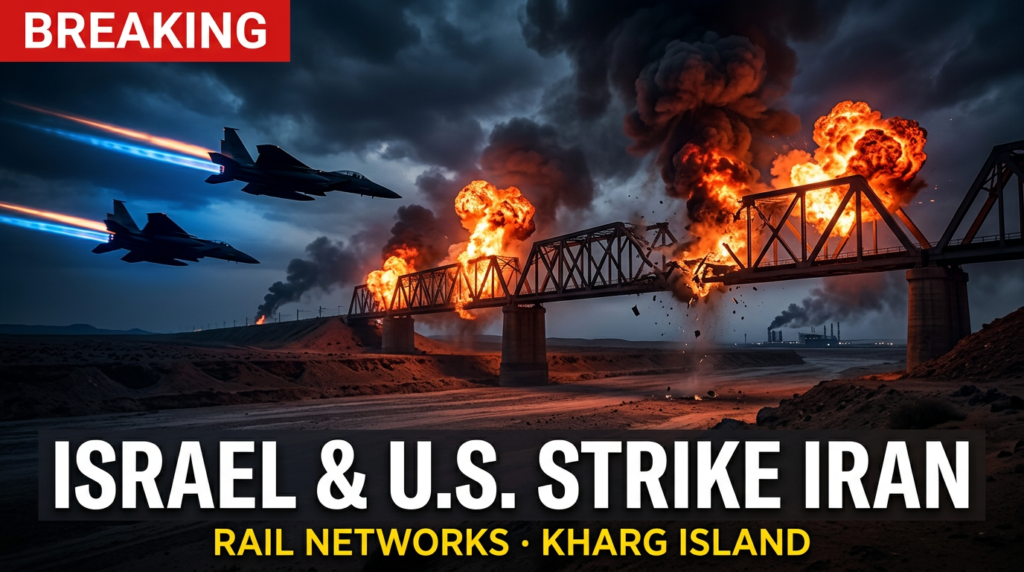
The explosions came at dawn. On Tuesday, April 7, Israeli Air Force jets executed a sweeping, coordinated assault on rail lines and road bridges across Iran — targeting cities from Tehran and Karaj to Tabriz, Kashan, and Qom. Simultaneously, U.S. forces struck military installations on Kharg Island, the Persian Gulf hub responsible for processing the vast majority of Iran’s crude oil exports. The message, delivered in smoke and rubble, was unambiguous: the era of consequence-free defiance is over.
This is not a skirmish on a distant frontier. This is a deliberate, escalating campaign by the United States and Israel to dismantle the military and economic infrastructure of the world’s leading state sponsor of terrorism — a regime that has spent decades exporting violence, strangling free navigation, and threatening American allies. For those who believe in peace through strength and accountability on the world stage, the events of April 7 represent a doctrine in action.
Support Independent Local Journalism
TheTownHall.News is a non-profit reader-supported journalism. Just $5 helps us hire local reporters, investigate important issues, and hold public officials accountable across Alameda County. If you believe our community deserves strong, independent journalism, please consider donating $5 today to support our work.What Happened: The Strikes in Detail
Prime Minister Benjamin Netanyahu confirmed the Israeli operation in direct terms. “We are targeting the railways and bridges used by the Revolutionary Guards,” he said. “They use them to transport raw materials for weapons, weapons, and the operatives who attack us, the U.S., and also the countries of the region.”
The Israel Defense Forces stated it struck eight bridge segments across multiple Iranian cities. Rail infrastructure in Karaj and Qazvin was destroyed. A rail bridge near Kashan was hit, killing two people. The city of Mashhad — Iran’s second-largest — canceled all train services. Khorramabad International Airport was also struck. Before the operation, the IDF issued Persian-language warnings urging Iranian civilians to stay away from trains and rail lines.
Across the Gulf, U.S. forces struck military targets on Kharg Island, an oil terminal that handles the overwhelming majority of Iran’s crude oil exports. Senior U.S. officials confirmed the strikes. The Pentagon stated oil infrastructure was not targeted — the focus was military assets on the island, consistent with pressure short of a full economic shutdown. But the signal was clear: nothing is off the table.
The Trump Ultimatum: No More Extensions
President Trump set a hard deadline of 8 p.m. ET Tuesday for Iran to reopen the Strait of Hormuz — the narrow waterway through which roughly 20% of the world’s oil supply flows. Iran has effectively strangled commercial shipping through the strait for weeks. Trump’s message to Tehran was blunt: “A whole civilization will die tonight” if no deal was reached.

Iran’s response was equally blunt — and revealing. Tehran rejected a temporary ceasefire, demanded compensation, insisted on retaining control of the Strait with the right to levy fees on passing vessels, and threatened to expand conflict to Gulf neighbors. Iran’s deputy sports minister, in a remarkable display of desperation, called for “human chains” of artists and athletes to physically surround Iran’s power plants as a deterrent against strikes.
That is not the posture of a confident regime. That is the posture of a government running out of options.
Why the Rail and Bridge Strategy Is Decisive
Critics in Western media have questioned the targeting of civilian infrastructure. It is a fair question — and one that deserves a serious answer.
The IDF’s stated rationale is precise and militarily sound: Iran’s Revolutionary Guard Corps (IRGC) relies on Iran’s rail and road network to move missile launchers, transport weapons components, and position operatives. These are not passenger trains being hit for symbolic effect. They are logistics arteries for a military force that has repeatedly launched ballistic missiles at Israel and coordinated proxy attacks across the region.
The IDF said it took “steps to mitigate harm to civilians, including the use of precise munitions and aerial surveillance” and issued advance warnings to the civilian population. Over 130 Iranian air defense systems have been dismantled since Operation Roaring Lion began on February 28 — systematically stripping Iran of the ability to protect its own skies.
Support Independent Local Journalism
TheTownHall.News is a non-profit reader-supported journalism. Just $5 helps us hire local reporters, investigate important issues, and hold public officials accountable across Alameda County. If you believe our community deserves strong, independent journalism, please consider donating $5 today to support our work.On the economic side, Israel has struck petrochemical facilities responsible for an estimated 85% of Iran’s petrochemical exports. Those revenues fund the IRGC. Cutting them is not punishment for its own sake — it is financial pressure aimed at ending a war.
What Critics Get Wrong
Some commentators and foreign policy analysts argue that the U.S.-Israeli campaign risks destabilizing the region, alienating allies, or triggering a wider war. These concerns deserve acknowledgment. The stakes are genuinely high, and the risk of miscalculation is real.
But this critique fundamentally misreads the trajectory of the last several years. Iran did not become aggressive because the West got tough. Iran became aggressive because the West spent years offering concessions, sanctions relief, and diplomatic patience — met, consistently, with accelerated uranium enrichment, proxy warfare, and attacks on commercial shipping. Appeasement did not produce stability. It produced Kharg Island on a Tuesday morning.
The argument for restraint also ignores the cost of inaction. A closed Strait of Hormuz is an attack on the global economy, on American energy security, and on the freedom of navigation that has underpinned international trade for decades. Defending that freedom is not adventurism — it is the definition of a legitimate national interest.
The Stakes for American Families and the Global Economy
The Strait of Hormuz is not an abstraction. It is the passage through which oil from Saudi Arabia, the UAE, Kuwait, and Iraq flows to markets around the world. When Iran threatens or controls that chokepoint, American families pay for it — at the gas pump, in heating costs, in the price of goods that move by fuel.
Iran reportedly struck energy infrastructure in Saudi Arabia in retaliation and threatened to plunge the entire Gulf region into “complete darkness” if its own power plants are hit. That is a regime threatening civilian populations of sovereign nations as a military strategy. It is state terrorism with an oil weapon attached.
The Trump administration’s response — escalating pressure, credible threats, and now strikes on military logistics — is the architecture of deterrence. It is the application of hard power to protect American interests, allied security, and global economic stability.
🔑 Key Takeaway
Iran spent years betting that American resolve was hollow. The strikes on April 7, 2026 — on Iranian rail, bridges, petrochemical plants, and Kharg Island — represent the most consequential test of that assumption yet. The Trump administration and Israel have chosen strength over symbolism.
The coming hours matter enormously. With Trump’s deadline now at its edge and Iran showing no meaningful signs of compliance, the next decision — to strike Iranian power plants or pursue a diplomatic opening — rests with a regime that has consistently prioritized its own survival over its people’s wellbeing. The world is watching. And this time, the threats were not bluffs.
Stay Informed. Stay Engaged.
This story is moving fast, and independent journalism is how you stay ahead of it. Share this article with your network. Bookmark The Town Hall News for real-time updates as Trump’s deadline expires and the next phase of this conflict unfolds. The decisions being made in Washington, Tel Aviv, and Tehran right now will shape energy markets, international security, and American foreign policy for years to come. Civic engagement starts with being informed — and sharing the truth when the mainstream narrative falls short.
Sources: Reuters, The Jerusalem Post, Times of Israel, USA Today, IDF Spokesperson’s Unit, official U.S. military statements.