Epstein Files DOJ Accused of Hiding Records From Congress — What We Know
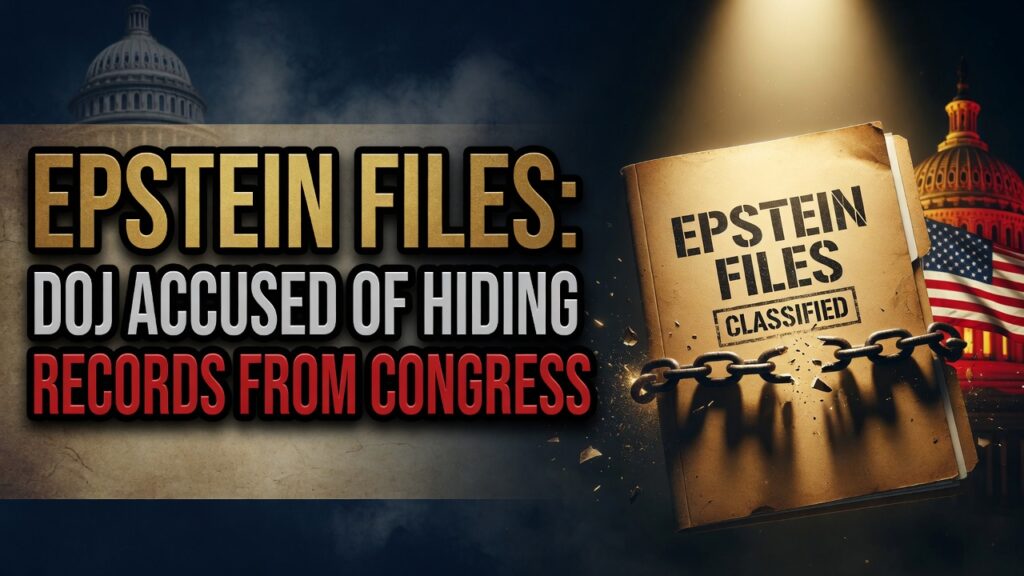
The Department of Justice was given a clear legal mandate to release the Epstein records. Months later, documents have vanished, names remain redacted, and the White House has reportedly been meeting in the Situation Room — not to ensure transparency, but to manage the political fallout.
The law was unambiguous. When the Epstein Files Transparency Act was signed on November 19, 2025, it carried a simple promise: the American public would finally have access to the full documentary record of one of the most disturbing criminal networks ever to operate in the shadows of power. The Department of Justice had until December 19, 2025 to comply. It missed the deadline — and what has followed raises questions that every American, regardless of party, deserves to have answered.
This is not a partisan story. The bipartisan push for transparency was led by Rep. Thomas Massie (R-KY) and Rep. Ro Khanna (D-CA), two lawmakers from opposite ends of the political spectrum who agreed on one fundamental principle: government accountability is not optional. What they have encountered since has been a masterclass in institutional resistance.
Support Independent Local Journalism
TheTownHall.News is a non-profit reader-supported journalism. Just $5 helps us hire local reporters, investigate important issues, and hold public officials accountable across Alameda County. If you believe our community deserves strong, independent journalism, please consider donating $5 today to support our work.What Did the Law Actually Require — and Did the DOJ Follow It?
The Epstein Files Transparency Act was explicit. It required the DOJ to publish all documents in its possession relating to Jeffrey Epstein in a searchable, publicly accessible format. The department released an initial batch of roughly three million pages out of an estimated six million or more total documents, claimed it was acting in good faith, and told a federal judge it was in full compliance. Congress, the press, and legal observers disagreed.
Almost immediately after the first release, at least 16 files disappeared from the DOJ’s public webpage. One of those files was a photograph of President Trump alongside Epstein — removed and later restored only after significant public backlash. Massie separately flagged another removed image he described as showing Epstein in a room with a box labeled “CIA,” which he said was pulled before he could examine the unredacted version. The DOJ cited victim privacy protections as the reason for the removals. Critics noted that victim privacy does not explain the selective disappearance of photographs.
The DOJ was given a legal deadline, a clear mandate, and full institutional resources — and still produced less than half the required documents on time. That is not compliance. That is delay dressed up as process.
Who Saw the Unredacted Files — and What Did They Find?
On February 9, 2026, the DOJ made unredacted versions of its publicly released files available for congressional review. Massie and Khanna were among those who attended. After reviewing the documents, they held a press conference and announced they had identified at least six names of men who, in their assessment, appeared “likely incriminated” — names that had been systematically redacted from the publicly available versions.

The following day, Khanna read those names into the congressional record from the House floor: Leslie Wexner, Sultan Ahmed bin Sulayem, Salvatore Nuara, Zurab Mikeladze, Leonid Leonov, and Nicola Caputo. Massie separately named three men he argued the DOJ should be actively investigating. Under pressure, the DOJ subsequently un-redacted additional names from the public files. Without that congressional pressure, those names would still be hidden.
“The question is no longer whether documents were withheld. The question is why — and who decided that the American public did not have the right to know.”
6 million. That is the estimated total number of Epstein-related documents in DOJ possession. Fewer than half have been released. The question no one in Washington has adequately answered: what is in the other half?
Is the White House Managing Transparency — or Managing the Story?
The most consequential recent development broke on June 10, 2026, when the New York Times published a major investigative report titled “Inside the White House Freakout Over the Epstein Files.” The reporting revealed that senior Trump administration officials had gathered in multiple Situation Room meetings — not to accelerate compliance with the law — but to contain the political damage from the document releases. An internal political memo reportedly described the Epstein issue as “a real negative” with key voter blocs.
On the same day, CNN reported that Vice President JD Vance had suggested that Tucker Carlson interview Ghislaine Maxwell as a means of shaping the public narrative around Epstein. House Democrats, led by Rep. Robert Garcia (D-CA), responded by formally requesting that Vance testify before the House Oversight Committee, calling the administration’s conduct a deliberate cover-up. Bill Gates also testified in a closed-door session before the same committee, telling lawmakers that Epstein had attempted to leverage knowledge of Gates’ personal affairs against him.
If a political memo is guiding how much of the Epstein record the public gets to see, then the Transparency Act is not being treated as a legal obligation — it is being treated as a political variable.
Support Independent Local Journalism
TheTownHall.News is a non-profit reader-supported journalism. Just $5 helps us hire local reporters, investigate important issues, and hold public officials accountable across Alameda County. If you believe our community deserves strong, independent journalism, please consider donating $5 today to support our work.What Happened to the Lawmakers Who Pushed for Accountability?
Thomas Massie lost his Republican primary on May 19, 2026, defeated by Trump-endorsed challenger Ed Gallrein. NBC News and multiple other outlets reported that President Trump effectively took political revenge on all four Republican lawmakers who had co-signed the Epstein Files Transparency Act. Khanna himself said Massie “lost because he had the guts to take on the Epstein case.”
The pattern is difficult to ignore. Lawmakers who used institutional tools — legislation, floor speeches, press conferences, court filings — to compel executive branch transparency were systematically targeted for political elimination. Massie, who served in Congress since 2012, has vowed to use his remaining months in office to continue forcing disclosures and has indicated he may seek office again in 2028.
What Do Supporters of the DOJ’s Approach Actually Believe?
To be fair, the DOJ and its defenders have raised legitimate points. The sheer volume of documents — millions of pages generated over years of federal investigation — presents a genuine logistical challenge. Victim privacy is a real and serious legal consideration; releasing personally identifying information about Epstein’s survivors without consent would cause measurable harm. The department has also argued that the Special Master request from Massie and Khanna was legally unsupported, a position a federal judge agreed with when he denied the request in January 2026.
These are reasonable procedural arguments. But they do not explain why files were selectively removed after being posted, why the six names Khanna read publicly had been redacted while the DOJ claimed compliance, or why the White House was treating a transparency law as a crisis communications challenge rather than a legal mandate to be fulfilled. Procedural complexity is not the same as institutional resistance — and the evidence increasingly suggests the latter.
Is the DOJ Inspector General Audit the Last Accountability Mechanism Standing?
In late April 2026, Senators Richard Blumenthal and Lisa Murkowski announced that the DOJ’s Office of Inspector General had launched a formal audit of the department’s compliance with the Epstein Files Transparency Act. The OIG stated it would review the DOJ’s processes for identifying, redacting, and releasing the required records. This audit represents perhaps the most credible independent check currently in operation.
The court denied the Special Master. Congress lost its most vocal champion to a primary defeat orchestrated by the same administration overseeing the document releases. The OIG audit is now the primary institutional mechanism available — and its outcome will matter significantly for the rule of law principle that no institution, including the DOJ itself, sits above the statutes it is required to follow.
Key Questions
- Why were specific files — including images — removed from the DOJ’s public portal after being posted, and who authorized those removals?
- If the White House was meeting in the Situation Room to manage the political fallout from the Epstein files, does that constitute interference with a legally mandated transparency process?
- Will the OIG audit have sufficient independence and authority to compel full disclosure, or will it face the same institutional resistance that defeated the Special Master request?
The Epstein Files Transparency Act was not written to give the DOJ flexibility. It was written to remove it. Every redaction, every disappeared file, every Situation Room meeting designed to manage the narrative instead of fulfill the law, represents an answer to a question the public was never supposed to ask. The real question is not whether the full record will eventually come out. It is whether the institutions responsible for releasing it will be held to the standard every American citizen is expected to meet: follow the law, fully, on time, without conditions.
What do you think — is an OIG audit enough to hold the DOJ accountable, or does this demand a stronger response? Share this article and tell us where you stand.
Still have questions? Subscribe for daily coverage of the Epstein files investigation and government accountability reporting. Think this story deserves a wider audience? Share it now. Want to make your voice count? Contact your representative through congress.gov and ask them where they stand on full Epstein file disclosure.