West Bank Violence 2026: Israel’s Checkpoint Crackdown Explained
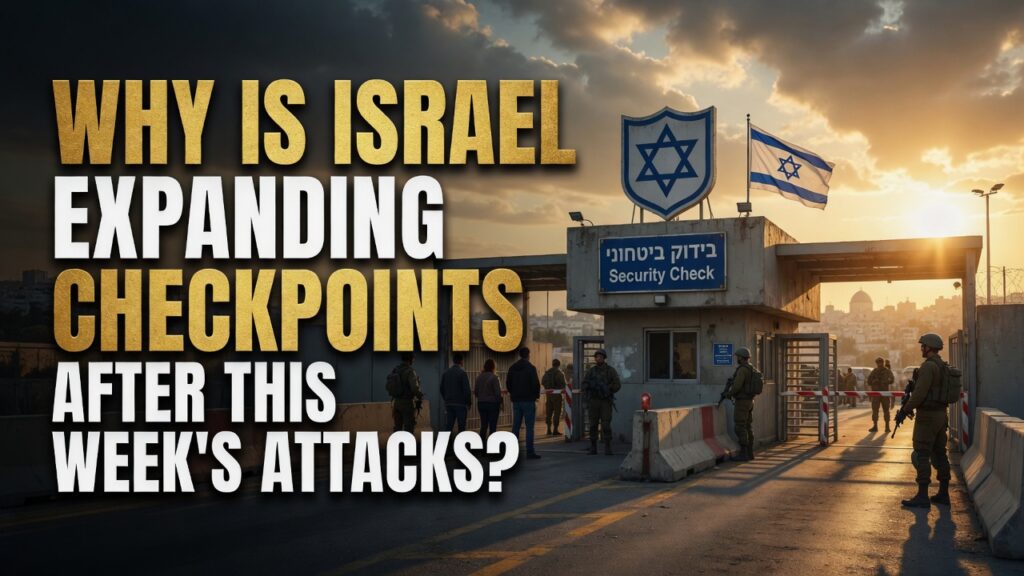
Violence in the West Bank has sharply escalated over the past week, prompting the Israeli government to expand the very control measures — checkpoints, permit revocations, home demolitions, troop deployments — that rights groups have long criticized as instruments of everyday control over Palestinian life.
What just happened?
On Friday, July 24, two Israelis were killed near Gilad Farm in a shooting that followed a confrontation after a group of Israeli civilians illegally crossed into Palestinian Authority-controlled territory while hiking; the IDF says Palestinians began throwing rocks before one of them opened fire. Separately, a settler raid on the Palestinian town of Tell left four Palestinians and one Israeli dead, which the Palestinian foreign ministry called a “massacre” and Abbas’s office described as terrorism by “Israeli colonists,” while the funeral for the four Palestinians killed in Tell drew only about 30 attendees due to heavy IDF restrictions. The Jerusalem PostWikipedia
The same days brought a mosque burning in an apparent “price tag” attack by Israeli extremists, plus a stabbing of an Israeli man who was trying to put out a fire he says Palestinian residents had set. The Jerusalem Post’s own editorial board argued the events “are not morally equivalent, but all demand an uncompromising response,” and separately raised the question of whether tougher enforcement against settler violence could have prevented the escalation. The Jerusalem Post
Support Independent Local Journalism
TheTownHall.News is a non-profit reader-supported journalism. Just $5 helps us hire local reporters, investigate important issues, and hold public officials accountable across Alameda County. If you believe our community deserves strong, independent journalism, please consider donating $5 today to support our work.How is Israel responding?
Prime Minister Netanyahu ordered a sweeping crackdown: demolishing the alleged attacker’s home, expanded counterterrorism operations in villages he described as “hotbeds of terror,” weapons seizures, revoked work permits, reinforced troop deployments, new checkpoints, and accelerated authorization of settlement farms. The IDF has since raised its West Bank deployment to 26 battalions, though it hasn’t disclosed how many forces are assigned to preventing attacks by Israeli extremists against Palestinians, saying that breakdown depends on broader situational assessments. More than 70 terror suspects were arrested in overnight raids following the attack. The Jerusalem Post + 2
Defense Minister Israel Katz has framed the approach as working, saying IDF operations have cut what he calls “terror attacks” by more than 80 percent. Haaretz
“These crimes undermine the rule of law, inflame tensions on the ground, damage Israel’s international standing, and ultimately put both law-abiding Israelis living in the West Bank and the security forces” at risk — a Jerusalem Post editorial, on unpunished settler violence.
Why do Palestinians and rights groups describe these measures as everyday control, not just security response?
Independent of this week’s news cycle, groups like Amnesty International and the U.S. State Department have documented these same tools — checkpoints, permits, administrative detention — as long-running features of Palestinian daily life, not one-off emergency measures.

The State Department’s human rights report describes a two-tier legal system: Israeli settlers are tried in civilian courts under Israeli civilian law, while Palestinians are tried under military law in military courts that allow indefinite administrative detention without charge for “security-related” offenses. Amnesty’s most recent report says roughly 4,622 Palestinians were held without charge or trial at year’s end — about 3,385 under administrative detention orders and 1,237 under Israel’s Unlawful Combatants Law — citing the Israeli rights group HaMoked. U.S. Department of StateAmnesty International
A standalone figure worth sitting with: more than 40% of Palestinian men in the occupied territories have been imprisoned at some point in their lives, according to research on Israel’s detention and movement-control system. What does that statistic mean for how ordinary Palestinians experience daily interactions with soldiers at checkpoints — as isolated security stops, or as a lifelong probability?
Is settlement expansion complicating the security picture?
An Israeli defense-establishment analysis (INSS) argues that the rapid growth of settlements and outposts is itself straining security resources — lengthening defensive lines, multiplying checkpoints and friction points, and diverting combat forces from counterterrorism to protecting remote outposts. The same analysis notes a March 2026 cabinet decision approved 34 new settlements in Area C in a single vote — legalizing 10 outposts and authorizing 24 new ones — bringing the total approved since January 2023 to roughly 102 settlements. That analysis, notably, comes from an Israeli security-establishment think tank, not a Palestinian advocacy source, and it warns the trend risks “an outbreak of terrorism, internal moral erosion, [and] intensified international criticism.” INSSINSS
What do supporters of Israel’s approach actually argue?
The core argument: Israel is a sovereign state responding to real, lethal attacks — two soldiers and civilians killed in a single week — and has both a right and an obligation to protect its citizens. Checkpoints, permits, and detention authority exist because Israel has faced sustained terrorism, including suicide bombings and shootings, for decades; the security barrier and checkpoint network specifically followed waves of attacks in the 2000s and 2015–16. From this view, restrictions are a security-driven response to threat levels, not a permanent system of ethnic control, and easing them unilaterally has historically been followed by attack spikes.
The counter-argument, echoed even inside some Israeli commentary, is that enforcement is asymmetric: the settler who killed a Palestinian human rights defender in a separate July incident was released after three days under house arrest without charges (per Amnesty), while Palestinian suspects face home demolitions and indefinite detention. That gap — not the existence of security measures themselves — is what draws sustained criticism from rights monitors and, this week, from Israeli commentators. The Jerusalem Post
Support Independent Local Journalism
TheTownHall.News is a non-profit reader-supported journalism. Just $5 helps us hire local reporters, investigate important issues, and hold public officials accountable across Alameda County. If you believe our community deserves strong, independent journalism, please consider donating $5 today to support our work.The unresolved question
Both governments’ security establishment and human rights monitors agree on one thing: the system of checkpoints, permits, and detention is expanding, not shrinking, after this week’s violence. The open question is whether tougher, broader enforcement resolves the underlying instability — or entrenches the conditions that keep producing it.