West Bank Settler Violence 2026: What the UN Report Reveals About IDF Accountability
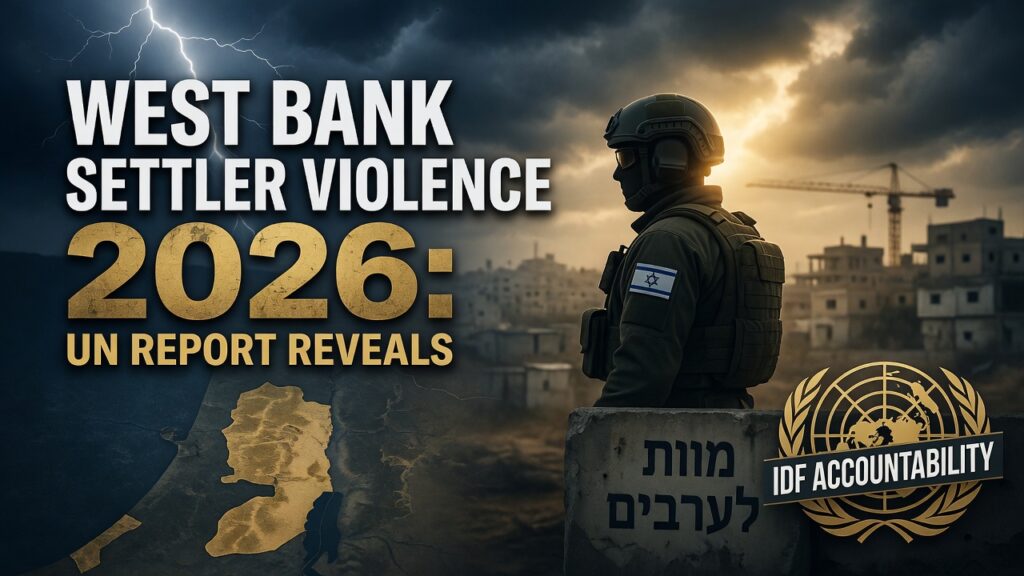
As a 7-month-old baby is buried in Hebron and a soldier is filmed beating Palestinians in broad daylight, the world is demanding a direct answer: who enforces the law when the law enforcers are part of the problem?
A baby cannot speak for himself. Sam Fahd Abu Haikal, seven months old, never got the chance. On the evening of June 5, 2026, an Israeli soldier opened fire on a family car in Hebron’s Tel Rumeida neighborhood, killing Sam with a single shot to the head and wounding both his parents. According to his father, the car had come to a complete stop on the soldier’s orders before the shots rang out — in daylight, at close range, with a family plainly visible inside the vehicle. That single incident, shattering as it is, did not happen in isolation. It happened the same weekend that dozens of Israeli settlers stormed the Palestinian town of Huwara, wounding nine civilians, stealing livestock, torching an auto repair shop — and doing so, on camera, alongside an active-duty IDF soldier who joined in the beating rather than stopping it. This is not a story about one bad weekend. It is a story about a system.
What the Evidence Now Shows
The facts on the ground have become impossible to dismiss. A UN Commission of Inquiry, reporting to the Human Rights Council on June 9, 2026, concluded that Israeli security forces “routinely accompanied settlers and acted as a shield” during attacks on Palestinian civilians. The report found that Israeli authorities had enabled settler attacks through direct financial and military support, while a climate of judicial impunity prevented meaningful accountability. The commission’s most damning line was clinical in its precision: “The increasing participation of Israeli security forces in settler attacks amounts to a de facto collapse of the distinction between settlers and soldiers.” [UN Commission of Inquiry on the Occupied Palestinian Territory, June 9, 2026] That is not the language of political advocacy. That is institutional fact-finding by a UN body.
Support Independent Local Journalism
TheTownHall.News is a non-profit reader-supported journalism. Just $5 helps us hire local reporters, investigate important issues, and hold public officials accountable across Alameda County. If you believe our community deserves strong, independent journalism, please consider donating $5 today to support our work.Is This the Deadliest Year on Record — And Why Does That Matter?
The data answers the question before it is even fully asked. According to the Armed Conflict Location and Event Data Project (ACLED), 2026 has already become the deadliest year for settler violence against Palestinians in the organization’s entire decade of monitoring the region. In just four months, the number of Palestinians killed by settlers surpassed the total recorded throughout all of 2025 — which itself was already a record high. [ACLED, May 2026] Attacks on Palestinian villages have become more frequent, settlers appear to be more heavily armed, and there are, in the words of ACLED’s Middle East research manager, “no restrictions on the use of weapons.” The UN’s own humanitarian bulletin for April 2026 documented that settler violence had displaced nearly 2,000 Palestinians from 43 communities in the West Bank in 2026 alone. Meanwhile, the Israeli military’s standard response — “the incident is under review” — has become a phrase that rights organizations on both sides of the debate acknowledge rarely leads to prosecution.
“The increasing participation of Israeli security forces in settler attacks amounts to a de facto collapse of the distinction between settlers and soldiers.” — UN Commission of Inquiry, June 9, 2026
Who Is Actually Being Held Accountable?
This is where the law-and-order argument must be made without flinching. Any society that claims to value rule of law — whether in Washington, London, Jerusalem, or Ramallah — must answer the same foundational question: does the law apply equally to those who carry weapons on behalf of the state? In Huwara, surveillance footage captured an IDF soldier actively participating in a settler rampage. The IDF condemned the soldier’s conduct. It launched a review. As of this writing, no charges have been filed. In Hebron, the Military Police opened a formal investigation into the killing of Sam Abu Haikal only after public pressure mounted, two days after the shooting. The investigation’s findings will be forwarded to the Military Advocate General for “possible charges” — a phrase that Israeli and Palestinian rights groups note rarely translates into actual punishment.
If a civilian in any democratic country were filmed beating unarmed individuals in broad daylight, would “under review” be an acceptable answer for two weeks?
The father of Sam Abu Haikal told Haaretz: “You can’t say he didn’t see it was a family.” The soldier, he said, was standing ten meters away in daylight when he fired. His wife was struck by shrapnel near her heart.

What Do Supporters of This Policy Actually Believe?
It is worth engaging seriously with the Israeli government’s position, because dismissing it outright would be intellectually dishonest. Israeli officials argue that military operations in the West Bank are counterterrorism measures in a genuinely dangerous environment, where soldiers face threats that require split-second decisions. The IDF stated that the soldier in Hebron fired because he perceived the vehicle as accelerating toward his unit. Israel’s Ambassador to France argued that international sanctions are “counterproductive” and may actually empower extremists by allowing the Israeli government to frame outside pressure as political hostility rather than legitimate accountability. Israel’s Foreign Ministry called the six-nation sanctions “disgraceful measures” that fuel antisemitism. These are arguments that deserve to be heard. The problem is that the evidence does not support the exceptionalism they require. B’Tselem, the Israeli human rights organization — not a foreign body, not a political opponent, but an Israeli institution — confirmed that Sam Abu Haikal was the thirteenth child killed by Israeli security forces in this period. The UN report documented incidents of Palestinian children being abducted at knifepoint by settlers. ACLED’s decade of data shows a consistent escalation, not a series of isolated incidents requiring case-by-case deference. When the data is this consistent, “under review” stops being a process and starts being a policy.
130%. That is how much settler attacks on Palestinian villages and agricultural land have risen since 2023, according to the UN Commission of Inquiry. The question every lawmaker should be forced to answer: at what number does accountability become non-optional?
Six Nations Have Acted. Why Hasn’t That Been Enough?
On June 9, 2026, the United Kingdom, Australia, Canada, France, Norway, and New Zealand announced coordinated sanctions targeting settler networks in the West Bank, including Israeli Finance Minister Bezalel Smotrich — a member of the sitting cabinet and a driving force behind settlement expansion. France barred Smotrich and 25 additional individuals from entering its territory. The UK sanctioned six entities and individuals involved in financing settlements or violent acts. The European Union had already approved its own separate sanctions package in May. [AP News, June 9, 2026; Reuters, June 9, 2026] These are significant diplomatic actions. But the sanctions coalition has been explicit about their limits: broader trade, including arms transfers, remains untouched. The Israeli government continues to operate with the full backing of its institutional structure. What the six-nation announcement actually proves is that the international community has sufficient evidence to act — and has chosen to act minimally.
Is This the Accountability Moment We Have Been Waiting For?
Personal responsibility is a value that must be universal or it means nothing. It cannot be invoked when convenient and suspended when politically uncomfortable. A soldier who beats a civilian on camera must be charged. A soldier who fires into a stopped family car and kills an infant must face a real criminal process — not a military review system that, by the admission of observers across the political spectrum, rarely produces consequences. That is not a political statement. That is a statement about the integrity of law itself.
When the soldiers of a democratic state join a mob attack in broad daylight and the response is a press release, something fundamental has broken — and every citizen who believes in law and order should be asking why.
Support Independent Local Journalism
TheTownHall.News is a non-profit reader-supported journalism. Just $5 helps us hire local reporters, investigate important issues, and hold public officials accountable across Alameda County. If you believe our community deserves strong, independent journalism, please consider donating $5 today to support our work.Amnesty International’s 150-page report, released June 11, 2026, accuses Israeli authorities of ethnic cleansing in the West Bank, detailing how forced displacement of Bedouin and herding communities is being systematically advanced through settler violence. The Soufan Center, in its intelligence brief published today — June 12, 2026 — notes that since the start of the Iran conflict, settler violence has intensified further, with reserve units drawn increasingly from settler populations blurring the line between military authority and vigilante force.
The question that should concern every reader who cares about governance, accountability, and rule of law is not whether this violence is happening — the cameras, the data, and the UN report confirm it is. The real question is what it means when institutions designed to enforce the law become instruments for evading it.
Key Questions This Story Raises:
- Will the IDF soldier who killed Sam Abu Haikal face criminal charges — and if not, what does that tell us about military accountability in democratic societies?
- Why have six Western nations imposed sanctions on Israeli settler networks while simultaneously leaving arms trade and broader economic ties untouched?
- At what point does a documented, decade-long escalation of state-enabled violence require a response beyond reviews, inquiries, and coordinated press releases?
What do you think — is international pressure enough to produce real accountability, or does it take something more? Share this article and tell us where you stand.
Still have questions? Stay informed — subscribe for daily coverage of law, governance, and accountability. Think others need to hear this? Share the article with someone who believes rule of law must be universal. Want to make your voice count? Contact your congressional or parliamentary representative and ask them directly what their government’s position is on arms transfers to nations under active UN sanction review.