Federal Judge Samantha Elliott Strikes Down New Hampshire Proof of Citizenship Voting Law
voter integrity law
A single federal judge has unilaterally overturned a voter registration law supported by the majority of New Hampshire residents — and with midterm elections on the horizon, millions of Americans are now asking: who actually gets to decide the rules of democracy?
A law is gone. Not repealed. Not debated. Erased by one judge.
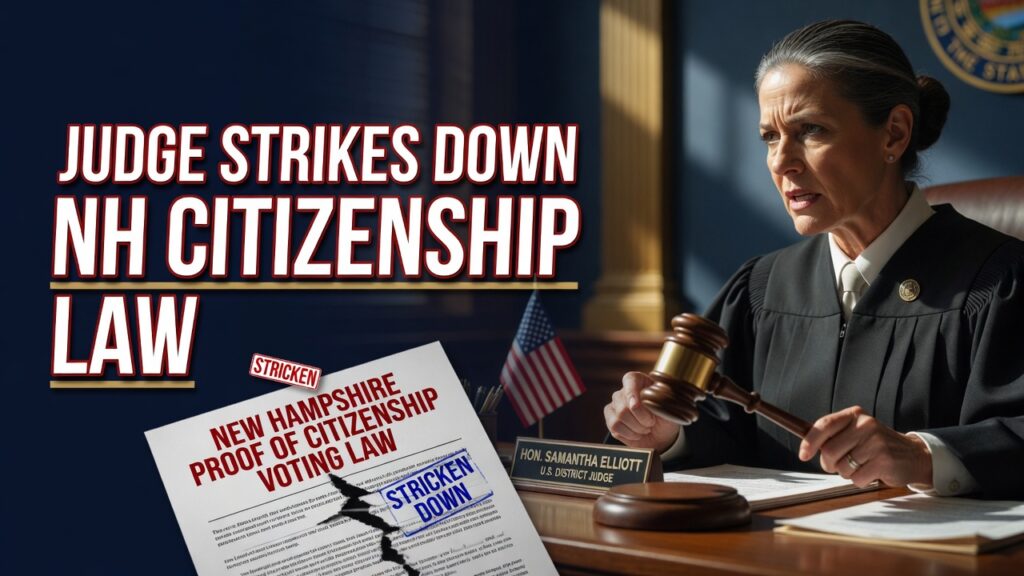
On May 29, 2026, U.S. District Court Judge Samantha Elliott — a Biden appointee — issued a 98-page ruling striking down New Hampshire’s House Bill 1569, a 2024 law requiring first-time voters to produce documentary proof of U.S. citizenship before registering. The ruling takes effect immediately, wiping the law from the books just months before the November 2026 midterm elections. No legislative debate. No public vote. One courtroom.
Support Independent Local Journalism
TheTownHall.News is a non-profit reader-supported journalism. Just $5 helps us hire local reporters, investigate important issues, and hold public officials accountable across Alameda County. If you believe our community deserves strong, independent journalism, please consider donating $5 today to support our work.What Did New Hampshire’s Law Actually Require?
The law was not extreme. House Bill 1569, signed by then-Governor Chris Sununu in 2024, asked first-time voters in New Hampshire to present one of several widely accepted documents — a birth certificate, a U.S. passport, a naturalization certificate, or a federally issued certificate of citizenship — when registering to vote. Standard documents. The kind most Americans carry or can obtain.
Before HB 1569, the state allowed registrants to skip documentation entirely by signing a “Qualified Voter Affidavit” — a sworn form attesting to citizenship. Supporters of the new law argued that while penalties existed for lying on that form, enforcement was inconsistent and verification was essentially nonexistent. HB 1569 closed that gap by requiring actual proof rather than a promise.
The law didn’t prevent anyone from voting — it asked them to prove they had the right to.
New Hampshire Secretary of State Dave Scanlan confirmed that, under the new law, voters would still be required to prove identity, age, and domicile. Citizenship documentation was simply the added layer — one that most Americans in most contexts are already expected to provide.

Is a Sworn Affidavit Really the Same as Proof?
Judge Elliott’s central argument is that restoring the affidavit system is sufficient to verify citizenship. Her reasoning: a signed affidavit carries criminal penalties for fraud, and therefore functions as legitimate proof.
But here’s the problem with that logic. An affidavit is only as strong as the enforcement behind it. If the state historically never launched a statewide investigation of citizenship affidavits — which the court itself acknowledged — then the criminal deterrent is theoretical, not practical. The law existed to add a verifiable layer to a system that had, by the court’s own admission, rarely been stress-tested.
“A sworn affidavit is only as powerful as the government’s willingness to prosecute. In New Hampshire, that willingness has been nearly non-existent — and one judge just decided that’s good enough.”
The judge also noted that only one person in 26 years has been prosecuted for knowingly voting as a non-citizen. Supporters of the law would argue that this low prosecution rate reflects a failure of enforcement, not evidence that fraud doesn’t occur. You cannot measure what you don’t look for.
What Do the Numbers Actually Tell Us?
Judge Elliott leaned heavily on the statistics. Out of 8.3 million ballots cast in New Hampshire between 1998 and 2024, only 47 documented cases of wrongful voting were found — just 8 involving non-citizens. [Source: court testimony, New Hampshire Bulletin, May 2026]
8 documented cases of non-citizen voting out of 8.3 million ballots. The question the ruling never seriously answers: how many cases went undocumented because no one looked?
Support Independent Local Journalism
TheTownHall.News is a non-profit reader-supported journalism. Just $5 helps us hire local reporters, investigate important issues, and hold public officials accountable across Alameda County. If you believe our community deserves strong, independent journalism, please consider donating $5 today to support our work.The judge also cited expert analysis estimating that between 5,433 and 59,583 eligible voters in New Hampshire currently lack citizenship documents. [Source: Dartmouth professor Michael Herron, court testimony, February 2026] That is a vast range — a sevenfold variance — and the uncertainty itself should give pause. Using the high end of a speculative estimate to dismantle a duly passed law is a significant judicial leap.
Meanwhile, a 2022 Special Committee on Voter Confidence found that 90% of New Hampshire residents had confidence in the state’s elections. Republicans would argue that confidence is partly built on laws like HB 1569 — not despite them.
Who Actually Loses When Accountability Standards Are Lowered?
The answer isn’t partisan. It’s every legitimate voter.
When the integrity of voter rolls is in question, public confidence in elections erodes. That erosion doesn’t just affect one party — it fuels cynicism, reduces participation, and undermines the very foundation of representative government. The people most harmed by a system people don’t trust are the people who play by the rules.
If proof of citizenship is too burdensome to require for voting, why do we require it for a driver’s license, a federal job, or a passport renewal?
Proponents of HB 1569 also point to the practical reality of Election Day in New Hampshire. The state allows same-day voter registration — a convenience that, on Election Day 2024 alone, saw more than 10,000 first-time voters use affidavits to register. That volume creates genuine verification challenges for local officials and leaves the rolls open to potential abuse that may only be discovered after ballots are already cast and counted.
What Do Supporters of This Ruling Actually Believe?
That’s a fair question — and it deserves a serious answer.
Supporters of Judge Elliott’s decision argue that HB 1569 created real and unnecessary barriers for legitimate voters. Nearly 40% of Americans do not hold a valid passport. [Source: court testimony, 2026] Married women who changed their names may find their birth certificates don’t match their current identification. College students from out of state may not carry their birth certificates to campus. These are not hypothetical concerns — testimony during the February 2026 trial showed that hundreds of would-be voters were turned away from smaller New Hampshire elections after the law took effect.
These are legitimate concerns. Voting access matters. No reasonable person wants eligible citizens turned away from the polls.
But the response to imperfect implementation should be refinement, not elimination. New Hampshire already passed a follow-up law in 2025 — House Bill 464 — allowing officials to verify citizenship through a statewide database of vital records and DMV files. Judge Elliott dismissed it as insufficient because it didn’t cover out-of-state births. That’s a solvable problem. That’s what legislatures are for. What is not appropriate is a single federal judge substituting her judgment for the democratic process entirely.
Is This the Accountability Moment We’ve Been Waiting For?
The New Hampshire Attorney General’s Office has announced it will appeal the ruling. That appeal will likely head to the First Circuit Court of Appeals, and depending on the outcome, could eventually reach the U.S. Supreme Court — particularly given the current high court’s track record on election law.
The real danger isn’t just this ruling. It’s the precedent that one judge, in one district, can unilaterally overturn a law backed by a democratic legislature — and that the burden of proof lies not with those who want to vote without documentation, but with the state that dared ask for it.
The plaintiffs, including the ACLU and the League of Women Voters, are also seeking attorney’s fees from the state of New Hampshire — meaning taxpayers may foot the bill for the legal dismantling of a law their elected representatives passed.
Key Questions This Story Raises:
- If a sworn affidavit is sufficient proof of citizenship, why is the same standard considered insufficient in virtually every other government context?
- Should a single unelected federal judge have the power to permanently block a voter registration law passed by a democratically elected legislature — with no legislative remedy required?
- With midterm elections months away and an appeal pending, who is responsible for ensuring that the integrity of New Hampshire’s voter rolls is maintained in the interim?
The real question isn’t whether fraud is rare in New Hampshire. The question is whether the democratic right to require proof of eligibility — a standard applied in countless civic and legal contexts — belongs to elected legislators or to a single federal courtroom.
The Attorney General is appealing. The clock is ticking. And the midterms are coming.
What do you think — should proof of citizenship be required to vote? Share this article and tell us where you stand.
📢 Call to Action:
- Still have questions? Subscribe for daily coverage of election integrity, voting rights, and civic policy.
- Think others need to hear this? Share the article — this ruling affects every state watching the First Circuit’s next move.
- Want to make your voice count? Contact your U.S. Representative or Senator and ask where they stand on federal standards for voter registration documentation. Find your representative at house.gov or senate.gov.