Kuwait Airport Attack by Iran: What Happened and What Comes Next?
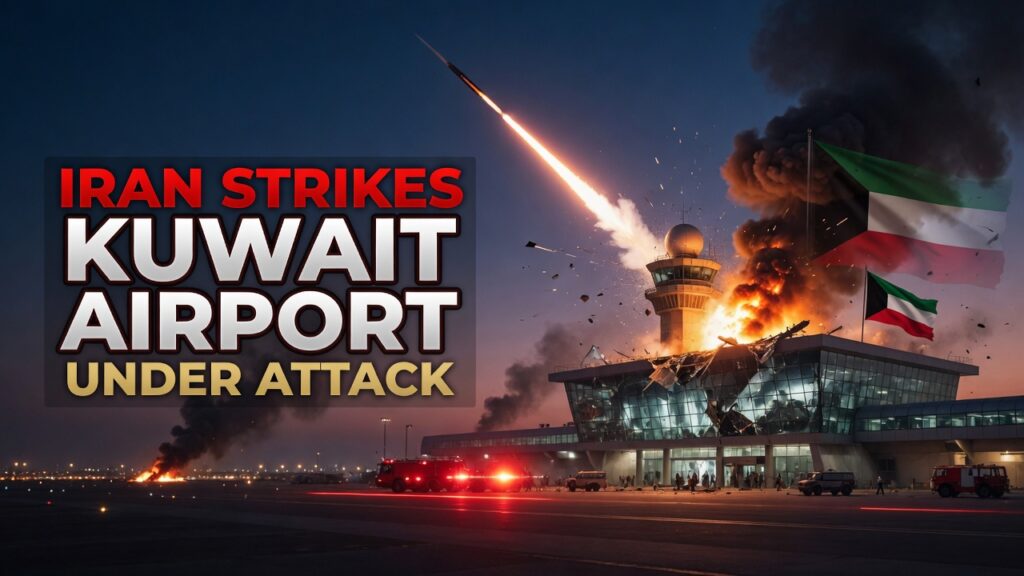
As Iranian drones reduce a newly reopened passenger terminal to rubble, Gulf nations are confronting an unsettling truth — no one is safe, and the cost of inaction is rising by the hour.
https://www.instagram.com/p/DZIait9G8eW
One person is dead. Sixty-three are wounded. And a freshly reopened international airport is in flames.
Support Independent Local Journalism
TheTownHall.News is a non-profit reader-supported journalism. Just $5 helps us hire local reporters, investigate important issues, and hold public officials accountable across Alameda County. If you believe our community deserves strong, independent journalism, please consider donating $5 today to support our work.On the morning of June 3, 2026, Iranian drones and missiles struck Kuwait International Airport’s Terminal 1, just 48 hours after it had quietly reopened following a months-long war-related closure. The attack — part of a broader Iranian missile-and-drone barrage targeting Kuwait and Bahrain — marks one of the most brazen strikes on civilian infrastructure in the Gulf since the 2026 Iran war began on February 28. It is also a sobering reminder that fragile ceasefires mean nothing without enforcement, accountability, and the political will to demand both.
The Attack That Should Alarm Every Free Nation
The facts are stark. Iran’s Islamic Revolutionary Guard Corps launched a coordinated salvo targeting not just military installations, but a functioning civilian airport packed with passengers and workers. Kuwait’s Defense Ministry confirmed that its forces destroyed over a dozen Iranian missiles and a similar number of drones — yet enough got through to kill an Indian national, injure dozens more, and reduce Terminal 1 to a scene of smoke, shattered glass, and chaos.
Kuwait International Airport had been open for exactly two days before Iran reduced its passenger terminal to rubble. Two days.
This is not a rogue strike. This is a deliberate targeting of civilian infrastructure — the kind of act that, if committed by any Western nation, would generate wall-to-wall global condemnation. The civilized world must ask itself: why are the standards different when Tehran pulls the trigger?

Kuwait Airways was forced to suspend all operations immediately. The airport was eventually partially reopened, with flights rerouted to Terminal 4. But the damage — both physical and psychological — will take far longer to repair.
Who Is Really Paying the Price for This Escalation?
The person killed at Kuwait’s airport was not a soldier. He was an Indian national — likely a traveler or an airport worker going about his day in a country he trusted to be safe.
The 63 injured include passengers and civilian staff. These are not abstractions on a diplomatic cable. They are real people with families, with responsibilities, with lives interrupted by a regime that answers to no democratic mandate and faces no meaningful consequences for its aggression.
“When a government targets a civilian airport packed with travelers, it isn’t making a military statement — it’s sending a message to every free society that nowhere is safe unless someone with resolve is willing to say: enough.”
This is precisely the kind of reckless state behavior that demands not just condemnation but clear-eyed accountability. Kuwait expelled two Iranian diplomats in response — a measured but symbolically important step. The question is whether the international community will match Kuwait’s resolve or retreat, once again, into the comfortable paralysis of endless “diplomatic engagement.”
What Do the Numbers Actually Tell Us?
63 wounded. 1 killed. 0 meaningful international consequences — so far.
Support Independent Local Journalism
TheTownHall.News is a non-profit reader-supported journalism. Just $5 helps us hire local reporters, investigate important issues, and hold public officials accountable across Alameda County. If you believe our community deserves strong, independent journalism, please consider donating $5 today to support our work.That arithmetic should trouble every reader who believes in law, order, and the principle that aggression must carry a cost. The ceasefire announced on April 8, 2026, was supposed to bring stability to the Gulf. Instead, Iran has used the cover of intermittent negotiations to continue pressuring its neighbors, testing boundaries, and striking civilian targets when it calculates the response will be measured in statements rather than consequences.
Iran still controls the Strait of Hormuz. Global fuel prices remain elevated. And the ripple effects of this conflict are being felt by ordinary citizens — at the gas pump, in supply chains, and in the rising cost of goods — far beyond the Gulf.
Is the Ceasefire Framework Already Broken Beyond Repair?
The timing of this attack is particularly troubling. Ceasefire negotiations between the U.S. and Iran have been dragging on for weeks, and Iranian news agencies — both believed to be close to the Revolutionary Guard — reported that Iran’s negotiators paused communication with mediators just days before the airport strike. Though U.S. President Donald Trump pushed back, calling such reports “false and erroneous,” the pattern is undeniable: Iran escalates militarily while talking diplomatically.
If Iran can bomb a civilian airport and still sit at the negotiating table, what exactly does that table stand for?
Iran has also conditioned any broader ceasefire on a separate truce in Lebanon, where Hezbollah continues to exchange fire with Israel. This linkage is a deliberate strategy — it gives Tehran maximum leverage while minimizing accountability for each individual act of aggression. It is the geopolitical equivalent of demanding a reward for stopping a fire you started.
What Do Supporters of This Diplomatic Approach Actually Believe?
To be fair, proponents of continued engagement with Iran argue that military escalation carries enormous risks — for regional stability, for global oil markets, and for the lives of civilians on all sides. They contend that diplomacy, however slow and frustrating, remains the only path to a durable peace. Some analysts point to Iran’s stated claim that its strikes are retaliatory — responses to prior U.S. and Israeli actions — and argue that breaking the cycle requires restraint from all parties.
These are not unreasonable arguments. Prudent foreign policy does require weighing consequences, and no serious person wants a broader conflagration in the Gulf.
But restraint without accountability is not diplomacy — it is appeasement. When a regime repeatedly targets civilian infrastructure, exposes innocent travelers to death and injury, and uses ceasefire talks as diplomatic cover for continued military pressure, the responsible answer is not to extend more patience. It is to make clear, in terms Iran’s leadership cannot ignore, that civilian targets are categorically off-limits — and that violating that principle carries a price.
Is This the Accountability Moment the Gulf Has Been Waiting For?
Kuwait’s response has been dignified but firm. The Foreign Ministry’s declaration that Kuwait “will neither accept nor tolerate the attacks,” paired with the expulsion of two Iranian diplomats, signals that even historically cautious Gulf states are running out of patience.
Senior Emirati diplomat Anwar Gargash publicly called for “a firm, unified, and cohesive Gulf position against Iran.” That language — from a country that has long preferred quiet diplomacy — is significant. It suggests that the regional calculus is shifting, and that Gulf nations are beginning to recognize that collective resolve is the only credible deterrent.
When even the most diplomatically cautious Gulf states start demanding accountability, it’s time for the rest of the world to start listening.
The U.S. has responded with strikes on Iran’s military ground control station on Qeshm Island and has continued to intercept Iranian missiles targeting its forces in the region. That is the appropriate posture: measured, firm, and tied directly to Iranian aggression.
The Question Every Reader Should Be Asking
The Kuwait airport attack is not just a foreign-policy story. It is a story about what happens when rogue regimes calculate — correctly or not — that their actions carry no serious consequences. It is a story about the cost of endless negotiations that reward aggression with legitimacy. And it is, ultimately, a story about whether the international community still believes that civilian lives matter enough to defend.
One Indian national went to work at an airport on an ordinary Wednesday morning and did not come home. Sixty-three others are recovering from injuries they did nothing to deserve. A civilian terminal rebuilt at public expense was destroyed in minutes.
The real question isn’t whether Iran’s actions are wrong — they clearly are. The question is whether the world has the resolve to ensure this is the last time, not merely the latest time.
Key Questions This Article Raises:
- If Iran can strike a civilian airport during active ceasefire negotiations and face no significant international penalty, what deterrent actually exists against the next attack?
- How long can Gulf nations — and the global economy — absorb the cascading effects of Iranian aggression before the human and financial cost becomes irreversible?
- At what point does continued diplomatic engagement with a regime that targets civilian infrastructure become a liability rather than a strategy?
What do you think — is the international community’s response proportionate to the threat, or are we watching history repeat itself in real time? Share this article and tell us where you stand.
Still have questions? Stay informed — subscribe for daily coverage of the Iran war and its global consequences.
Think others need to hear this? Share the article and start the conversation.
Want your voice to count? Contact your elected representatives and ask them directly: what is their government’s position on Iranian strikes against civilian infrastructure?