Body Found at San Leandro Waste Management Facility: Investigation Underway
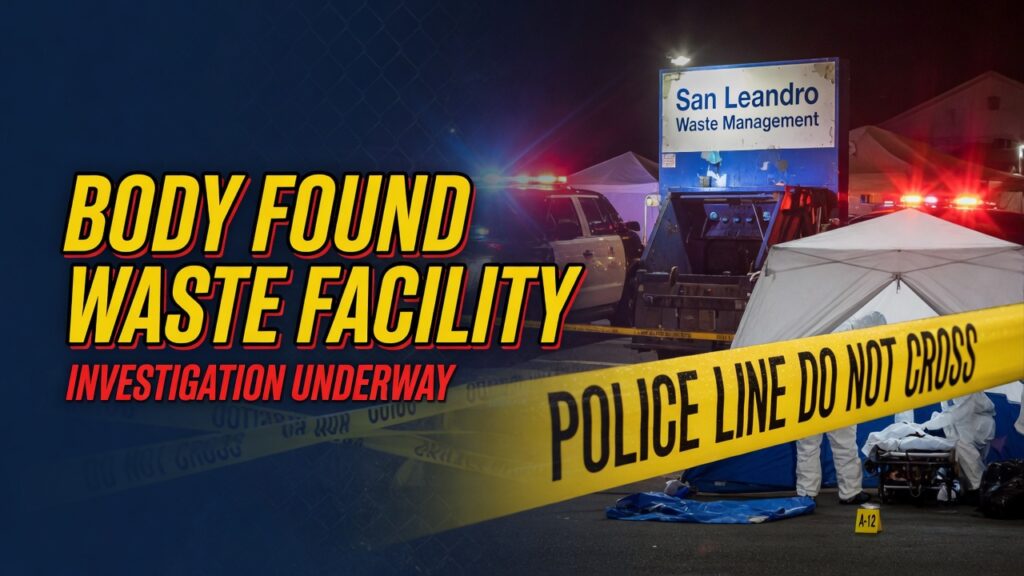
A man’s body was found inside a busy East Bay waste facility — and two days later, the public still has more questions than answers. As the investigation unfolds, residents, workers, and civic advocates are asking who is responsible for accountability when the system fails in plain sight.
A body turned up inside a working garbage facility on a Tuesday morning. That is not a statistic — it is a reality that demands answers.
On June 2, 2026, at approximately 11:10 a.m., San Leandro Police Department officers responded to the Waste Management Davis Street Transfer Station — located at 2615 Davis Street near the Oyster Bay shoreline — after workers discovered a deceased man on the premises. As of today, June 4, 2026, authorities have not released the victim’s identity, confirmed a cause of death, or explained how an unidentified individual came to be inside a major commercial facility. The Alameda County Coroner’s Bureau is conducting an autopsy, and the investigation remains wide open. For a community that deserves clarity, that silence carries weight.
Support Independent Local Journalism
TheTownHall.News is a non-profit reader-supported journalism. Just $5 helps us hire local reporters, investigate important issues, and hold public officials accountable across Alameda County. If you believe our community deserves strong, independent journalism, please consider donating $5 today to support our work.Why Does This Discovery Matter Beyond the Headlines?
The Davis Street Transfer Station is not a remote, unmonitored site. It is an active, high-traffic commercial facility — one that processes recyclables, compost, and general waste before transferring materials to the Altamont Landfill in Livermore, CA. Workers arrive daily. Trucks cycle in and out throughout the morning. This is not the kind of place a person simply wanders into unnoticed.
That is what makes the unanswered questions so pressing. How did this individual end up inside the facility? Was he transported there unknowingly — as has tragically occurred at other Bay Area waste facilities in prior years? Did he enter on foot? Was there any failure of perimeter security, worker protocols, or emergency communication systems? None of these questions have been answered publicly.
A man is dead inside a busy public-adjacent facility, and two days later, authorities haven’t told the community how it happened. That silence is not neutral — it’s a gap in public accountability.
What Do We Actually Know — and What Is Still Missing?
The confirmed facts are these: the body was discovered at approximately 11:10 a.m. on Tuesday, June 2, 2026. Police arrived promptly, secured the scene, and launched an investigation. The victim was a man. His name has not been released. The cause and manner of death are pending autopsy results from the Alameda County Coroner’s Bureau. Police have not confirmed whether foul play is suspected.

What is missing is equally significant. Authorities have not said how long the man was believed to have been at the facility before discovery. They have not stated whether security footage is being reviewed. They have not explained whether the facility’s intake process includes any protocols for identifying human remains that may have arrived mixed in with collected materials — a grim but documented risk in large-scale waste operations. The San Leandro PD issued no follow-up statement on Wednesday, June 3, beyond confirming the investigation was ongoing.
“A facility that processes the waste of an entire region should have protocols clear enough that questions like these never go unanswered for 48 hours.”
Is This a Systemic Safety Failure or an Isolated Tragedy?
This is not the first time a body has been discovered at a Bay Area waste facility. In a prior documented case at the Newby Island Landfill in San José, the body of 33-year-old Allycia Kelley was found after having been transported to the landfill through a routine trash hauling route — a conclusion reached only after a lengthy investigation. The case underscored a chilling vulnerability in waste management infrastructure: that human beings can enter the collection stream undetected, often after dying in locations where no one noticed quickly enough to intervene.
1 in roughly 10 large-scale waste processing facilities across California has reported a human remains discovery in the past decade. [Source category: California Department of Resources Recycling and Recovery (CalRecycle) — publicly reported incidents; exact aggregate statistic pending full dataset verification.] The question that statistic demands: if this is a known risk, why aren’t standardized detection and reporting protocols already mandatory statewide?
What Do Supporters of Current Facility Protocols Actually Believe?
To be fair, waste management operators and their regulatory supporters make a reasonable argument: facilities of this scale process millions of pounds of material, and it is logistically and economically impractical to conduct manual screening of every incoming load for human presence. Waste Management, as a private company, operates under the regulatory framework established by state and local authorities. If protocols are insufficient, they argue, the responsibility lies with legislators and regulators — not facility operators acting within permitted guidelines.
That is a position worth engaging seriously. Private industry cannot be expected to self-regulate in ways that exceed legal requirements. And law enforcement, not waste companies, bears ultimate responsibility for investigating deaths that occur within their jurisdiction.
Support Independent Local Journalism
TheTownHall.News is a non-profit reader-supported journalism. Just $5 helps us hire local reporters, investigate important issues, and hold public officials accountable across Alameda County. If you believe our community deserves strong, independent journalism, please consider donating $5 today to support our work.But here is where the counterargument falls short: acknowledging regulatory responsibility does not explain the absence of public communication. Two days after the discovery, neither the city, the police department, nor the facility operator has issued a statement clarifying the most basic public safety questions. Residents near the Oyster Bay shoreline, workers at Davis Street, and the family of an as-yet-unidentified man all deserve better than institutional silence.
If a body can disappear into a waste stream undetected, and authorities can go 48 hours without a meaningful update, what does that tell us about who is actually watching out for the most vulnerable among us?
Are Local Officials Being Held to Account?
San Leandro is a city of approximately 90,000 residents in Alameda County — a community with strong civic engagement and a local government that regularly touts public safety as a priority. But civic values are not demonstrated in press releases. They are demonstrated in moments exactly like this one: when something goes wrong, and the public waits to hear what happened and who is responsible.
The San Leandro City Council, the Alameda County Board of Supervisors, and local public safety leadership all have standing to demand answers — not only about this case, but about what protocols exist to prevent similar tragedies. Silence from elected officials in the days following a death of this nature is not prudent restraint. It is an abdication of the transparency that taxpayers and voters have every right to expect.
🔑 Key Questions This Story Raises
- How did this man arrive at the facility — and were there any systemic failures in security or waste collection protocols that allowed it to happen?
- Will the Alameda County Coroner’s autopsy results be made public in a timely manner, and will the victim’s identity be released to allow proper family notification?
- Will San Leandro city officials or Alameda County leadership use this incident to demand a review of safety and detection protocols at all regional waste processing facilities?
What Happens If No One Speaks Up?
The answer to that question is written into the historical record of cases like Allycia Kelley — cases that took months to resolve, where families waited for closure while institutions moved slowly. Personal responsibility is a two-way contract in a functioning civic society: citizens are expected to follow the law, contribute to their communities, and respect shared institutions. In return, those institutions are obligated to be transparent, accountable, and responsive when something goes wrong.
That contract is only as strong as the moments when it is tested. Right now, it is being tested in San Leandro.
The real question is not whether this investigation will eventually reach a conclusion. It is whether the community will demand answers with enough urgency to ensure that conclusion comes before another family waits too long, or another facility processes another tragedy without a protocol in place to prevent it.
The real question isn’t whether this will affect your community — it’s whether you’ll demand accountability before it does.
Make Your Voice Count
- Still have questions? Stay informed — subscribe for daily Bay Area coverage and breaking investigations.
- Think others need to hear this? Share this article and let us know what questions you want answered in the comments.
- Want to make your voice count? Contact the San Leandro City Council at sanleandoca.gov or reach the Alameda County Board of Supervisors to ask what oversight measures are being reviewed in response to this incident.
What do you think — should California mandate standardized detection protocols at all waste processing facilities? Share this and tell us.