Acoustic Fire Suppression Technology and the US Patent Secrecy Act Explained
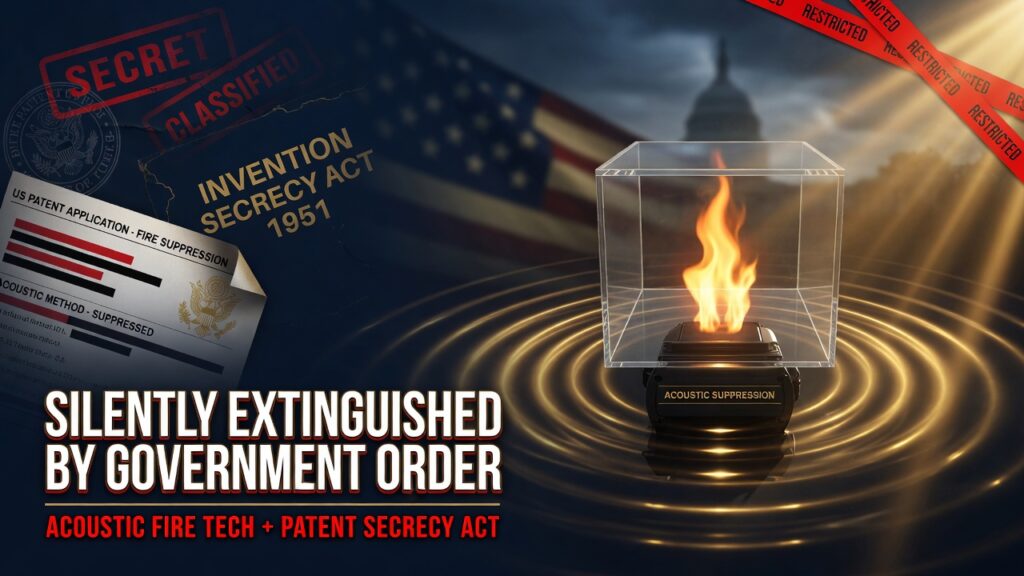
A NASA-inspired startup just proved fire can be extinguished without a single drop of water. Meanwhile, the U.S. government quietly maintains secrecy orders on over 6,500 patents — and most Americans have no idea the law even exists.
A pan of oil ignites on a kitchen stove. No sprinkler drenches the room. No chemical foam ruins the floors. Instead, an invisible wave of sound — lower than anything the human ear can detect — snuffs the fire out in seconds. This isn’t science fiction. It happened in a demonstration kitchen in Concord, California, in 2026. And it raises a question every taxpayer deserves to ask: if breakthrough technologies like this are already working, what else has been quietly sitting on a shelf?
The answer, buried in federal statute and public records, is sobering. Under the Invention Secrecy Act of 1951 — a real, functioning U.S. law — the federal government currently holds secrecy orders on 6,543 patent applications as of the end of fiscal year 2025 [federal data, Federation of American Scientists / USPTO]. These are inventions that exist, that have been filed, and that the public is legally prohibited from knowing about. The justification is national security. But the scope of that justification, and who decides it, is a conversation this country is long overdue to have.
Support Independent Local Journalism
TheTownHall.News is a non-profit reader-supported journalism. Just $5 helps us hire local reporters, investigate important issues, and hold public officials accountable across Alameda County. If you believe our community deserves strong, independent journalism, please consider donating $5 today to support our work.The Technology That’s Changing Everything
The science behind acoustic fire suppression is not fringe. It is peer-reviewed, it is documented, and in 2026, it is finally commercial.
Sonic Fire Tech, a California-based startup founded by former NASA acoustics engineers, has built a system that uses infrasound — low-frequency sound waves in the 20 Hz range, below the threshold of human hearing — to physically displace oxygen from around a fire’s fuel source. No oxygen, no combustion. The fire chemistry simply collapses.
In March 2026, the San Bernardino County Fire Department publicly tested the technology. Officials from CAL FIRE — California’s lead wildland firefighting agency — were present. The results were dramatic enough that Sonic Fire Tech was named a CES 2026 Innovation Award Honoree in the Smart Home category. The company has raised $3.5 million in seed funding from Khosla Ventures and other top-tier investors [company disclosure]. By late May 2026, it had launched a campaign to place 100 portable acoustic suppression backpacks with California fire agencies for field evaluation — tools that could allow wildland crews to fight fires without water in remote terrain.
A fire system that deploys in milliseconds, uses no water, leaves no chemical residue, and costs nothing to “reload” — and most Americans still haven’t heard of it.

The implications for a state where wildfires have consumed hundreds of thousands of acres annually are almost impossible to overstate. So why isn’t this on the front page of every newspaper?
What Is the Invention Secrecy Act — and Why Should You Care?
6,543 patents under active secrecy orders—as of FY2025 [USPTO / Federation of American Scientists]
That number should stop you cold. The question no one in Washington wants to answer plainly: how many of those inventions could be changing lives right now?
The Invention Secrecy Act of 1951 empowers the federal government to impose secrecy orders on patent applications that it deems sensitive to national security. Critically, this power applies even to patents filed by entirely private citizens — no government funding required, no defense contract necessary. A private inventor in their garage can submit a patent and receive a classified suppression order in return.
The law has a legitimate core. Preventing adversaries from accessing weapons designs, radar systems, or cryptographic breakthroughs is a defensible national interest. The problem is transparency. The review process is administered primarily by the Department of Defense, largely outside public view. There is no independent civilian oversight board. There is no automatic sunset provision requiring re-evaluation. And while the government is technically required to compensate inventors whose suppressed patents prevent them from earning income, legal cases documenting that process are rare and hard-fought [federal court records].
Support Independent Local Journalism
TheTownHall.News is a non-profit reader-supported journalism. Just $5 helps us hire local reporters, investigate important issues, and hold public officials accountable across Alameda County. If you believe our community deserves strong, independent journalism, please consider donating $5 today to support our work.If a private citizen’s invention can be classified and buried by the government without their consent, is that still a free market — or something else?
What Do Supporters of This Policy Actually Believe?
To be fair: the national security case for patent secrecy is not manufactured. Proponents — including defense attorneys, intelligence officials, and some legal scholars — argue that the United States faces genuine adversaries who actively seek to exploit public patent filings for military and strategic advantage. In their view, selectively suppressing sensitive applications is a minimal, targeted intrusion that prevents catastrophic capability transfers.
They also point out that the number of secrecy orders — roughly 6,500 — represents a small fraction of the more than 600,000 patent applications the USPTO receives annually [USPTO data]. The system, they argue, is not a broad dragnet but a surgical tool applied narrowly.
These are fair points. The problem is not the existence of the law. It is the absence of accountability structures around it. A law that allows the government to suppress private innovation indefinitely, with no independent judicial review and no public reporting on the categories of technology affected, is a law operating on trust alone. And trust, without verification, is not a governance principle — it is a blank check.
“When the government can classify a private citizen’s invention without consent, without compensation, and without appeal to independent review — that is not national security. That is unchecked administrative power.”
Is Anyone in Washington Paying Attention?
The short answer is: not enough people, and not loudly enough.
A February 2026 law review paper from the University of New Hampshire described the Invention Secrecy Act as “dubiously constitutional” and “partially obsolete,” arguing that its peacetime applications have outgrown their legal and democratic foundations [University of New Hampshire Law Review, 2026]. The paper joins a small but growing body of legal scholarship pushing for reform — including mandatory periodic declassification reviews, independent oversight, and strengthened compensation rights for affected inventors.
Meanwhile, the acoustic fire suppression story offers a useful lens. Here is a technology that was not suppressed — and look what happened. Private engineers took NASA acoustics research, built a startup, attracted venture capital, and within years are testing the product with real fire departments in the middle of America’s worst wildfire crisis in recorded history. Innovation, when allowed to move freely, finds its way to the problems that matter most.
The real cost of suppression isn’t just lost profit — it’s lost solutions to problems that are killing people.
What Happens When Innovation Is Delayed by Decades?
Consider the math. If even a fraction of the 6,543 currently suppressed patents contain commercially viable technology in fields like energy, medicine, or environmental protection, the human cost of delayed deployment is real and calculable — even if we can’t name it specifically.
The fire suppression case is instructive not because it was suppressed, but because it shows how long legitimate acoustic science existed in academic literature before anyone commercialized it. Researchers have published on acoustic combustion disruption for years. The 2018 academic literature noted that “acoustics alone are insufficient to control flames beyond the incipient stage” — a finding Sonic Fire Tech is now actively challenging with real-world demonstrations [peer-reviewed literature]. Independent experts still want full-scale testing data. But the direction of the science is clear.
Progress happens. The question is whether government structures accelerate it — or slow it down in the name of security, while providing no accountability for the cost of that delay.
Key Questions This Story Raises
- Who reviews the 6,543 suppressed patents annually — and is there any independent civilian body with authority to challenge a secrecy order?
- If acoustic fire suppression technology was available in research for years, what other peer-reviewed breakthroughs are waiting for a founder brave enough to commercialize them?
- Should private inventors be entitled to automatic judicial review when the government classifies their work — rather than having to sue for compensation after the fact?
The Accountability Question No One Is Asking Loudly Enough
Here is where personal responsibility and civic accountability intersect. The Invention Secrecy Act is not a conspiracy. It is a public law, traceable in the Federal Register, trackable through the USPTO, and documented by the Federation of American Scientists. The information is available. The question is whether enough citizens care to demand that their elected representatives engage with it seriously.
Sonic Fire Tech’s story — from NASA research to a CES Innovation Award to California fire department tests — is a reminder of what American ingenuity can achieve when it is allowed to run. It is also a challenge: if this technology could have arrived sooner, what should we be doing differently to ensure the next one does?
The real question isn’t whether suppressed patents affect your life. It’s whether you’ll demand an answer before the next crisis makes the cost impossible to ignore.
Still have questions? Subscribe for daily coverage of the policies and technologies shaping your future. Think others need to hear this? Share this article and let the conversation start. Want to make your voice count? Contact your congressional representative and ask where they stand on independent oversight of the Invention Secrecy Act — the House Committee on the Judiciary is the right place to start.