Iran Sanctions Violation: California CEO Arrested for Supplying U.S. Tech to Iran’s Nuclear Program
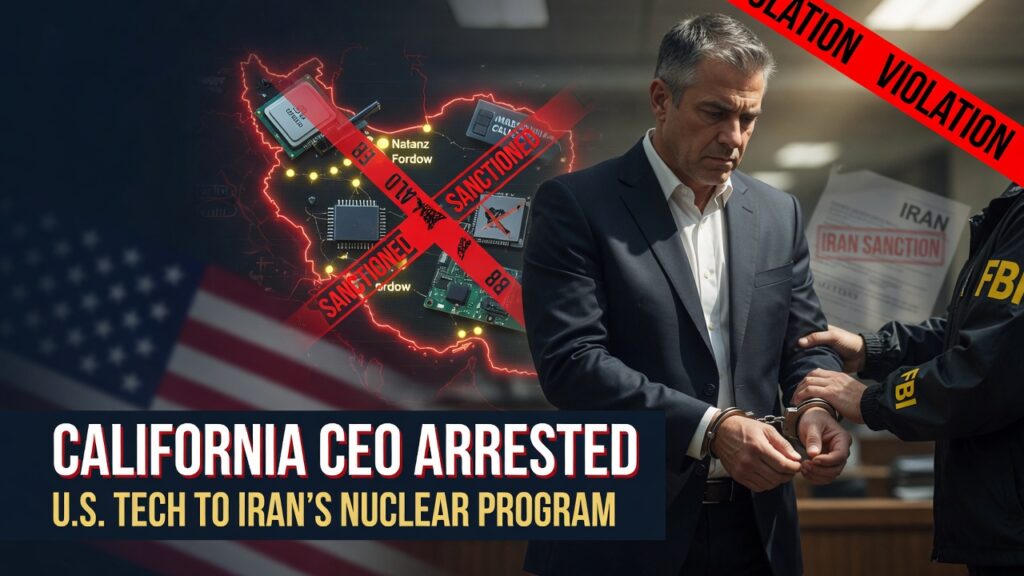
A California tech CEO lived in a $35 million mansion, reported nearly no income, and allegedly spent over a decade funneling American hardware directly to Iran’s nuclear and military establishment. How does something like this go on for so long — and who is accountable for letting it happen?
The arrest happened in broad daylight on June 3, 2026. Federal agents descended on a Newport Coast estate worth $35 million and took Jamshid Ghomi, 63, into custody.
What prosecutors allege is not a minor paperwork violation. According to the Department of Justice, Ghomi spent more than a decade systematically supplying U.S.-origin computer networking, security, and encryption equipment to some of the most dangerous institutions on earth — including Iran’s nuclear enrichment program and its Ministry of Defense. He is charged with conspiracy to violate the International Emergency Economic Powers Act (IEEPA), a federal crime that carries a maximum sentence of 20 years in prison. For millions of Americans who believe in law and order, fiscal accountability, and national security, this case raises questions that demand real answers.
Support Independent Local Journalism
TheTownHall.News is a non-profit reader-supported journalism. Just $5 helps us hire local reporters, investigate important issues, and hold public officials accountable across Alameda County. If you believe our community deserves strong, independent journalism, please consider donating $5 today to support our work.The Allegations: What Prosecutors Say Actually Happened
The DOJ’s affidavit paints a detailed picture of deliberate, long-running deception. Ghomi is the founder and CEO of Faraz Pardaz Rayaneh Co. Ltd. (FPR), a Tehran-based technology company. From 2011 to 2023, prosecutors allege he used that company as a vehicle to procure U.S.-origin hardware for Iranian customers — routing goods through front companies in the United Arab Emirates to conceal Iran as the true destination. He allegedly directed co-conspirators to keep his name off shipping documents, omit invoices, and physically hide American equipment inside larger shipments.
From 2014 to 2018 alone, Ghomi allegedly arranged the smuggling of more than 250 metric tons of networking equipment into Iran. He used his own eBay and PayPal accounts to make hundreds of purchases, directing goods to UAE intermediaries. The court documents note that he and co-conspirators referred to Iran internally as “Motherland.”
From 2017 to 2023, FPR supplied U.S. networking equipment directly to the Atomic Energy Organization of Iran — the agency responsible for Iran’s centrifuge and uranium-enrichment programs. The company even formally registered as an AEOI-approved vendor in 2021 and 2022, while U.S. sanctions against that organization were firmly in place.
Who Was Supplying Iran’s Ministry of Defense — and for How Long?
The nuclear program was not the only customer. According to prosecutors, FPR supplied U.S.-origin networking, security, and encryption equipment to Iran’s Ministry of Defense and Armed Forces Logistics and affiliated defense-electronics entities from 2014 to 2022. A 2017 contract, signed by Ghomi himself, explicitly named the buyer as the “Ministry of Defense and Armed Forces Logistics — Iran Computer Industries.” This was not ambiguous. The buyer was identified in writing. And the sales allegedly continued for years.

FPR’s annual revenue exceeded $10 million, according to the DOJ. Its clientele included hundreds of Iranian companies and government entities, many of which were already subject to U.S. sanctions. The scale here is not that of a careless mistake. It is, as prosecutors describe, an elaborate, multi-year scheme with layers of concealment built in from the start.
“Ghomi is accused of aiding our declared enemies by selling U.S.-origin computer networking parts to Iran and earning millions of dollars in violation of U.S. sanction laws.” — First Assistant U.S. Attorney Bill Essayli
Is This the Accountability Moment America Has Been Waiting For?
For years, critics of U.S. sanctions enforcement have argued that the system has significant blind spots — that determined actors can exploit shell companies, foreign intermediaries, and gaps in financial oversight to move prohibited goods without consequence. The Ghomi case, if the allegations hold, is Exhibit A.
$15 million. That is how much prosecutors say Ghomi moved from Iran into U.S. bank accounts between 2011 and 2024 — while reporting a peak annual income of just $20,684 on his federal tax returns. The question no compliance system should have to ask: how was this not flagged sooner?
Ghomi allegedly claimed the Earned Income Tax Credit — a benefit designed for working-class and low-income Americans — in seven separate tax years, all while reporting over $1.7 million in mortgage interest on the same returns. He falsely characterized the incoming funds to the IRS as a foreign inheritance. The construction of his Newport Coast mansion, which cost approximately $10.49 million to build on a lot he purchased for $4.49 million in 2010, was allegedly funded by those same proceeds. More than $7 million in foreign-source wires flowed into the construction escrow account between 2011 and 2015.
If a working American underreported income by even a fraction of this amount, the IRS would have been at their door. The question worth asking is: why did it take this long?
Support Independent Local Journalism
TheTownHall.News is a non-profit reader-supported journalism. Just $5 helps us hire local reporters, investigate important issues, and hold public officials accountable across Alameda County. If you believe our community deserves strong, independent journalism, please consider donating $5 today to support our work.What Do Supporters of Engagement With Iran Actually Argue?
It is fair to ask whether critics of this arrest have a point. Some analysts and foreign policy advocates have long argued that broad U.S. sanctions regimes cause unintended humanitarian harm, create perverse economic incentives, and push adversary nations toward greater self-sufficiency in weapons development rather than deterring them. The argument goes that more diplomatic engagement — not stricter enforcement — is the more effective path to nuclear non-proliferation.
That is a serious debate worth having. But it is a separate debate entirely from this case. The issue here is not the policy merits of sanctions; it is the alleged deliberate violation of clearly established law over more than a decade, while simultaneously defrauding American taxpayers by claiming poverty-level income benefits. One can hold nuanced views on Iran diplomacy and still insist that laws on the books be enforced — and that those who violate them face consequences. Personal responsibility and civic accountability are not partisan values. They are foundational ones.
Are Sanctions Enforcement Gaps Leaving America Exposed?
The Ghomi case is not an isolated incident. Federal prosecutors in the Central District of California, working alongside IRS Criminal Investigation and the Department of Commerce’s Bureau of Industry and Security, have described a system actively exploited through front companies, falsified documentation, and offshore financial routing. The question for policymakers is whether existing enforcement tools are adequate — or whether systemic reform is overdue.
First Assistant U.S. Attorney Essayli has stated that prosecutors intend to seek seizure of Ghomi’s assets, including the Newport Coast mansion. That is the right instinct. Law and order means consequences that are proportionate and real — not nominal fines absorbed as a cost of doing business. If convicted, Ghomi faces up to 20 years in federal prison.
A man who allegedly built a $35 million estate on the proceeds of sales to Iran’s nuclear program — while collecting low-income tax credits — is either a symbol of a broken enforcement system or a warning that the system can still catch up. Either way, Americans deserve to know which one it is.
📌 Key Questions This Story Raises
- How did Ghomi’s financial discrepancy — reporting less than $21,000 in income while paying over $1 million annually in property taxes — go undetected by federal agencies for over a decade?
- What U.S.-origin technology reached Iran’s nuclear and military programs, and could any of it have contributed to weapons development or operational military capability?
- Are existing sanctions enforcement mechanisms sufficient to detect and prevent similar schemes, or does this case reveal structural gaps that require legislative action?
The real question this case forces every citizen to confront is not whether Jamshid Ghomi is guilty — that will be determined in court. The real question is whether the systems Americans trust to protect national security and enforce the law are capable of catching this kind of threat before it has run for fifteen years. That question does not have a comfortable answer yet.
What do you think — is it time for a full review of how U.S. sanctions are enforced at home? Share this article and join the conversation.
Still have questions? Stay informed — subscribe for daily coverage of national security, law enforcement, and fiscal accountability.
Think others need to hear this? Share this article with someone who values law and order.
Want to make your voice count? Contact your representative on the House Foreign Affairs Committee or the Senate Banking Committee — both have jurisdiction over sanctions enforcement — and ask what oversight reforms are being considered in the wake of this case.