California Minimum Wage 2026: What the New $25–$26.50 Mandates Mean for Workers and Businesses
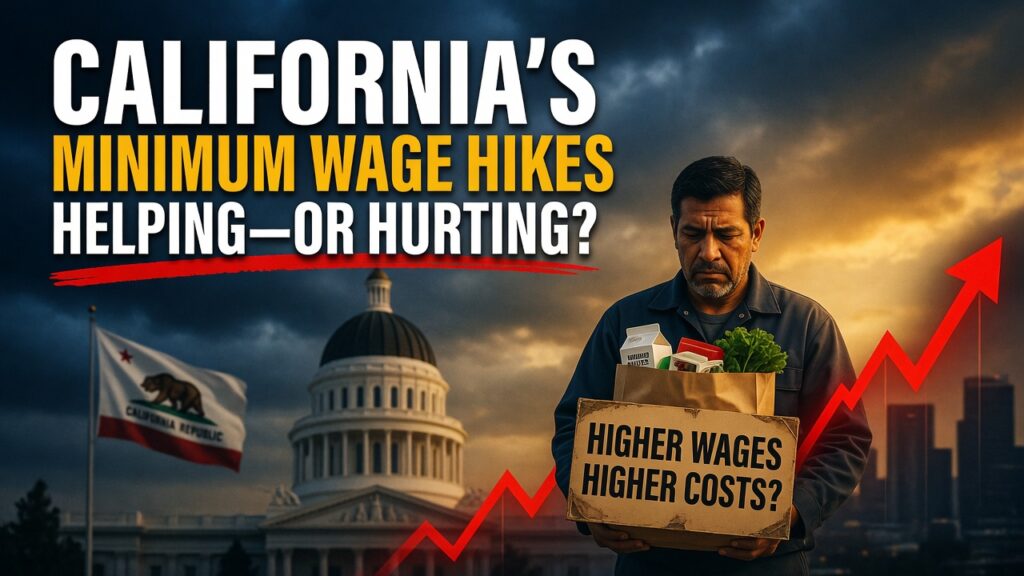
As new wage floors hit Southern California this July 1 — some topping $26.50 an hour in hospitality — millions of workers, business owners, and consumers are left asking the same question: who actually wins when government mandates the price of labor?
The bill is due. Effective July 1, 2026, healthcare workers at large hospital networks saw their minimum wage rise to $25 per hour, while specific regional hospitality and hotel staff tiers climbed as high as $26.50 per hour — numbers that sound like victories until you trace where the money actually comes from. California has spent nearly a decade layering wage mandate upon wage mandate, industry by industry, city by city. The results are beginning to tell a story that Sacramento’s policymakers would rather not read aloud. FOX 11 Los Angeles
What Did California Just Mandate — and for Whom?
The July 1 wave was not a single, uniform increase. It was a cascade. Several city and county minimum wage increases, including a new minimum wage requirement for hospitality employees in San Diego, and statewide increases for certain types of healthcare facilities, all took effect on July 1, 2026. Long Beach covered hotel employees now earn $26.50 per hour, while Los Angeles-area covered hotel and airport hospitality employees face rates that may reach or exceed $25 per hour, subject to the applicable ordinance and healthcare-benefit requirements. California Employers AssociationPaulChenGLaw
Support Independent Local Journalism
TheTownHall.News is a non-profit reader-supported journalism. Just $5 helps us hire local reporters, investigate important issues, and hold public officials accountable across Alameda County. If you believe our community deserves strong, independent journalism, please consider donating $5 today to support our work.Healthcare saw its own ratchet upward. Under SB 525, most large hospitals, integrated systems, and dialysis clinics moved to $25 per hour, while most other covered facilities — including skilled nursing facilities — moved to $23 per hour. These are not modest bumps. For a nursing home running 40 employees on a shift, even a $2-per-hour increase translates to tens of thousands of dollars in new monthly payroll costs — costs that have to go somewhere. California Employment Law Report
Is This About Workers — or About Sacramento’s Ambitions?
The political framing is always the same: this is about dignity. But the trajectory of California’s wage policy reveals something beyond worker protection — it reveals a government that has grown comfortable dictating private business decisions at an accelerating pace. The City of Los Angeles hotel worker minimum wage took effect at $22.50 per hour on September 8, 2025, and is set to reach $30 per hour by July 2028. San Diego is on a parallel track: phased increases will push all covered hospitality businesses to $30 per hour by July 2030. EcjlawEcjlaw
When politicians set a wage floor, they are also setting a ceiling — on the hours businesses can afford to offer, on the entry-level jobs that actually exist, and on the prices every consumer pays.
This is not hypothetical. When California imposed its $20-per-hour fast food minimum wage in 2024, the results were measurable and swift. A study published in July 2025 by the National Bureau of Economic Research found that from September 2023 to September 2024, employment in the fast food sector declined by approximately 18,000 jobs, or 3.2 percent, while the nationwide rate grew by 0.8 percent over that same period. [Source: NBER working paper, July 2025] Wikipedia

18,000 jobs. The question no one in Sacramento wants to answer: where did those workers go?
What Do Supporters of This Policy Actually Believe?
Proponents of California’s wage mandates make a serious and sincere argument that deserves a fair hearing. They point out that the cost of living in Southern California is among the highest in the nation. The current rate of $16.50 per hour — before the July increases — suggested that a minimum wage worker would need to work 98 hours per week to afford a one-bedroom rental at fair market rent in California, according to the National Low Income Housing Coalition. If workers cannot survive on their wages, the argument goes, government must act. CalMatters
Supporters also cite data showing that some wage increases have not destroyed employment at the predicted scale. A UC Berkeley study found that the fast food minimum wage hike barely raised prices, contradicting some earlier projections. Economists who favor higher minimums argue that increased worker spending power pumps money back into local economies, stabilizing employment through consumer demand. These are not frivolous claims. Fortune
But the counterevidence is equally serious. A Cato Institute report from November 2025, using Bureau of Labor Statistics data, found the fast food sector lost 18,000 jobs relative to the rest of the labor market. A November 2025 study from University of California at Santa Cruz found the minimum wage law was associated with higher menu prices, as well as fewer hours and benefits for restaurant workers. [Sources: Cato Institute, November 2025; UC Santa Cruz, November 2025] The economic debate is genuine — but the burden of proof must rest with the policy that eliminates jobs and raises prices, not with the businesses trying to survive them. Fortune
Are Small Businesses Being Written Out of the Economy?
“Every mandate sounds good on paper — until the small business has to raise prices, cut hours, or close its doors. At that point, who exactly has been helped?”
The hospitality and healthcare industries absorb the highest hits not because they are the wealthiest sectors, but because they employ the most hourly workers. A family-run hotel with 65 rooms in Los Angeles does not have the financial cushion of a Marriott. A community clinic in the San Fernando Valley does not have the billing infrastructure of a hospital system. Yet both face identical mandated wage schedules on identical timelines.
Support Independent Local Journalism
TheTownHall.News is a non-profit reader-supported journalism. Just $5 helps us hire local reporters, investigate important issues, and hold public officials accountable across Alameda County. If you believe our community deserves strong, independent journalism, please consider donating $5 today to support our work.For employers operating in multiple jurisdictions — particularly those with hotel, hospitality, or healthcare workers — the compliance landscape continues to grow more complex. Businesses are now required to track not just state and federal law, but a patchwork of dozens of local ordinances that vary block by block. Miss a rate adjustment and face lawsuits, penalties, or audits under California’s Private Attorneys General Act — a law that empowers employees to sue on the state’s behalf and collect a share of the penalties. The compliance cost alone, before a single wage is paid, can break a small operation. California Employment Law ReportChauvel & Glatt, LLP
California keeps adding costs and then expresses genuine bewilderment at why nothing gets more affordable.
What Do the Numbers Actually Tell Us?
California is one of 19 states that raised minimum wages in 2026. Over two dozen local jurisdictions have increased their local minimums this year alone. At the same time, labor organizers in May 2025 secured a city minimum wage increase that would push hotel and airport employee pay to $30 per hour by the 2028 Olympics. The 2028 Games are being used as a political justification to accelerate wage mandates — a convenient deadline that obscures the permanent economic architecture being built underneath it. CalMattersCalMatters
California’s 2024 fast food minimum wage increase produced a 13 percent increase in weekly earnings for workers who kept their jobs — alongside a loss of roughly 3 percent of fast food jobs statewide, while the nationwide fast food sector grew. [Source: NBER, July 2025] That is the honest ledger: some workers earned more; others lost their jobs entirely; and consumers paid higher prices at the counter. Whether that trade-off is worth it is a legitimate policy debate. But California is not having that debate openly — it is having it through unilateral ordinance, imposed from the top down, with no sunset clauses and no accountability mechanism if the projections prove wrong. Wikipedia
Is Anyone in Sacramento Asking the Hard Questions?
The political incentive structure in Sacramento rewards the announcement of a mandate, not its consequences. A mayor who signs a $30 wage ordinance gets a press release and a union endorsement. A restaurant owner who cuts three employees’ hours to make payroll does not generate headlines. A nursing home that raises its daily rates to cover a $23 minimum wage passes those costs to families — quietly, incrementally, invisibly.
If a small business in Long Beach has to raise its prices or eliminate a shift to pay $26.50 an hour, is that success — or is that the cost being quietly transferred to the consumer?
After the Los Angeles City Council approved its hotel wage ordinance, the American Hotel & Lodging Association warned the bill’s effects would cause an “economic tsunami.” That may prove to be hyperbole — or it may prove to be understatement. Either way, the workers who get caught in the gap between what a mandate requires and what a business can afford are rarely the ones at the podium when the signing ceremony takes place. Hotel Dive
Key Questions
- Who absorbs the cost? When wage mandates outpace productivity gains, the burden falls on prices, hours, or jobs — but policymakers rarely track which outcome follows which ordinance.
- Is the patchwork sustainable? With at least 38 California cities maintaining a minimum wage higher than the state floor, how long before the compliance burden itself becomes a barrier to operating a small business in California? Paycor
- What happens in 2028? When the Olympic wave of wage increases becomes permanent policy — as it inevitably will — will Sacramento revisit the math, or simply move the next deadline further out?
California’s wage experiment is real-time, large-scale, and consequential. The state deserves a full accounting of who benefits, who pays, and who quietly disappears from the labor force entirely. That accounting will not come from the politicians who signed the ordinances. It will have to come from voters, business owners, and the workers left navigating a labor market that grows more complicated every July 1.
The real question isn’t whether California workers deserve a living wage — they do. The question is whether a government that mandates $30 an hour and then wonders why a hotel room costs $400 a night has any honest reckoning coming at all.
What do you think — is California’s wage policy helping the workers it’s supposed to protect, or pricing them out of the jobs they need? Share this article and weigh in.
Still have questions? Stay informed — subscribe to The Town Hall News for daily coverage of California policy and accountability journalism.
Think others need to hear this? Share the article — especially with small business owners in your community.
Want to make your voice count? Contact your California state assemblymember at legislature.ca.gov and ask them to publish a cost-benefit analysis of SB 525 and the hotel wage ordinances before the next round of increases takes effect.