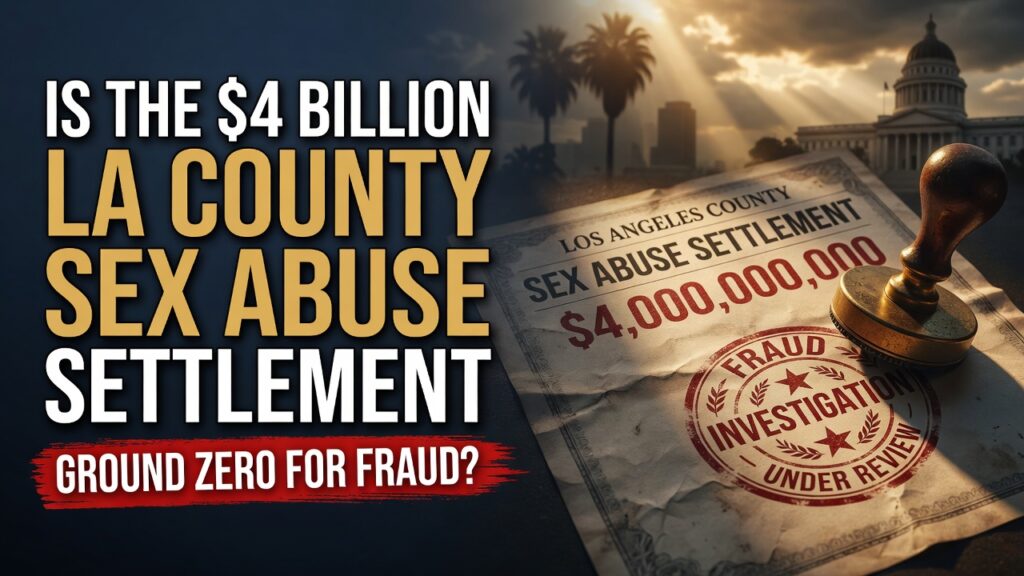
Is the $4 Billion LA County Sex Abuse Settlement Ground Zero for Fraud?
A record-breaking child abuse settlement was supposed to deliver justice. Instead, prosecutors say up to 81% of the claims may be fake — and the people who were genuinely abused are the ones being hurt most.
The largest child sex abuse settlement in American history may also be its most spectacular fraud. That is not a political opinion. That is what the Los Angeles County District Attorney’s Office told a Superior Court judge earlier this month.
The $4 billion settlement, approved by the LA County Board of Supervisors in April 2025 to resolve more than 11,000 claims of sexual abuse at county juvenile halls, foster homes, and children’s shelters, has become the focal point of a sweeping criminal investigation. District Attorney Nathan Hochman’s office believes fraudulent claims could account for as much as 81% of those seeking compensation from the fund — a figure so staggering it is forcing California lawmakers, county officials, and the public to confront how this was allowed to happen.
Support Independent Local Journalism
TheTownHall.News is a non-profit reader-supported journalism. Just $5 helps us hire local reporters, investigate important issues, and hold public officials accountable across Alameda County. If you believe our community deserves strong, independent journalism, please consider donating $5 today to support our work.How Did an $4 Billion Settlement Become a Fraud Magnet?
The mechanism was disturbingly simple. California’s Assembly Bill 218, enacted in 2020, temporarily lifted the statute of limitations for childhood sexual abuse claims against public institutions. The intent was compassionate: giving survivors of long-ago institutional abuse a final window to seek justice. The result, critics argue, was a structured invitation to commit fraud.
With the window open, thousands of claims flooded county courts. The LA County Board of Supervisors approved the first $4 billion settlement in April 2025 — without discovery, meaning without the standard legal process of examining evidence before agreeing to pay. A second settlement worth $828 million followed in October 2025, bringing total county exposure to nearly $5 billion across more than 11,000 cases, with an estimated 2,500 additional cases still pending.
$4.8 billion committed to a settlement that prosecutors now say is riddled with fabricated claims. The question taxpayers deserve an answer to: who authorized this without demanding evidence first?
What Did Investigators Actually Uncover?
The Los Angeles Times broke the story of how the scheme operated at the ground level. Investigators found individuals who said they were paid by recruiters — connected to a prominent personal injury law firm — to file lawsuits against the county. Some admitted they had fabricated stories of abuse. Others acknowledged they had never been in county custody at all.

DA Hochman described the scheme plainly: people “who never suffered sexual abuse at the hands of Los Angeles County” saw the settlement as an opportunity to get what he called “free money.” The law firm at the center of the investigation, Downtown LA Law Group, which represented more than 2,700 claimants, has denied any wrongdoing. The firm told the Times it hired an outside company to investigate whether false claims were made on its behalf.
“Fraudulent claims may account for as much as 81 percent of those seeking compensation from the settlement fund.” — District Attorney Nathan Hochman, June 2026
The criminal probe has expanded well beyond individual claimants. Prosecutors are investigating plaintiffs, attorneys, and therapists connected to the claims. Hochman’s office has established a fraud hotline for claimants who wish to voluntarily confess — a signal of how broad the alleged scheme may be.
Who Is Really Paying for This?
Los Angeles County’s taxpayers. The settlement is structured to be paid over five years, but the financial damage extends beyond the direct payout. County CEO Fesia Davenport cited the multi-billion-dollar settlements as a primary driver behind $88.9 million in budget cuts, cuts that reduce services for the same communities the county claims to serve.
If a law firm can recruit fake plaintiffs, coach fabricated stories, and collect hundreds of millions in attorneys’ fees before anyone asks a single question, the system isn’t just broken — it’s been weaponized.
The damage to legitimate survivors is equally serious. Attorneys representing genuine abuse victims argue their clients have already been thoroughly vetted and have faced repeated delays in receiving compensation. One claimant’s attorney warned in court filings that her client, currently unhoused, will “go from semi-unhoused to fully unhoused” if the next payment tranche is delayed. Another claimant is receiving end-of-life care and may not survive long enough to receive any payment at all.
Support Independent Local Journalism
TheTownHall.News is a non-profit reader-supported journalism. Just $5 helps us hire local reporters, investigate important issues, and hold public officials accountable across Alameda County. If you believe our community deserves strong, independent journalism, please consider donating $5 today to support our work.Is California’s AB 218 the Law That Made This Possible?
The statute at the center of this disaster is Assembly Bill 218, signed by Governor Gavin Newsom in 2020. The law was championed as a victim-centered reform, and for genuine survivors of institutional abuse, the intent was defensible. But the law contained a structural vulnerability: it allowed cases to be filed without meaningful corroborating evidence, simply because the lookback window was open.
County officials, led by Supervisor Kathryn Barger, are now pushing state lawmakers to reform AB 218 before additional cases drain county coffers further. Thousands of similar lawsuits have been filed against California school districts and other public entities under the same law. The $4.8 billion in LA County settlements may be only a fraction of the statewide liability exposure.
Is California’s legislature finally ready to close the loophole that turned a victim protection law into a fraud pipeline — or will taxpayers keep paying the price?
What Do Supporters of This Law Actually Believe?
This is a fair question, and it deserves a direct answer. Advocates for AB 218 argue that genuine survivors of childhood sexual abuse face enormous barriers to coming forward. Shame, trauma, and fear often delay disclosure by decades. The traditional statute of limitations effectively barred thousands of legitimate victims from ever seeing justice — particularly survivors of abuse at MacLaren Hall, the county-operated children’s shelter with a documented history of abuse stretching back to 1959.
The argument is not without merit. The first lawsuits in this settlement were filed in 2021 by plaintiffs who described credible, specific, and corroborated abuse. The Department of Justice conducted an independent investigation and concluded there was systemic failure to protect youth from harm by county staff. Real abuse happened. Real victims exist.
The problem is not that AB 218 created a window for survivors. The problem is that the window was left open long enough, and the evidentiary threshold kept low enough, that organized fraud became not just possible but apparently lucrative. The county approved a $4 billion settlement without standard discovery. That decision belongs to elected officials who will face no personal consequence for it.
Is This the Accountability Moment California Has Been Waiting For?
On June 15, Superior Court Judge Lawrence Riff declined to freeze payments until the end of 2026 as Hochman requested, but did issue a temporary halt on payouts until July 25 — giving the court more time to evaluate the fraud evidence. That hearing is the next significant legal milestone in a case that is now moving fast.
Hochman has been unambiguous: he intends to pursue not just individual fraudulent claimants but the attorneys and law firms that may have recruited them. “We’re going to go after them to put them behind bars,” he said in November 2025. “We’re going to send a message.”
Whether the legal system delivers on that promise — and whether California’s legislature acts before the next AB 218-style settlement is approved without scrutiny — will define whether this scandal produces real reform or simply becomes another chapter in the state’s long record of institutional failure dressed up as compassion.
KEY QUESTIONS
- Will DA Hochman’s investigation result in criminal charges against attorneys and law firms, or will prosecutorial pressure fade before trial?
- Will the California legislature reform or repeal AB 218 before similar fraud schemes metastasize across other counties and school districts?
- Are the legitimate survivors of abuse at LA County facilities — the people this settlement was supposed to help — going to receive any meaningful compensation before the fund is consumed by litigation and fraud?
Think others need to hear this? Share the article and tell us: if 81% of claims in a $4 billion settlement turn out to be fabricated, who should be held criminally accountable — the claimants, the lawyers, or the legislators who made it possible?
Stay informed on California accountability stories — subscribe to The Town Hall News for daily coverage.