El Mencho Is Dead: Why the Killing of Mexico’s Most Wanted Drug Lord Proves America Must Get Serious About the Border
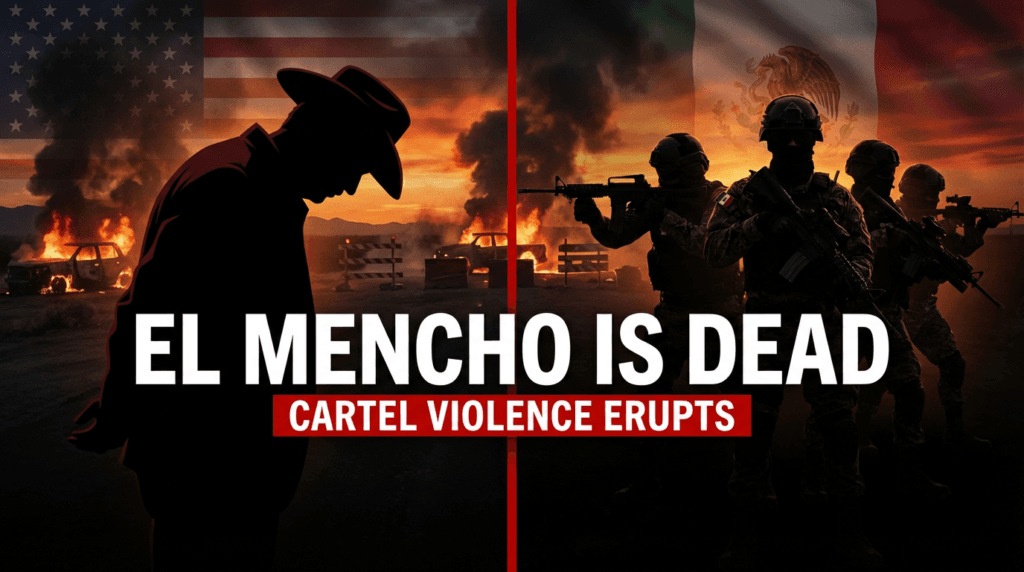
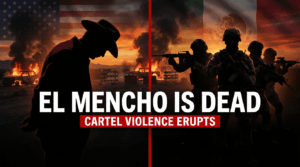
On Sunday, February 22, 2026, Mexican special forces, armed with U.S. intelligence, descended on the small town of Tapalpa in the state of Jalisco and did what the world’s law enforcement agencies had been trying to do for over a decade. They killed Nemesio Rubén Oseguera Cervantes — known as “El Mencho” — the 59-year-old leader of the Jalisco New Generation Cartel (CJNG), one of the most ruthless and powerful criminal organizations on the planet. He had a $15 million U.S. bounty on his head. He died being airlifted to Mexico City after a gun battle in which six of his associates were also killed and weapons including rocket launchers were seized.
Within hours, Mexico was on fire — not metaphorically, but literally. Cartel gunmen torched gas stations, buses, and businesses. They blockaded highways in 20 of Mexico’s 31 states. At least 62 people were killed in the raid and the retaliatory chaos, including 17 members of Mexico’s state and federal security forces, and a pregnant woman caught in crossfire. Schools were shuttered. Soccer matches were canceled. Flights out of Puerto Vallarta — one of the most popular tourist destinations in North America — were suspended. American tourists were told by the U.S. Embassy to shelter in place. Guadalajara, Mexico’s second-largest city and a 2026 FIFA World Cup host, ground to a halt.
This is what the collapse of law and order looks like. And it should be a wake-up call for every American who cares about sovereignty, security, and the rule of law.
A Victory — But One That Exposes Deeper Failures
Let us be clear: the killing of El Mencho is a good thing. U.S. Deputy Secretary of State Christopher Landau called him “one of the bloodiest and most ruthless drug kingpins” in history and described his death as “a great development for Mexico, the U.S., Latin America, and the world.” Mike Vigil, the former DEA Chief of International Operations, called his takedown “one of the most significant actions undertaken” against global drug trafficking. These are not overstatements.
Under El Mencho’s leadership, CJNG grew from a splinter faction of the collapsed Milenio Cartel into a transnational empire with operations in nearly all 50 U.S. states. The DEA has identified CJNG as a dominant trafficker of cocaine, methamphetamine, heroin, and — most devastatingly — fentanyl. The cartel’s reach extended into extortion, fuel theft, human trafficking, and even political assassination. In 2020, CJNG gunmen attacked Mexico’s public security secretary with grenades and high-powered rifles in broad daylight on the streets of Mexico City.
The operation itself demonstrated what happens when governments take decisive action. Mexican special forces executed the raid. The White House confirmed that the U.S. provided critical intelligence through the Joint Interagency Task Force-Counter Cartel (JIATF-CC), a task force launched in January 2026 to identify, disrupt, and dismantle cartel operations threatening the United States. This is the model: American strength and resolve, paired with cooperation from willing partners, producing real results.
But a single operation, however significant, does not solve a problem decades in the making. The wave of violence that followed El Mencho’s death — over 250 cartel roadblocks across 20 states, 25 National Guard troops killed in Jalisco alone, entire cities shut down — is a brutal reminder of how deeply these organizations have embedded themselves into the fabric of Mexican society. The question is not just whether we can kill cartel leaders. It is whether we have the will to confront the systems that produce them.
The Fentanyl Crisis Is a Border Crisis
No honest conversation about cartel violence can ignore the poison that flows north every day. Fentanyl — largely manufactured with Chinese precursor chemicals and trafficked by organizations like CJNG — has been the leading cause of overdose deaths in the United States. In 2023, synthetic opioids, primarily fentanyl, killed roughly 199 Americans every day. Over a quarter of a million Americans have died from fentanyl overdoses since 2021.
There is encouraging news. Overdose deaths fell approximately 27% in 2024, the largest single-year decline ever recorded, dropping to around 80,000 from a peak of nearly 110,000 in 2022. Early data suggests further declines through 2025. These numbers correlate directly with increased enforcement pressure on cartels, disruption of trafficking routes, and the designation of organizations like CJNG as foreign terrorist organizations — a designation that unlocked greater military tools and increased financial liability for institutions doing business with these groups.
This progress did not happen by accident. It happened because leaders chose to treat the cartels as what they are: enemies of the American people, not merely law enforcement problems. The foreign terrorist organization designation, the creation of JIATF-CC, the use of military assets to intercept drug shipments in the Caribbean and Pacific — these are the tools of a government that takes seriously its most fundamental obligation: protecting its citizens.
Fiscal conservatives should note what is at stake. The economic cost of the opioid crisis has been estimated in the hundreds of billions annually — in healthcare, lost productivity, law enforcement, and shattered communities. Every dollar spent on border security and cartel disruption is an investment in reducing that staggering burden on American taxpayers.
Sovereignty Means Something
The aftermath of the Tapalpa raid also raises a question that conservatives have been asking for years: at what point does the instability south of our border become an unacceptable threat to American sovereignty?
When American citizens are told by their own embassy to shelter in place in a foreign country because criminal organizations have effectively seized control of major cities and transportation networks, something has gone deeply wrong. When airports are shut down and tourists are trapped, when smoke rises over resort towns, when cartel gunmen operate with impunity across two-thirds of a nation’s territory — that is not merely Mexico’s problem. That is a direct threat to every American who travels, does business, or lives near the 1,954-mile border we share.
The Trump administration’s approach — applying tariff pressure that led Mexico to deploy approximately 10,000 National Guard and Army personnel to the border, demanding the handover of criminal gang members, and providing the intelligence that led to El Mencho’s elimination — reflects a straightforward principle: nations that cannot or will not control the criminal organizations within their borders should expect their neighbors to act in their own self-defense.
This is not interventionism. It is common sense. It is what limited, responsible government looks like when it focuses on its core constitutional duties rather than expanding into areas where it does not belong.
The Hard Truth About What Comes Next
Experts warn that El Mencho’s death creates a dangerous power vacuum. Chris Dalby, an organized crime analyst, has cautioned that if no clear successor emerges and CJNG splinters, Mexico could see “almost record levels of violence” as rival factions fight for control. El Mencho’s stepson, Juan Carlos, has been identified as a possible successor who might hold the organization together — but history suggests fragmentation is more likely. The collapse of previous cartel leadership structures has consistently produced more violence, not less.
This is precisely why the killing of one man, however important, cannot be the end of the strategy. It must be the beginning. The United States and Mexico have a narrow window to press the advantage — to dismantle CJNG’s financial networks, arrest its lieutenants, and choke off the supply chains that feed the fentanyl crisis. As Mike Vigil noted, this moment “presents a significant opportunity for Mexico and the United States to work together on an intelligence-based assault against the cartel.”
That opportunity will require sustained political will. It will require leaders who refuse to go soft on border security when the media cycle moves on. It will require holding Mexico accountable — not with empty rhetoric, but with the kind of concrete pressure that produces results. And it will require American communities, particularly those devastated by the opioid crisis, to demand that their elected officials treat this as the national emergency it is.
A Moment of Clarity
The death of El Mencho is a moment of clarity. It proves that decisive action works. It proves that American intelligence, paired with cooperative partners and backed by political will, can reach the most protected criminals on earth. But it also proves that the cartels are not merely criminal gangs — they are paramilitary organizations capable of shutting down an entire nation within hours of losing their leader.
The American people deserve a government that takes this threat as seriously as the cartels take their business. That means strong borders. It means holding trading partners accountable. It means designating enemies as enemies and giving law enforcement and military professionals the tools to do their jobs. And it means never forgetting that behind every statistic — every overdose death, every trapped tourist, every pregnant woman caught in cartel crossfire — is a human life that our institutions have a duty to protect.
El Mencho is dead. The fight is far from over.
Stay informed. Share this article with your friends, family, and elected officials. The security of our border and the safety of our communities depend on citizens who refuse to look away. Subscribe to our newsletter for continued coverage, and contact your representatives to demand sustained action against the cartels threatening American lives.