Iran’s $2 Million Strait of Hormuz Transit Fee Is Maritime Extortion — And It’s Killing Sailors
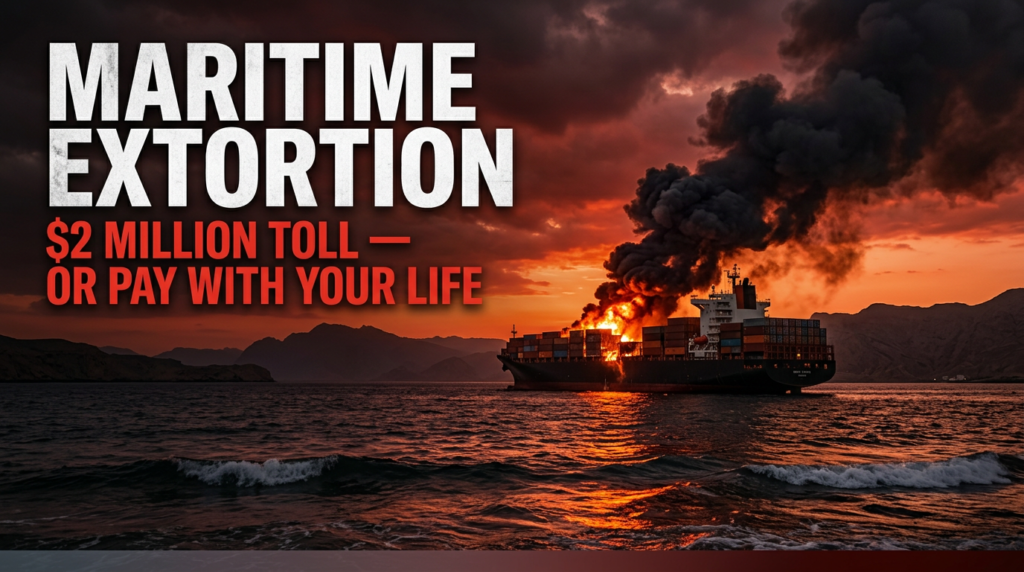
After a Thai cargo ship was attacked for refusing Iran’s demanded $2 million “safe passage” fee, the world faces a clear choice: defend the rule of law on international waters — or surrender to it.
Three crew members are still missing. Human remains have been found aboard a scorched cargo vessel run aground off Iran’s Qeshm Island. And the ship’s crime? Attempting to exercise its lawful right to navigate international waters — without paying a $2 million ransom to a regime that holds no legal authority to demand it.
The Thai-flagged bulk carrier Mayuree Naree was struck in the Strait of Hormuz on March 11, 2026. Iranian forces targeted the vessel after it reportedly refused to pay what Tehran’s parliament has been quietly institutionalizing as a “transit fee” — a cash-for-passage scheme targeting merchant ships in one of the world’s most critical shipping lanes. What is unfolding in the Strait of Hormuz is not a border dispute or a diplomatic misunderstanding. It is state-sanctioned piracy.
Support Independent Local Journalism
TheTownHall.News is a non-profit reader-supported journalism. Just $5 helps us hire local reporters, investigate important issues, and hold public officials accountable across Alameda County. If you believe our community deserves strong, independent journalism, please consider donating $5 today to support our work.A Chokepoint Turned Into a Cash Register
The Strait of Hormuz is the jugular vein of the global energy supply. Roughly 20% of the world’s oil and liquefied natural gas passes through its waters every single day, connecting the Persian Gulf to international markets. It is, by any legal standard, an international strait — governed by the United Nations Convention on the Law of the Sea (UNCLOS), which guarantees the right of “transit passage” to all vessels. No nation owns it. No nation has the right to charge for it.
Iran has chosen to ignore that legal reality. Iranian Member of Parliament Alaeddin Boroujerdi publicly confirmed that merchant vessels are now being charged up to $2 million per passage, framed as compensation for what Tehran calls its “war costs.” At least two vessels have already paid the fee, according to Lloyd’s List. Iran has also granted selective exceptions — allowing two Indian LPG carriers and a Pakistani tanker to transit through diplomatic channels — a classic hallmark of coercion: reward compliance, punish defiance.
Since March 2026, more than 17 vessel attacks have been reported in the strait. The container ship Selen was turned back by Iran’s Revolutionary Guard Corps Navy for a “lack of permit.” The message from Tehran is unmistakable: pay up, or face the consequences.
The Human Cost Behind the Headlines
The Mayuree Naree did not make it through.

The bulk carrier was struck at its stern on March 11, triggering an explosion in the engine room. Twenty crew members were rescued by the Omani Navy. Three were not. By March 26, the stricken vessel had drifted and run aground off Iran’s Qeshm Island — a haunting image of what happens when law and order on the high seas collapses entirely.
Then, on April 3, the ship’s owner delivered the news no family wants to hear: human remains had been found aboard the wreck. The missing crew members — men who went to sea to earn a living, to support families, to do honest work — became casualties of a regime that decided international law was optional and extortion was policy.
This is the real cost of geopolitical weakness. Not statistics in a trade report. Not disrupted supply chains. Human lives.
Why This Is Not Just a Middle East Problem
It is tempting to view the Strait of Hormuz crisis as a distant regional conflict — something for diplomats to manage quietly while global markets adjust. That temptation is dangerous and wrong.
When a state actor can blockade or extort one of the world’s critical maritime arteries, the effects ripple outward immediately. Energy prices rise. Shipping costs spike. Goods take longer and cost more to move. Businesses absorb those losses — or pass them directly to consumers. In the United States, Europe, and across Asia, ordinary families pay the price at the pump and in the grocery store.
Support Independent Local Journalism
TheTownHall.News is a non-profit reader-supported journalism. Just $5 helps us hire local reporters, investigate important issues, and hold public officials accountable across Alameda County. If you believe our community deserves strong, independent journalism, please consider donating $5 today to support our work.Fiscal accountability doesn’t stop at national borders. When international order collapses on a critical shipping lane, taxpayers and consumers everywhere absorb the cost. More than 600 vehicles bound from Mexico to Gulf markets were recently stranded at Chennai Port, India — a small but vivid illustration. Multiply that across thousands of vessels and hundreds of product categories, and the scale of disruption becomes impossible to dismiss.
What the Critics Get Wrong
Some voices in diplomatic and academic circles have urged restraint and “de-escalation dialogue” as the preferred response to Iran’s actions. The argument runs that military posturing only inflames tensions, and that quiet negotiation offers a more stable path forward.
There is a kernel of truth there: no responsible government should rush toward open conflict. But restraint without consequence is not diplomacy. It is appeasement.
The problem with Iran’s “toll” scheme is not only that it is aggressive — it is that it is working. Vessels have paid. Ships have been turned away. Iran has demonstrated it can operate a coercive access regime in international waters with limited immediate pushback. Every week that passes without a firm, unified response emboldens further escalation.
The United States has moved to impose a naval blockade following failed peace talks in Islamabad. President Trump has warned Iran to reopen the strait or face strikes on power infrastructure. Iran has counter-threatened to completely close the waterway if military action follows. But the alternative — legitimizing Iran’s right to charge passage fees in international waters — would set a precedent that no free nation should ever accept.
The Principle That Cannot Be Compromised
Strip away the geopolitics, and what remains is a straightforward question of law and order — the kind citizens apply to their own communities every day.
If a private individual erected a toll booth on a public road and threatened violence against anyone who refused to pay, we would call it what it is: extortion. We would expect law enforcement to respond. We would not debate whether the toll-collector had “legitimate grievances” justifying the blockade.
The same principle applies on the high seas. International maritime law exists precisely to prevent powerful actors from weaponizing geography against commerce, civilian crews, and global supply chains. When that law is flouted — and civilians are killed in the process — the response cannot be a shrug and a preference for dialogue.
“Free nations built the post-war international order on the premise that the rule of law, not the rule of force, should govern global commons. That premise is being tested right now — and the answer must be unambiguous.”
🔑 Key Takeaway
Iran’s $2 million transit fee is not a legitimate policy position. It is extortion backed by military force — and the crew of the Mayuree Naree paid the price with their lives. The world cannot afford to treat maritime lawlessness as a negotiating chip.
What Must Happen Now
The international response must be clear, coordinated, and non-negotiable: no state holds the legal right to charge passage fees in international straits under UNCLOS. Any framework that emerges from this crisis must reaffirm that principle and enforce it.
Allied navies should provide convoy escorts through the strait — as was done effectively during the tanker wars of the 1980s. Nations that have already paid Iran’s toll must be transparent; rewarding extortion in secret only entrenches the behavior. The broader international community must make clear this is not a bilateral U.S.–Iran dispute — it is a challenge to the rule of law that touches every trading nation on earth.
The families of the missing Mayuree Naree crew deserve justice. Future crews deserve safe passage. The global economy deserves a Strait of Hormuz governed by law — not by whoever is willing to shoot first.
Conclusion
The attack on the Mayuree Naree is more than a maritime incident. It is a test of whether the international community will defend the rule of law when it becomes costly to do so — or retreat when that defense becomes inconvenient.
Iran has made its position clear. The question now is whether free nations will make theirs equally so.
Stay informed. Share this article. Demand answers from your elected representatives. Independent journalism survives because readers refuse to look away — and so does a free and lawful world.