Operation Epic Fury: Why America Had No Choice But to Strike Iran
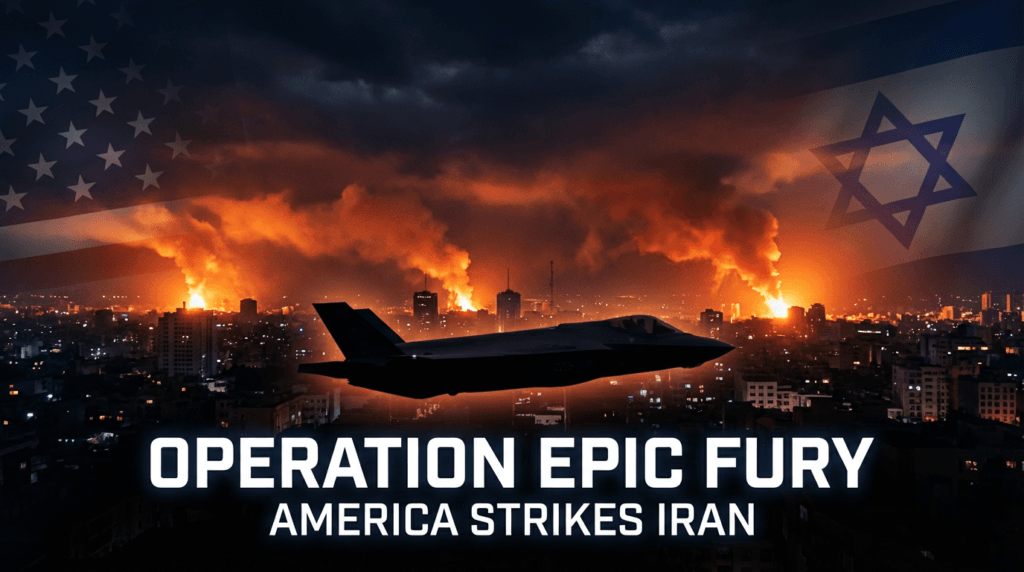
In the early hours of Saturday, February 28, 2026, the skies above Tehran lit up with fire. Explosions tore through Iran’s capital as the United States and Israel launched a joint military operation — dubbed Operation Epic Fury by the Pentagon — targeting nuclear facilities, ballistic missile arsenals, and the security infrastructure of one of the most dangerous and destabilizing regimes on earth. President Donald Trump addressed the nation, confirming “major combat operations” had begun and that the mission was “massive and ongoing.”
For months, America’s critics had warned against military action. They counseled patience. They urged more diplomacy, more concessions, more waiting. But here is the uncomfortable truth that no amount of wishful thinking can erase: Iran was given every opportunity to choose peace, and it chose defiance. The United States did not start this confrontation. It is finishing one the Iranian regime has been building toward for decades.
This is not warmongering. This is what responsible, America-first governance looks like.
Diplomacy First — Iran Said No
Before a single bomb was dropped, the Trump administration pursued diplomacy with discipline and good faith. The United States presented Iran with three clear, non-negotiable demands: a permanent end to all uranium enrichment, strict limits on its ballistic missile program, and a complete halt to its financial and military support for regional proxy terror groups — including Hamas, Hezbollah, and the Houthis.
These were not unreasonable demands. They were the minimum conditions for a world in which American service members, regional allies, and civilians could live without the constant shadow of Iranian aggression.
The latest round of negotiations concluded in Geneva on February 26, 2026 — just two days before the strikes — without a deal. Iran rejected every substantive proposal on the table: transferring enriched uranium abroad, halting enrichment, and dismantling key nuclear sites. Tehran offered only a temporary freeze — a stalling tactic dressed up as compromise. When President Trump publicly asked why Iran would not “capitulate” on its nuclear ambitions, Iranian Foreign Minister Abbas Araghchi replied with breathtaking arrogance: “Curious to know why we do not capitulate? Because we are IRANIAN.”
That is not the language of a nation seeking peace. It is the language of a regime that has made a calculated decision to gamble with the lives of its own people — and with the security of the world. When diplomacy fails because one party refuses to engage in good faith, the responsible course is strength — not surrender.
The Nuclear Threat Is Real and Urgent
Some will argue the threat was overstated. The facts say otherwise.
At the time of the strikes, Iran possessed an arsenal of over 2,000 ballistic missiles scattered across the country — weapons capable of striking U.S. military bases and personnel throughout the Middle East. The White House formally declared, in a February 6, 2026 Executive Order, that Iran’s actions constitute a “continuing unusual and extraordinary threat to the United States.” That is not political rhetoric. It is a legal and national security designation backed by hard intelligence.
Iran is, by any credible measure, the world’s leading state sponsor of terrorism. For years, Tehran has funded, trained, and directed proxy militias across the region — groups that have killed and wounded American soldiers, destabilized sovereign nations, and deliberately targeted civilians. A nuclear-armed Iran would not simply be a threat to Israel. It would be an existential threat multiplier for every American deployed in the region, every ally we are treaty-bound to defend, and every taxpayer footing the bill for a military forced to operate under perpetual threat.
The cost of inaction is not abstract. It is measured in American lives and American dollars. Fiscal accountability demands we ask: what is the true price of allowing a terror-sponsoring regime to acquire a nuclear weapon? The answer is a figure no treasury could absorb and no generation should be asked to pay.
A Regime That Murders Its Own People
Beyond the nuclear calculus lies a moral one — and conservatives should not shy away from it.
Beginning in December 2025, the Iranian people rose up in nationwide protests, driven to the streets by a collapsing economy, a currency in freefall, and decades of brutal misrule. The regime’s response was not reform. It was massacre. According to Iran International, more than 36,500 Iranians were killed by security forces during the January 8–9 crackdown alone — making it, in the words of Amnesty International, “the deadliest period of repression by the Iranian authorities in decades.” Human Rights Watch documented a “tsunami of arbitrary arrests and enforced disappearances,” with more than 53,000 people detained, including activists, lawyers, and journalists. Among those sentenced to death: a 19-year-old named Mohammad-Amin Biglari — one of at least seven young Iranians condemned for the crime of demanding freedom.
Conservatives believe in law and order — and they understand that legitimate governance requires the consent of the governed. A regime that massacres its own citizens by the tens of thousands has forfeited any claim to legitimacy. When the bombs fell on Tehran, reports emerged that Iranian citizens responded not with grief, but with laughter and celebration — some cheering at a strike near the Supreme Leader’s compound. That is the voice of a people who have been waiting for justice.
Traditional values are not only about protecting one’s own family and community. They are about recognizing the God-given dignity of every human being — including those who have lived for decades under the boot of a theocratic tyranny.
Strength Over Appeasement: The Trump Doctrine at Work
History has a clear lesson when it comes to Iran: appeasement does not work.
In 2015, the Obama administration signed the Joint Comprehensive Plan of Action — the Iran nuclear deal — offering Tehran billions in sanctions relief in exchange for temporary, reversible limits on enrichment. The result? Iran used the freed-up resources to accelerate its support for regional proxies, expand its missile program, and bide its time before resuming full nuclear activity. In 2018, President Trump withdrew from that failed agreement, re-imposed maximum pressure, and designated Iran’s Islamic Revolutionary Guard Corps (IRGC) as a Foreign Terrorist Organization — a long-overdue recognition of reality.
Upon returning to office, Trump restored that maximum pressure framework immediately. When Iran continued pushing forward with its nuclear ambitions in mid-2025, Trump authorized Operation Midnight Hammer, which struck Iran’s nuclear facilities and significantly degraded Tehran’s capabilities. Even after that, the administration returned to the table and gave diplomacy another chance in Geneva. Iran walked away.
Operation Epic Fury is not an impulsive act of aggression. It is the logical and principled conclusion of a doctrine that takes American security seriously — one that understands peace is not achieved through concession, but through credible, demonstrated strength. This is what limited but effective government action looks like on the world stage: targeted, purposeful, and unapologetically in defense of American interests and values.
What’s at Stake for Every American
The stakes of this moment extend far beyond the Middle East.
A nuclear-armed Iran would permanently alter the global security landscape in ways that hit Americans directly — through higher defense spending, greater risks for deployed military personnel, and an emboldened network of terror proxies operating under a nuclear umbrella. The Iranian regime has made no secret of its contempt for America. “Death to America” is not a slogan. It is a state policy, repeated from government pulpits and etched into the regime’s founding ideology.
Fiscal conservatives should understand this clearly: preventing a nuclear Iran now is exponentially less costly than managing one tomorrow. The price of decisive action today is far lower than the price of paralysis and regret.
For Americans who believe in law and order — at home and abroad — this moment also matters because it sends a message to every adversary watching: the United States will not be threatened, manipulated, or worn down by regimes that bet on American hesitation. Deterrence is only credible when it is occasionally demonstrated.
America Did Its Duty — Now Do Yours
Operation Epic Fury did not begin with bombs. It began with patience — with diplomacy pursued in good faith, with warnings clearly delivered and repeatedly ignored, and with a regime that chose terror over peace, repression over reform, and nuclear ambition over the lives of its own people.
America did not choose this fight. But America did not run from it, either. And that is something worth defending.
The world is watching how the United States conducts itself in this moment — and so are our enemies. Now is not the time for doubt or division. It is the time to stay informed, speak clearly, and stand firm in the values that have always made this nation worth defending.
Share this article with fellow Americans who believe in a strong, principled foreign policy. Stay engaged with trusted, independent news sources as this situation continues to develop. Contact your representatives and make your voice heard in support of an America that leads from the front, not from the sidelines. And subscribe to stay informed — because in moments like this, an educated citizenry is the most powerful force of all.
The price of freedom has never been passivity. It has always been courage.