Did Iran Just Blow Up the Ceasefire? IRGC Strikes U.S. Bases in Kuwait and Bahrain
The missiles flew between 2 and 3 a.m. The sirens followed. And by morning, the fragile truce holding the 2026 Iran War together was staring into the abyss — again.
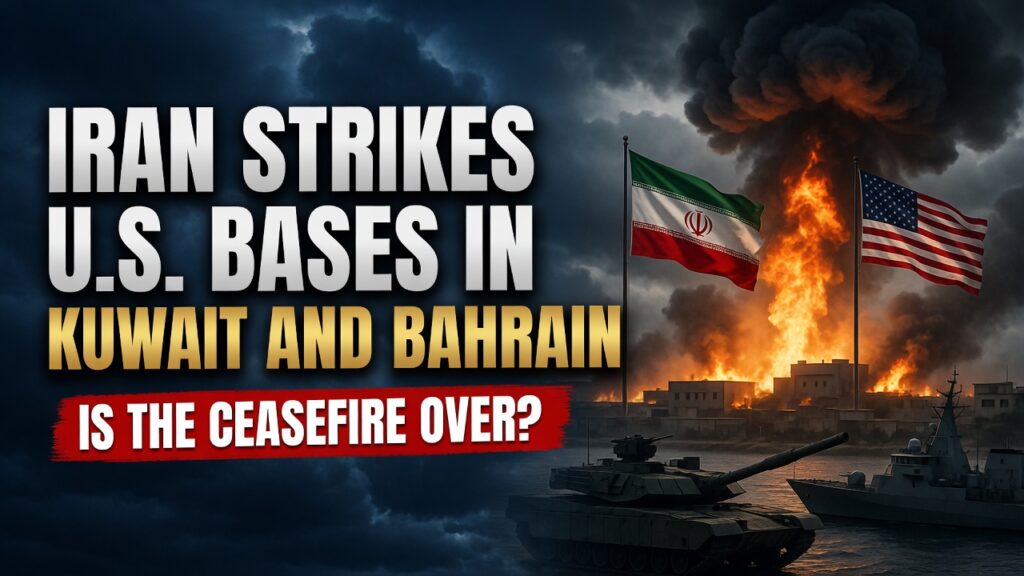
Iran’s Islamic Revolutionary Guard Corps launched a coordinated barrage of ballistic missiles and drones against two of America’s most strategically vital military installations in the Gulf: Ali Al Salem Air Base in Kuwait and the U.S. Fifth Fleet headquarters at Port Salman in Bahrain. The IRGC called it a “decisive response.” The U.S. called it a ceasefire violation. And analysts are now warning of a domino effect that neither side seems capable of stopping.
This is Day 121 of a war that was supposed to be winding down.
Support Independent Local Journalism
TheTownHall.News is a non-profit reader-supported journalism. Just $5 helps us hire local reporters, investigate important issues, and hold public officials accountable across Alameda County. If you believe our community deserves strong, independent journalism, please consider donating $5 today to support our work.What Triggered the June 28 Attack — and Why the Timeline Matters
The chain of events leading to Sunday’s strikes began three days earlier, when Iran’s IRGC launched a one-way attack drone that hit the Singapore-flagged cargo ship M/V Ever Lovely as it exited the Strait of Hormuz near the Omani coast on June 25. No injuries were reported, but the symbolic damage was severe: Iran had just struck a commercial vessel in the very waterway a ceasefire agreement was supposed to reopen.
The U.S. did not wait. On June 26, CENTCOM struck Iranian missile and drone storage facilities and coastal radar sites in response — describing it as a “powerful response” to Iran’s “dangerous behavior.” Iran struck back the following day. The U.S. struck again. And at 2 a.m. on Sunday, June 28, the IRGC launched what it claimed was a large-scale joint naval and aerospace operation targeting eight U.S. military installations across Kuwait and Bahrain.
The IRGC’s public statement, carried by state broadcaster IRIB, was pointed: “Your zealous sons in the IRGC’s naval and air forces… destroyed eight important infrastructures of the child-killing U.S. army at the Ali Al Salem base in Kuwait and the Fifth Naval Fleet in Port Salman, Bahrain.”
That language — calling the U.S. army “child-killing” — is not incidental. It is a direct reference to an airstrike early in the war that killed students at a girls’ school in Minab, Iran. Tehran has been invoking that strike consistently in its domestic communications ever since.

What Actually Happened on the Ground
The gap between what Iran claimed and what was independently confirmed is significant — and matters for accountability journalism.
In Kuwait: The Army General Staff said its air defense systems intercepted “hostile missile and drone attacks,” advising residents that explosion sounds were from interceptions. U.S. officials confirmed two Iranian missiles fell apart en route and that American forces “downed multiple drones” targeting U.S. personnel. No injuries or significant damage were reported at the base.
In Bahrain: Warning sirens activated across the capital, Manama. Bahrain’s Defense Ministry said its military intercepted and destroyed three missiles and multiple drones. An Iranian drone did damage a residential building near Bahrain International Airport — but the building was not near Fifth Fleet headquarters. No fatalities were reported.
The IRGC’s claim that eight U.S. military installations were “destroyed” is not supported by independent reporting.
A U.S. official told Reuters there were no reported American casualties or major damage. CENTCOM confirmed commercial vessel traffic through the Strait of Hormuz continued after the exchange.
Support Independent Local Journalism
TheTownHall.News is a non-profit reader-supported journalism. Just $5 helps us hire local reporters, investigate important issues, and hold public officials accountable across Alameda County. If you believe our community deserves strong, independent journalism, please consider donating $5 today to support our work.This matters: Iran has a well-documented pattern of overstating operational results in public IRGC statements, particularly during periods of domestic pressure. The claim of “decisive response” serves an internal audience as much as a strategic one.
The Ceasefire That Keeps Not Ceasefiring
To understand Sunday’s attack, you need to understand the legal document both sides are now accusing the other of violating.
On June 17, President Trump and Iranian President Masoud Pezeshkian signed a 14-point Memorandum of Understanding at the Palace of Versailles. The MOU — brokered after months of brutal fighting that began February 28 with U.S.-Israeli strikes that killed Supreme Leader Ali Khamenei — gave both sides 60 days to negotiate a permanent end to the conflict.
Article 5 is the central flashpoint. It states that Iran will “make arrangements using its best efforts for the safe passage of commercial vessels” through the Strait of Hormuz during the 60-day window. Iran interprets this as confirmation that it retains sovereign oversight of the waterway. The U.S. interprets it as Iran agreeing to simply let ships through — without a veto.
That interpretive gap has now produced a shooting war within a ceasefire.
On June 27 — just days after signing — the Joint Maritime Information Center, overseen by the U.S. Navy, announced an expanded transit route near Oman for inbound and outbound traffic. Tehran called it a unilateral violation of the MOU. Iranian Foreign Minister Abbas Araghchi warned Sunday that “any attempt to adopt new or separate arrangements compared to what is underway by the Islamic Republic of Iran will only lead to more complicated situations and delays in the reopening of the Strait of Hormuz.”
Iran also skipped technical ceasefire talks scheduled for Sunday, citing U.S. non-compliance with financial provisions — including questions about access to previously frozen Iranian funds.
The ceasefire is being observed the way Trump himself described it in early June: “I’d say in that part of the world a ceasefire is when you’re shooting in a more moderate manner.”
Lebanon: The Variable No One Accounted For
The MOU contains a provision that has become a structural fault line: it requires the war to end “on all fronts, including in Lebanon.” But Israel was not party to the MOU negotiations. Neither was Hezbollah.
On June 26 — the same day the U.S. struck Iran over the Ever Lovely attack — Israel and Lebanon signed a separate trilateral framework agreement with Washington, facilitated by Secretary of State Marco Rubio. Israel continued airstrikes in southern Lebanon within 24 hours. Hezbollah said the ceasefire did not apply as long as Israeli forces remained on Lebanese soil.
Iran’s position: the trilateral deal contradicts the MOU and proves the U.S. is not fulfilling its obligations. The U.S. position: Lebanon is a separate track. Israel’s position: Lebanon was never part of the deal.
Three governments. Three interpretations. One document.
Iranian Foreign Minister Araghchi said Sunday that the U.S. must force Israel to halt attacks and withdraw from Lebanon before Iran will return to full talks. Israeli military chief Eyal Zamir, meanwhile, approved plans for “continued operations in the security zone” in Lebanon — explicitly framing the occupation as consistent with the ceasefire agreement.
The Regional Stakes: Gulf States Caught in the Middle
Kuwait and Bahrain are not passive bystanders. They host the infrastructure on which American military presence in the Gulf depends — and they are paying for it.
Kuwait described Sunday’s attack as “repeated heinous Iranian aggressions” constituting a “flagrant violation of its sovereignty.” Bahrain said the strikes “violated its sovereignty and undermined opportunities for de-escalation.” The UAE called them a “blatant violation.” Qatar condemned the attacks while simultaneously launching a search and rescue operation after a Qatari coastguard vessel failed to return — one Qatari citizen was later confirmed dead from shrapnel wounds linked to the military exchanges.
These are not abstract diplomatic statements. Since the war began on February 28, Gulf states have absorbed a staggering toll: by March 31, the cost to Arab countries was estimated at $120 billion. Kuwait International Airport — which had only just reopened in early June after months of closure — was hit again by Iranian drones in early June, killing one Indian national and wounding 63 others.
The Gulf states allied with the U.S. are hosting a war they did not choose, on a timeline they cannot control.
The Counterargument: Is Iran’s Position Legally Defensible?
Iran’s case is not without logic, even if its execution involves ballistic missiles in the early hours of the morning.
The IRGC’s core argument is that the U.S. struck Iranian territory first — hitting five coastal outposts — and that Iran’s response was therefore lawful retaliation, not a ceasefire violation. Tehran maintains that the MOU explicitly preserves its authority over Strait of Hormuz navigation, and that the U.S. Navy’s unilateral expansion of transit corridors near Oman constitutes the actual breach.
The IRGC also warned explicitly: “The enemy should understand that violating the ceasefire constitutes a breach of Clause One of the Islamabad understanding and will result in the complete suspension of all related processes.”
Tehran-based political analyst Abas Aslani told Al Jazeera that Iran views the Strait as its primary deterrent against future U.S. attacks — and that giving it up without binding security guarantees would leave Iran militarily exposed at the negotiating table.
From Iran’s perspective, the Strait is not a trade issue. It is an existential insurance policy.
Key Questions
- Who fired first on June 28? CENTCOM says U.S. struck Iranian targets first that day, in response to prior Iranian attacks on commercial shipping. Iran says U.S. struck its coastal outposts in violation of the MOU. Both are citing earlier provocations. The escalation cycle is its own answer.
- Did Iran actually destroy eight U.S. installations? No independent source has confirmed the IRGC’s claim. U.S. officials reported no casualties and no significant damage.
- What happens to the 60-day negotiating window? Iran has now threatened a “complete halt” to talks if U.S. strikes continue. With the window already strained by the Lebanon dispute, that threat is increasingly credible.
- Is the Strait of Hormuz actually open? Technically yes — but conditionally, contested, and with Iran still asserting traffic control authority. The “dual blockade” dynamic that characterized much of the war has not fully dissolved.
- Where does Trump’s “complete the job” threat stand? On Saturday, Trump warned the U.S. military would “complete the job” if Iran doesn’t comply with the ceasefire. He has issued similar threats repeatedly since February without follow-through. Markets are watching.
What Comes Next
Hassan Ahmadian, an associate professor at the University of Tehran, was blunt in his assessment: “I think we’re up for escalation because, obviously, the Iranians will retaliate.”
As of Sunday evening, Iran had skipped the scheduled conflict control talks. The IRGC had warned that future U.S. attacks would result in a “crushing response broader than this.” Israeli forces had struck two locations in southern Lebanon. And the ceasefire — now on its 11th day — was producing the same question it has produced through every prior iteration:
Is this a war that’s ending, or a war that’s being paused in between escalations?