Yamaha’s California Exodus: After 50 Years, Another Corporate Giant Votes With Its Feet
When a Company Walks Away, It Is Trying to Tell You Something
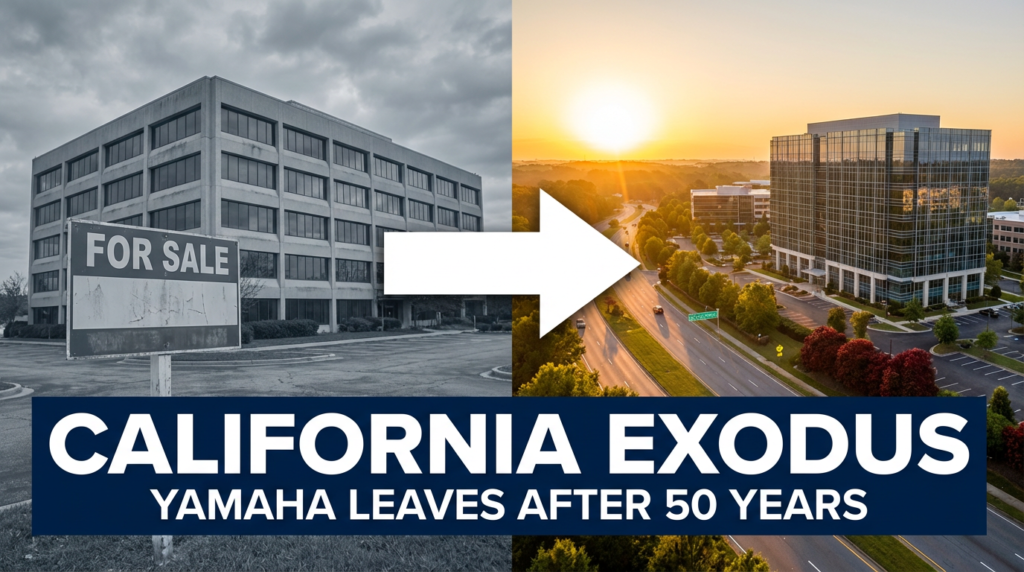
There is a moment in the life of every overreaching government when the institutions it governs stop complaining and simply leave. California has been collecting those moments for years. The latest comes from Yamaha Motor Corporation, U.S.A. — one of the most storied names in American motorsports — which announced in February 2026 that it is abandoning its longtime headquarters in Cypress, California, and relocating to Kennesaw, Georgia.
After nearly half a century in Orange County, Yamaha is done. The company’s sprawling 25.1-acre campus on Katella Avenue — nearly 279,000 square feet of office, industrial, and warehouse space spanning an entire city block — has been listed for sale. The move will unfold in phases from late 2026 through 2028 and will directly affect approximately 250 workers.
This is not merely a business story. It is a policy verdict — and California’s leaders should be required to sit with it.
Support Independent Local Journalism
TheTownHall.News is a non-profit reader-supported journalism. Just $5 helps us hire local reporters, investigate important issues, and hold public officials accountable across Alameda County. If you believe our community deserves strong, independent journalism, please consider donating $5 today to support our work.The Facts Are Not in Dispute
Yamaha Motor Co., Ltd., the Japan-based parent company, made the announcement on February 26, 2026, framing the relocation as part of broad “structural reforms” aimed at improving profitability and asset efficiency in the United States. The company cited mounting costs — including the impact of U.S. tariffs that contributed to a staggering 30.4% drop in operating profit in 2025 — and the straightforward logic of operational consolidation.
Company spokesman Bob Starr put it plainly: “In terms of efficiency, to have us all together in Georgia — all the functions of the business — it makes a lot of sense.”
That is not political grievance. It is a well-managed company making a rational, numbers-driven decision. Georgia already hosts Yamaha’s marine division (moved there in 1999) and its motorsports operations (moved in 2019). The company also manufactures its ATVs and side-by-sides in Newnan, Georgia. What remained in Cypress — corporate administration and financial services — was the last piece of a puzzle assembling itself eastward for over two decades. Yamaha is not slamming the door on California. It is quietly and permanently closing it.
California Made This Decision Easy
To understand why Yamaha chose Georgia, you must first understand what California demands of the businesses that remain there.

The state imposes a top corporate tax rate of 8.84% — among the highest in the nation — and a top personal income tax rate of 13.3%, the steepest of any state in the country. The Tax Foundation has consistently ranked California among the worst states in America for business tax climate. Commercial real estate in the Los Angeles region ranks among the most expensive on earth. And California’s regulatory environment, anchored by statutes like the California Environmental Quality Act (CEQA), is notorious for adding years and millions of dollars to projects that other states approve in months.
The Public Policy Institute of California tracked 789 company headquarters leaving the state between 2011 and 2021, with departures accelerating after 2017 and the number of firms moving in nearly cut in half over the same period. In 2024 and 2025 alone, the departures included Chevron, SpaceX, X (formerly Twitter), Realtor.com, and John Paul Mitchell Systems — each citing the same combination of punishing taxes, excessive regulation, and unsustainable costs. Yamaha’s departure is not an outlier. It is a continuation.
A City That Has Seen This Before
Cypress has been here before. In 2019, Mitsubishi Motors North America ended its 31-year run in the city, relocating approximately 200 jobs to Franklin, Tennessee. Now Yamaha — one of the very first companies to locate in the Cypress Business Park in 1980 — is following the same road east.
City Planning Director Alicia Velasco responded with grace: “Yamaha has been an important part of our business community for more than 40 years. We thank Yamaha for its long-standing partnership and look forward to working with its management to transition the site to new ownership.”
That is a dignified response to a painful reality. But dignity does not replace the jobs, the tax base, or the civic identity that an anchor employer provides. Some of those 250 affected workers will relocate to Georgia. Many will not. For those who built careers and household stability around Yamaha’s Orange County campus, this is not an abstraction — it is real disruption arriving at real kitchen tables.
Support Independent Local Journalism
TheTownHall.News is a non-profit reader-supported journalism. Just $5 helps us hire local reporters, investigate important issues, and hold public officials accountable across Alameda County. If you believe our community deserves strong, independent journalism, please consider donating $5 today to support our work.Personal responsibility and honest work are foundational conservative values. They deserve a government serious enough to protect the conditions in which hard work is rewarded — not one so consumed by spending and regulation that it drives employers away and leaves workers behind.
What Georgia Is Getting Right
The more instructive question may be the one California refuses to ask itself: what is Georgia doing differently?
Georgia has cultivated one of America’s most competitive business climates through deliberate, principled policy. The state has actively lowered its corporate tax rate and invested in infrastructure and workforce development to attract exactly the kind of long-term corporate investment Yamaha represents. Cobb County, home to Kennesaw, has built a reputation as one of the most business-friendly jurisdictions in the Southeast. Georgia does not treat business as a burden to be managed. It treats it as an engine of community prosperity.
This is limited government working as it should — governance disciplined enough to recognize its proper role: create a stable, predictable environment for enterprise and let people build.
The contrast with California could not be sharper. Lawmakers in Sacramento are actively debating a proposed 5% wealth tax on billionaires so aggressive that even Governor Gavin Newsom publicly warned it would trigger a mass departure of the state’s highest earners. When a sitting governor cautions his own legislature against its own tax proposals, that is not a policy disagreement. That is a governing crisis unfolding in plain sight. Fiscal accountability is not a slogan. It is the foundation of every state currently winning the competition for investment, talent, and sustainable growth.
The Verdict the Market Has Already Delivered
Markets are honest in ways that politics rarely are. Every corporate relocation is a vote cast in the most consequential currency available: jobs, investment, and long-term commitment to a community.
Yamaha first established its American presence in Los Angeles in 1960. It built a landmark campus in Cypress and helped shape motorsports culture in the United States for generations. Its departure is not a betrayal of California. It is a response — measured, logical, and long overdue — to a state that has made itself too expensive, too unpredictable, and too hostile to business to justify staying.
California has extraordinary natural advantages — world-class universities, an innovation culture, unmatched geography. None of those assets vanish when Yamaha leaves. But none are enough to overcome a government that treats every business as a revenue source rather than a community partner. The principles that drove American economic greatness — limited government, fiscal discipline, and respect for the people who create jobs — are not relics. They are the operating model of every state currently winning. California once understood this.
Conclusion: The Message Is Clear. Will Sacramento Listen?
Yamaha’s exit from California after nearly 50 years closes a chapter that generations of workers and enthusiasts helped write. It also sends a message that no press release or campaign promise can obscure.
When a company of this history concludes that the savings available in another state outweigh half a century of roots, the calculation speaks for itself. The market has rendered its judgment. California still has time to reverse course — but only if its leaders are willing to make the principled choices serious governance requires: cutting spending, streamlining regulation, and treating business as a public good. The states competing for California’s departing companies already figured this out.
The moving trucks are the evidence. It is time Sacramento read the bill.
Call to Action
The Yamaha story is one chapter in a much larger book — and new pages are being written every month.
If you believe businesses deserve a government that works with them rather than against them, that workers deserve leaders who fight to keep good employers in their communities, and that fiscal responsibility is non-negotiable — this story matters to you. Share this article with someone who needs to understand the real cost of runaway government. Stay informed about the ongoing corporate flight from high-tax, overregulated states. And hold your elected representatives accountable at every level for the policy choices that are redrawing America’s economic map, one headquarters at a time.
The market has spoken. It is time our leaders listened.