
ADCOP Pipeline Fire: Iran’s Strike on the UAE’s Hormuz Bypass Is a Threat to Global Energy Security
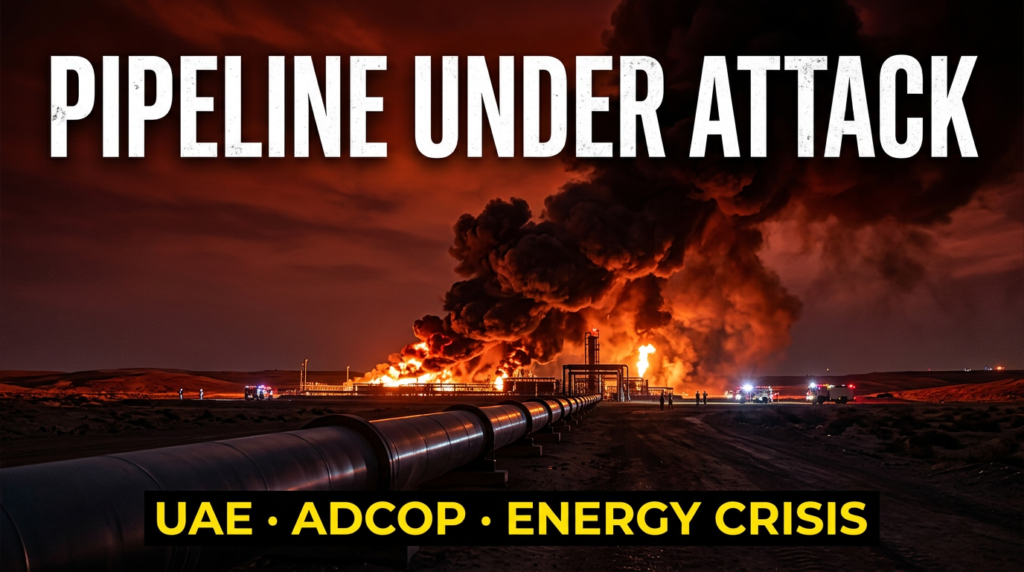
The fires burning along the UAE’s Habshan–Fujairah pipeline aren’t an accident — they’re a calculated strike on the world’s last major oil bypass route. Every American filling up at the pump will feel the consequences.
The smoke rising from two pumping stations along the Abu Dhabi Crude Oil Pipeline (ADCOP) on March 30 should alarm every household in the Western world — not just energy traders and geopolitical analysts. Satellite imagery confirmed fires at the facilities along the 380-kilometer pipeline, the critical artery built specifically to route Emirati oil around the Strait of Hormuz. No one has formally claimed responsibility. No official cause has been confirmed. But the pattern is unmistakable.
Iran has spent the past month methodically dismantling the global energy infrastructure that the free world depends on. First, it closed the Strait of Hormuz. Then it struck the UAE’s Fujairah oil terminal, Qatar’s Ras Laffan LNG hub, and ADNOC’s Ruwais refinery — the largest in the UAE. Now, the bypass route that was supposed to be the contingency plan is on fire. This is not escalation. This is a strategy.
Support Independent Local Journalism
TheTownHall.News is a non-profit reader-supported journalism. Just $5 helps us hire local reporters, investigate important issues, and hold public officials accountable across Alameda County. If you believe our community deserves strong, independent journalism, please consider donating $5 today to support our work.The Pipeline That Was Supposed to Be the Answer
ADCOP was never just an oil pipeline. It was a geopolitical insurance policy.
Built in 2012 specifically to circumvent Hormuz, the pipeline carries between 1.5 and 1.8 million barrels of crude per day from the Abu Dhabi interior directly to the port of Fujairah on the Gulf of Oman — no strait required. When Iran effectively closed Hormuz on March 4, triggering what analysts at Bloomberg have called the largest oil supply disruption in history, ADCOP became the UAE’s lifeline. It was running near full capacity.
Now that lifeline has been targeted.
The Bloomberg analysis tells the story in numbers that should be pinned to the wall of every Treasury and Energy ministry in the Western world: the Hormuz closure created an 18.4 million barrel-per-day shortfall. IEA stockpile releases, diverted Saudi flows, and offshore reserves partially offset that figure to roughly 11.1 million barrels per day net — but only barely. Oil is already trading near $116 per barrel, up 60% since the conflict began. Analysts warn prices could reach $200 per barrel if the crisis extends beyond three to four months.

If ADCOP goes offline, that math gets significantly worse.
A Deliberate Strategy, Not Collateral Chaos
The fires along ADCOP aren’t random. They represent a strategic pivot that should command far more attention than it is currently receiving.
Iran’s initial logic was straightforward: close Hormuz, the chokepoint through which roughly 20% of global oil and LNG flows, and weaponize the world’s energy dependency. When Gulf producers and their allies responded by redirecting flows through alternative corridors — ADCOP to Fujairah, Saudi Arabia’s East-West Pipeline to Yanbu — Iran adapted. The new targets are the workarounds themselves.
Targeting bypass infrastructure is the geopolitical equivalent of blocking the emergency exit after locking the front door.
Earlier this month, strikes damaged the Fujairah oil terminal and forced ADNOC to temporarily suspend oil-loading operations. Qatar’s largest LNG liquefaction plant reportedly suffered missile damage severe enough to raise questions about a multi-year repair timeline, threatening roughly 20% of global LNG capacity. Saudi Arabia’s East-West Pipeline — the other major bypass route, diverting up to 60% of the Kingdom’s exports to Yanbu on the Red Sea — is now under heightened threat assessment.
Support Independent Local Journalism
TheTownHall.News is a non-profit reader-supported journalism. Just $5 helps us hire local reporters, investigate important issues, and hold public officials accountable across Alameda County. If you believe our community deserves strong, independent journalism, please consider donating $5 today to support our work.This is not chaos. It is a coordinated campaign to eliminate every viable exit from the Gulf for Western-aligned energy exports.
What It Costs Every Household
The broader political debate over Middle East policy often feels abstract to the average American family. The ADCOP fires should end that abstraction.
U.S. consumer price inflation jumped to 3.4% year-over-year in March 2026 — up from 2.4% the previous month — driven in significant part by energy costs. Diesel and jet fuel prices have topped $200 per barrel. According to Bloomberg’s economic modelling, oil sustained at $170 per barrel would add one percentage point to inflation and shave 0.6% from eurozone GDP. Weaker European economies mean weaker trading partners, slower export markets, and a global economic drag that Americans will absorb.
This is fiscal reality, not fearmongering. Energy is not a luxury commodity. It heats homes, moves food from farms to grocery shelves, and powers the supply chains that keep consumer goods affordable. Every barrel taken offline in Fujairah is a cost transferred directly onto working families who had no vote in Tehran’s strategic calculations.
The people least able to absorb an energy price shock are always the first to feel it — and the last to be consulted before the decisions that caused it were made.
What Critics Get Wrong
Some voices argue that Western military involvement in the region — or energy dependence on Gulf allies — is itself the root cause of instability, and that the solution is disengagement, green energy transition, or diplomatic overture to Tehran.
These arguments deserve a fair hearing — and a clear response.
First, energy transitions happen over decades, not months. The U.S. and its allies cannot simply pivot away from Gulf oil on a crisis timeline. Pretending otherwise does not protect families from $6-per-gallon gasoline. Second, diplomatic overture requires a willing counterparty. Iran has spent March 2026 striking civilian energy infrastructure from the UAE to Qatar while threatening to “irreversibly destroy” essential facilities across the region if the U.S. escalates further — per statements reported by The Guardian. The record of recent weeks does not suggest a regime currently interested in negotiated de-escalation.
Acknowledging complexity does not require abandoning clarity. Iran is targeting civilian infrastructure that serves the global economy. That is a fact, not a framing.
The Eastern Pipeline Is Next — And the West Needs to Say So
Analysts are already watching Saudi Arabia’s East-West Pipeline with growing anxiety. If Iran successfully degrades ADCOP and sustains pressure on Fujairah, the Yanbu corridor becomes the only major remaining bypass route for Gulf crude. Should that pipeline face a serious strike — particularly in combination with instability in the Bab al-Mandeb strait off Yemen — the remaining partial offsets to the Hormuz closure would effectively collapse.
Six Western nations, including the UK, France, and Germany, issued a joint statement on March 19 calling on Iran to cease attacks on maritime traffic and energy infrastructure. The statement was measured and multilateral. It was also, by all observable evidence, ignored.
Words are not pipelines. The West’s credibility as a guarantor of energy security — and by extension, economic stability — will be judged by what it does to deter the next strike, not the statements it issues after the last one.
Key Takeaway
The ADCOP pipeline fires are not a sideshow. They are the leading edge of a strategy designed to eliminate every alternative to Hormuz for Gulf energy exports. With oil near $116 per barrel and global supply already down by nearly 11 million barrels per day, the margin for further disruption is razor-thin. The cost of inaction is now measured at the pump, on grocery receipts, and in the household budgets of ordinary citizens who deserve an honest accounting of what is at stake.
Conclusion: Energy Security Is National Security
The fires along ADCOP represent something more fundamental than an infrastructure incident in a distant country. They represent a direct challenge to the economic scaffolding on which modern life is built.
Free markets, personal prosperity, and the fiscal stability of governments depend on accessible, affordable energy. When Iran targets the pipeline that was designed to keep that energy flowing even in a worst-case scenario, it is not simply attacking the UAE. It is attacking the economic foundation that enables everything else — jobs, family budgets, public services, and the kind of ordered, stable society that makes civic life possible.
The response demands clarity of purpose, honest communication with the public, and the political will to protect the infrastructure the free world depends on. The alternative — hoping the fires burn themselves out — is not a strategy. It is a surrender.
Stay informed on stories like this one. Share this article with someone who needs to understand what’s really at stake in the Gulf. Independent journalism depends on engaged readers — subscribe, share, and make your voice heard.