House Passes Deporting Fraudsters Act: A Long-Overdue Defense of American Taxpayers
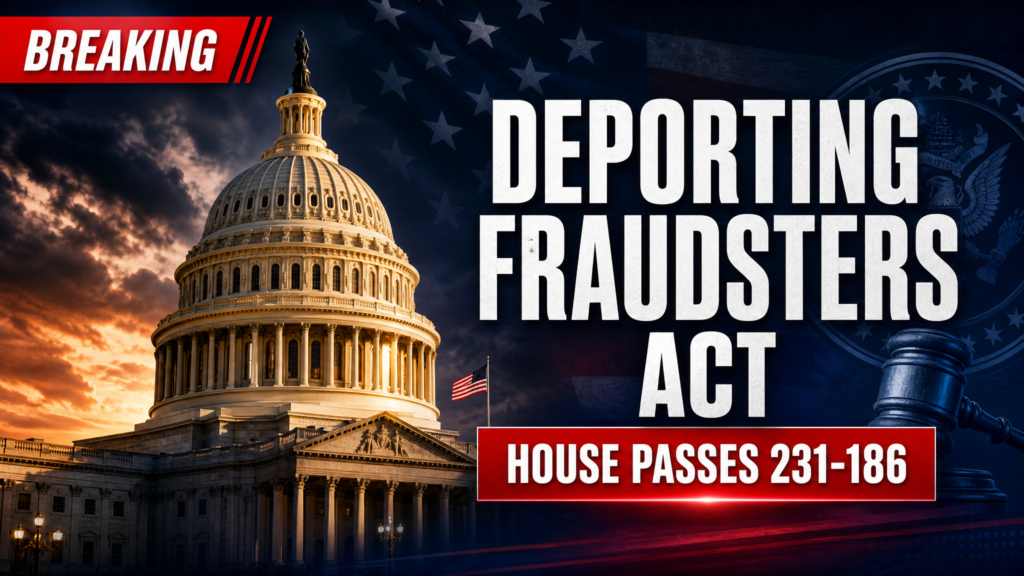
The House just voted 231–186 to make benefit fraud a deportable offense for illegal immigrants. The bill now heads to the Senate — and the political battle reveals exactly where each party stands on protecting taxpayer dollars.
For years, hardworking Americans have watched a familiar story play out: federal welfare programs designed for vulnerable citizens get drained by waste, fraud, and abuse, while Washington shrugs and asks taxpayers for more. On March 18, 2026, the U.S. House of Representatives finally took a concrete step to stop one specific abuse — and the resulting vote tells you everything you need to know about the current state of American politics.
The House passed the Deporting Fraudsters Act of 2026 (H.R. 1958) by a margin of 231–186, making it explicit federal policy that illegal immigrants convicted of defrauding U.S. benefit programs become deportable and permanently inadmissible. The bill, sponsored by Rep. Dave Taylor (R-OH-2), now sits with the Senate Judiciary Committee, where its real test begins.
Why This Issue Matters Right Now
This isn’t a symbolic gesture. Recent estimates from the White House Office of Management and Budget suggest the federal government loses between $233 billion and $521 billion to fraud every year across all programs. Sen. Mike Lee (R-UT) has publicly cited estimates that illegal immigrants alone receive roughly $42 billion in public benefits annually, according to the bill’s official press materials Rep. Taylor’s Office.
Support Independent Local Journalism
TheTownHall.News is a non-profit reader-supported journalism. Just $5 helps us hire local reporters, investigate important issues, and hold public officials accountable across Alameda County. If you believe our community deserves strong, independent journalism, please consider donating $5 today to support our work.State-level scandals make the abstract numbers concrete. In Minnesota, federal investigators have uncovered that more than half of $18 billion in federal social-service funds were allegedly misappropriated. California reported $181 million lost to EBT fraud, and New York exposed a $120 million Medicare and Medicaid scheme. These are not rounding errors. They are systemic failures that punish the working families whose tax dollars built these programs in the first place.
What the Bill Actually Does
The Deporting Fraudsters Act amends the Immigration and Nationality Act to close what supporters call a glaring loophole. While violent crimes have long triggered deportation, the existing statute does not explicitly list defrauding the U.S. government as a deportable offense.
Under H.R. 1958, a non-citizen becomes deportable and inadmissible if convicted of — or if they admit to committing — any of the following:
- SNAP (food stamp) fraud
- Social Security benefits fraud
- Fraud involving any federally funded program, including Medicare and Medicaid
- Production of fraudulent identification documents
Those found guilty also become ineligible for most discretionary immigration relief, according to the official bill summary Congress.gov. In plain English: if you came here illegally and stole from American taxpayers, you don’t get to stay and you don’t get to come back.

A Vote That Drew a Clear Line
The 231–186 tally is worth examining. Virtually every Republican voted yes. The overwhelming majority of Democrats — roughly 150 members — voted no. House Republican Conference Chairwoman Lisa McClain (R-MI) framed the bill bluntly in her official statement: “American taxpayers are not an ATM for criminal aliens” GOP.gov.
That line is destined to be quoted on social media for weeks, and for good reason. It captures a frustration shared by millions of Americans who believe public benefits should serve citizens and lawful residents first, not those who broke the law to enter the country and broke it again to access taxpayer-funded programs.
“Defraud the American people and you’re gone.” — Rep. Lisa McClain (R-MI)
The Principle of Personal Responsibility
At its core, this bill is about something larger than immigration policy. It’s about restoring the principle that actions have consequences — a cornerstone of any functioning civil society.
Welfare programs are funded by Americans who get up every morning, work long hours, and trust that their tax dollars will support neighbors in genuine need. When that trust is broken by fraud — particularly fraud committed by individuals who have no legal claim to be in the country — the entire social compact frays.
Personal responsibility is not a partisan concept. It used to be a shared American value. The Deporting Fraudsters Act simply reinforces what most citizens already believe: if you abuse a system designed to help the vulnerable, you forfeit your place in it.
Support Independent Local Journalism
TheTownHall.News is a non-profit reader-supported journalism. Just $5 helps us hire local reporters, investigate important issues, and hold public officials accountable across Alameda County. If you believe our community deserves strong, independent journalism, please consider donating $5 today to support our work.What Critics Get Wrong
Opponents have raised two primary objections, and both deserve a direct response.
The first argument, advanced by several House Democrats, is that the bill is redundant — that non-citizens convicted of serious fraud are already deportable under current law. This is technically partially true but practically misleading. As Rep. Mike Kennedy (R-UT) noted on the floor, “the list of crimes that make an alien deportable does not explicitly include defrauding the United States” Rep. Taylor’s Office. Existing pathways rely on prosecutorial discretion and legal interpretation. H.R. 1958 removes the ambiguity. In a system where bureaucratic gray areas routinely shield bad actors, clarity is not redundancy — it’s enforcement.
The second objection is that the bill is somehow harsh or unfair. But the bill applies only to individuals convicted of fraud or who admit to committing fraud. There is no scenario in which a law-abiding immigrant, documented or otherwise, faces consequences under this statute. The threshold is criminal conduct, not status alone.
The Real Cost of Doing Nothing
Skeptics often ask whether deportation is a proportionate response to benefits fraud. The honest answer is yes — because the harm extends far beyond the dollars stolen.
Every fraudulent SNAP claim means fewer resources for families genuinely struggling to feed their children. Every fake Medicaid enrollment means longer waits and tighter budgets for elderly Americans relying on the program they paid into for decades. Every counterfeit identification document used to access benefits also creates vulnerabilities in voter rolls, financial systems, and national security databases.
Fraud is not victimless. The victims are the citizens and legal residents these programs were designed to serve. Tolerating it isn’t compassion — it’s a quiet betrayal of the people who need help most.
How This Affects Families and Communities
Consider a single mother in Ohio working two jobs to qualify for modest SNAP assistance. She follows the rules, submits the paperwork, and waits. Meanwhile, someone who entered the country illegally — using fraudulent documents — accesses the same program without scrutiny. Her benefits shrink. Her wait times grow. Her trust in government erodes.
Multiply that story by millions of households, and you have the political moment we’re living in. The Deporting Fraudsters Act is, in part, a response to that quiet erosion of faith. It tells working families that someone in Washington still believes the system should serve them first.
The Senate Showdown Ahead
The bill’s path is uncertain. It now sits in the Senate Judiciary Committee, where the 60-vote filibuster threshold looms. A companion measure (S. 3113) was introduced in November 2025 by Sens. Ted Cruz, John Cornyn, and Mike Lee Congress.gov, but moving it to a floor vote will require sustained pressure and at least a handful of Democratic crossovers.
This is where citizen engagement matters. Senators respond to constituent communication, especially on issues where public opinion is overwhelmingly on one side. Polls consistently show Americans of all political backgrounds support stronger enforcement against benefits fraud.
Key Takeaway
The Deporting Fraudsters Act is not radical. It does not target lawful immigrants. It does not bypass due process. It simply states a common-sense principle: if you are in this country illegally and you steal from American taxpayers, you forfeit the privilege of remaining here.
That is a position rooted in fairness, fiscal responsibility, and respect for the rule of law — values that once united Americans across the political spectrum and that millions of voters are demanding their representatives uphold once again.
Stay Informed. Stay Engaged.
The Senate will decide the fate of this bill in the coming weeks. If you believe taxpayer dollars belong to taxpayers — and that public benefits should serve those who need and qualify for them — make your voice heard. Call your senators. Share this article. Talk to your neighbors.
Independent journalism survives only when citizens choose to engage rather than disengage. The Deporting Fraudsters Act is one battle in a larger fight over what kind of country we want to be. The outcome will be decided not just in the Senate chamber, but in living rooms, comment sections, and ballot boxes across America.
Stay informed. Speak up. And don’t let Washington forget who actually pays the bills.