Trump’s Alien Enemies Act Deportations: Supreme Court Battles, Gang Threat, and the Constitution at a Crossroads
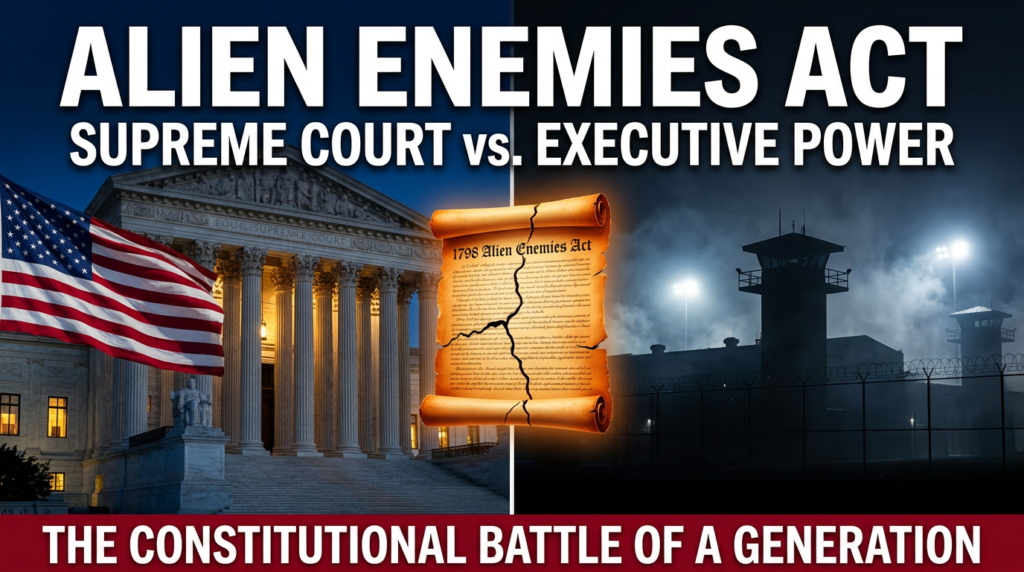
The Supreme Court handed Trump a procedural win on the 1798 Alien Enemies Act — then pumped the brakes. Here’s what every American needs to know about the most consequential immigration legal battle in a generation.
It happened just after 1 a.m. on April 19, 2025. The Supreme Court of the United States issued an emergency overnight order — the kind that interrupts sleep and makes history simultaneously — blocking the Trump administration from deporting a group of Venezuelan detainees to El Salvador’s CECOT mega-prison. Less than two weeks earlier, the same Court had appeared to clear the runway for those very deportations.
Welcome to the most legally turbulent immigration battle in a generation. The Trump administration’s use of the 1798 Alien Enemies Act to target alleged members of Tren de Aragua, a violent Venezuelan criminal organization, has exploded into a constitutional showdown touching the boundaries of executive power, the rule of law, national security, and the rights of individuals on U.S. soil. For Americans who believe in limited government, law and order, and personal accountability — this case forces a hard but necessary reckoning.
Support Independent Local Journalism
TheTownHall.News is a non-profit reader-supported journalism. Just $5 helps us hire local reporters, investigate important issues, and hold public officials accountable across Alameda County. If you believe our community deserves strong, independent journalism, please consider donating $5 today to support our work.What the Alien Enemies Act Actually Says — and Why It Matters
The Alien Enemies Act has sat largely dormant in American law since 1798. It was invoked during the War of 1812, World War I, and World War II — periods of declared, unambiguous armed conflict. It grants the president sweeping authority to detain or deport nationals of an enemy nation during wartime or invasion. Three uses in over two centuries.
On March 14, 2025, President Trump signed an executive order invoking the Act against alleged members of Tren de Aragua, arguing the gang constitutes a “predatory incursion” linked to the Maduro regime in Venezuela. The strategy was deliberately bold: use a wartime statute to bypass the slow machinery of standard immigration proceedings and accelerate removals to El Salvador’s CECOT detention facility.
Supporters rightly argue that Tren de Aragua is no ordinary street gang. Designated as a Foreign Terrorist Organization by the Trump administration, TdA has been tied to human trafficking, drug smuggling, extortion, and violent crimes across multiple U.S. cities. The Department of Justice confirmed a nationwide crackdown on TdA operations through 2025. DHS reported deporting documented TdA members, sexual predators, and violent offenders in coordinated operations. The gang’s presence in American communities — from Aurora, Colorado, to New York — is not a political invention. It is a documented public safety threat.
The Supreme Court: One Step Forward, Two Steps Back
On April 7, 2025, the Supreme Court issued its first major ruling in Trump v. J.G.G., giving the administration a significant procedural victory. The Court vacated a nationwide restraining order that had frozen the deportations and ruled that legal challenges must be filed via habeas corpus — in the specific federal district where each detainee is held. No more blanket, nationwide injunctions thrown up by a single sympathetic judge.

This was a genuine win for executive authority and a rebuke of judicial overreach by district courts acting as one-person veto machines against national policy.
But the Court did not stop there. It mandated that the government provide detainees with clear notice and a “meaningful opportunity to respond” before removal. That requirement — grounded in basic due process — would become the administration’s recurring stumbling block.
By May 2025, the Court had extended its block on AEA-based deportations, citing that 24-hour notices — stripped of meaningful information — fell far short of constitutional requirements. Multiple district courts in New York, Texas, Pennsylvania, and Colorado issued their own blocks. As of early 2026, the full 17-judge Fifth Circuit Court of Appeals was deliberating in W.M.M. v. Trump, wrestling with whether courts can review the president’s AEA proclamation at all. The legal outcome remains genuinely unresolved.
Why Law-and-Order Conservatives Should Read the Fine Print
There is a compelling argument that a government serious about public safety should have robust tools to remove dangerous foreign nationals from American soil. Communities that have experienced TdA-related violence deserve to know their government is acting decisively.
But here is where personal responsibility and limited-government conservatism demands intellectual honesty: the rule of law is not a selective principle. It does not bend because the cause feels urgent.
Support Independent Local Journalism
TheTownHall.News is a non-profit reader-supported journalism. Just $5 helps us hire local reporters, investigate important issues, and hold public officials accountable across Alameda County. If you believe our community deserves strong, independent journalism, please consider donating $5 today to support our work.The case of Kilmar Abrego Garcia should give every American pause. A Salvadoran man with a 2019 court order explicitly protecting him from deportation was sent to CECOT on March 15, 2025. The government’s “evidence” reportedly amounted to a Chicago Bulls hat and an uncorroborated tip. The Supreme Court, the 4th Circuit Court of Appeals, and a Maryland federal district court all ordered the government to facilitate his return. The administration has refused, claiming it cannot compel El Salvador.
If a government can send the wrong person to a foreign prison and shrug at court orders to correct it — that is not law and order. That is the absence of it.
What Critics Get Wrong — and What They Get Right
Critics from the left have framed this entirely as a xenophobic dragnet. That framing is unfair and unserious. The United States has a sovereign right — and a civic obligation — to remove violent foreign nationals with no legal right to be here. The existence of a dangerous transnational gang operating on American soil is not a talking point. It is a fact documented by law enforcement at every level.
Where critics land more firmly is on the question of evidence standards. U.S. intelligence reporting has reportedly cast doubt on whether a formal, operational link exists between the Maduro government and Tren de Aragua — a link the AEA’s legal framework requires to justify an “enemy nation” designation. Applying a 1798 wartime statute to a non-state criminal organization, in a country with which the U.S. has no declared war, is a legal stretch that courts across the ideological spectrum have found troubling.
Fiscal conservatives should also note: the U.S. is reportedly paying El Salvador approximately $6 million to house deportees at CECOT — an arrangement that raises accountability questions and appears designed to place individuals beyond the reach of American courts. That is not fiscal prudence. That is outsourcing justice at the public’s expense.
The Real Stakes: Executive Power and the Constitution’s Limits
This case is not just about immigration. It is a live test of where executive power ends and constitutional limits begin. The Trump administration’s position — that courts have no jurisdiction to review an AEA presidential proclamation — is one of the most expansive claims of presidential authority in modern American legal history.
Conservatives who spent years rightly warning about executive overreach under previous administrations should be consistent. The Constitution does not grant any president unchecked power to remove people from the country without due process — however urgently that removal may be warranted.
A 5th Circuit decision is the next critical inflection point. A Supreme Court merits ruling — not just on procedure, but on the AEA’s constitutional validity in this context — appears increasingly inevitable.
📌 Key Takeaway
The Trump administration’s use of the Alien Enemies Act reflects a legitimate frustration with a broken immigration system and a real public safety threat. But the execution — inadequate due process, documented wrongful deportations, and defiance of court orders — has undermined what could have been a defensible legal strategy. Americans who believe in law and order must demand both: aggressive action against violent criminals and rigorous adherence to the rule of law that defines this nation.
What Comes Next — And Why You Should Care
The Fifth Circuit’s ruling will almost certainly be appealed to the Supreme Court. The merits case on the AEA’s constitutionality is working through the system. The Abrego Garcia case continues to test whether court orders carry real weight.
These are not abstract legal debates. They are decisions that will define the boundaries of presidential power, the meaning of due process, and what kind of country America chooses to be — for every citizen and every administration that follows.
Stay informed. Read critically. Share this article with someone who needs the full picture. Demand that your elected representatives hold both gangs and government to account.
Independent journalism depends on readers who are engaged, informed, and willing to push back on easy narratives — from any direction. If this article gave you something to think about, share it.