Israel’s Air Defense Is Being Depleted — And Washington Needs to Answer for It
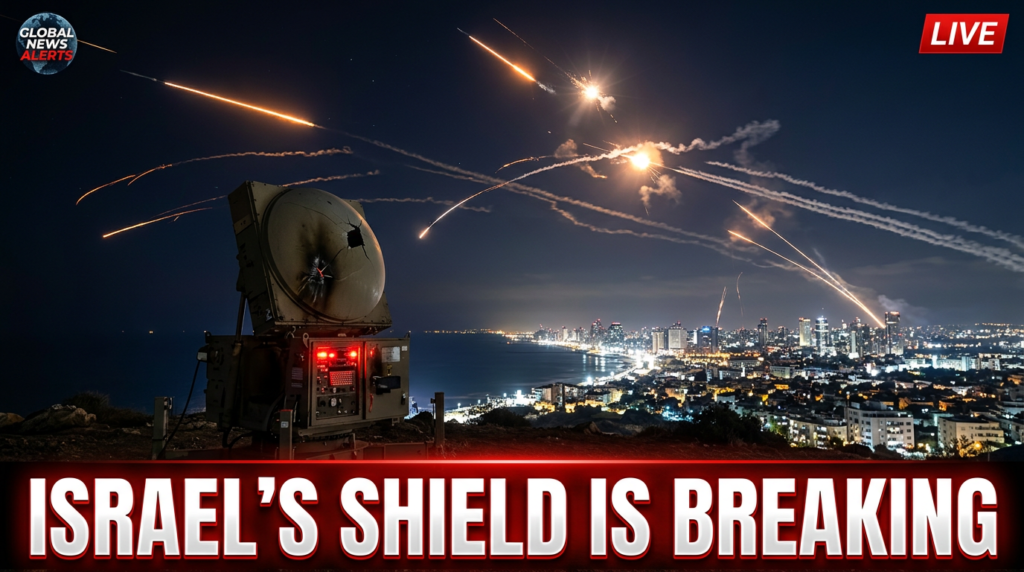
When Iran’s missiles started landing in Tel Aviv, it wasn’t just a military failure — it was a policy failure years in the making. Here’s what the headlines aren’t telling you.
The images from Tel Aviv on the morning of March 24, 2026, were not supposed to be possible. Apartment blocks shattered. A residential street near the Yarkon River reduced to rubble. Nine wounded in Bnei Brak. A kindergarten damaged in Dimona. These weren’t scenes from a Hollywood war film — they were the result of 42 Iranian ballistic missiles that slipped through one of the most advanced air-defense networks ever built.
For years, Western governments reassured their publics that layered missile shields — Iron Dome, David’s Sling, Arrow 2 and 3 — made Israel virtually impenetrable. That assurance is now cracking under the weight of reality. The question isn’t just how Iran’s missiles got through. The question is: who is accountable for letting this happen?
Support Independent Local Journalism
TheTownHall.News is a non-profit reader-supported journalism. Just $5 helps us hire local reporters, investigate important issues, and hold public officials accountable across Alameda County. If you believe our community deserves strong, independent journalism, please consider donating $5 today to support our work.The Shield That Wasn’t Infinite
Israel’s air-defense architecture was designed for exactly this kind of threat. Arrow 3 can intercept ballistic missiles in the exo-atmosphere — beyond the edge of space — at ranges exceeding 1,400 miles. Arrow 2 handles atmospheric intercepts. David’s Sling bridges the mid-tier. Iron Dome catches rockets and drones at close range. On paper, it is a layered fortress.
But fortresses run out of ammunition.
After four weeks of near-daily Iranian ballistic missile barrages — a campaign that began escalating in early March 2026 — Israel is now rationing its highest-end interceptors. A March 26 analysis cited by Defence Security Asia estimated that roughly 80 percent of Israel’s Arrow 2 and Arrow 3 stockpile had already been expended. David’s Sling was also reportedly approaching exhaustion under sustained operational use.
Israel’s military still claims an overall interception rate above 90 percent. But as analysts have noted, a high aggregate number can mask a dangerous operational truth: when stockpiles run low, commanders are forced to make triage decisions — letting some missiles hit open areas rather than spending irreplaceable interceptors on lower-priority threats.

Why This Crisis Was Preventable
This is not a story about technology failing. It’s a story about planning — and the consequences when governments prioritize optics over preparedness.
The Arrow and David’s Sling interceptors cost between $700,000 and several million dollars per unit. Iron Dome interceptors run $50,000 to $70,000 each. These aren’t items you restock overnight. Defense analysts have long warned that full replenishment of advanced interceptor stockpiles can take years, not weeks. Yet Israel entered this conflict with already-reduced Arrow inventories — a legacy of the prior June 2025 Iran exchange — and production timelines were never accelerated accordingly.
This is exactly the kind of long-term strategic negligence that fiscal conservatives have warned about for decades: the failure to invest responsibly in genuine national security infrastructure while political leaders congratulate themselves on diplomatic frameworks that never held. When the bill comes due, it is ordinary civilians — families in Arad, children in Dimona, residents of unrecognized Bedouin villages with no shelters at all — who pay it.
Preparedness isn’t a talking point. It’s a moral obligation.
The Attrition Game Iran Is Winning
Iran does not need a perfect missile to win this war. It needs a persistent one.
Support Independent Local Journalism
TheTownHall.News is a non-profit reader-supported journalism. Just $5 helps us hire local reporters, investigate important issues, and hold public officials accountable across Alameda County. If you believe our community deserves strong, independent journalism, please consider donating $5 today to support our work.Every barrage forces Israel to expend precious interceptors. Every interceptor spent narrows the defensive envelope for the next attack. Former Israeli air and missile defense commander reserve Brig. Gen. Ran Kochav has described the situation as “prioritisation of threats.” Analyst Tal Inbar was more direct: “The number of interceptors of every type is finite.”
Iran’s strategy is not innovation — it’s exhaustion. By maintaining daily missile pressure, Tehran is imposing asymmetric economic and industrial strain on a defender whose weapons cost orders of magnitude more than the missiles being fired at them. Iran launches a $500,000 ballistic missile. Israel fires a $2 million Arrow interceptor to stop it. Do that math over four weeks of daily barrages and the strategic picture becomes stark.
The March 21 strikes on Dimona and Arad — near Israel’s Shimon Peres Negev Nuclear Research Center — are the clearest proof point. Israel launched interceptors. Both Iranian missiles got through anyway. Hundreds of kilograms of warhead penetrated a defended zone around one of the most sensitive sites in the country.
What Critics Get Wrong
Some analysts argue that the “Israel is defenseless” framing is Iranian propaganda — a psychological operation designed to erode public morale and embolden further attacks. They are not entirely wrong.
Iran’s parliament speaker Mohammad Bagher Ghalibaf declaring “Israel’s skies are defenseless” is a political statement, not a military assessment. Israel’s Iron Dome has performed remarkably well against rockets and drones. The IDF has successfully intercepted the vast majority of Iranian ballistic missiles over this campaign. Israeli officials have rejected the notion of an “outright shortage crisis.”
But acknowledging Iran’s propaganda motive does not make the underlying vulnerability disappear. The facts remain: 42 missiles struck populated areas on a single day. Dozens of Israelis were wounded. Critical infrastructure near a nuclear facility was hit. Warheads weighing hundreds of kilograms landed in residential neighborhoods. Calling that propaganda does not rebuild Arrow stockpiles or shelter unrecognized villages.
Dismissing the crisis because the enemy is also lying about its scale is not strategic clarity — it is wishful thinking.
The Real Cost Nobody Is Talking About
Here is the dimension of this story that deserves far more scrutiny: the United States is deeply embedded in this crisis, and the American taxpayer is footing a growing portion of the bill.
The Pentagon has already ordered emergency interceptor resupply as stocks approach what officials have described as “critical depletion” levels. The U.S. repositioned Patriot missile batteries toward the Iran theater — a move that, according to a March 20 Washington Post report, created gaps in European air defenses at a time when Ukraine continues to face Russian missile attacks. America is simultaneously propping up missile defense in the Middle East and Eastern Europe while managing its own munitions burn rate.
Gulf allies are also requesting more U.S. systems. The global interceptor production line cannot keep pace with demand across multiple simultaneous theaters. Defense officials have pushed back publicly on concerns about a U.S. munitions shortage — but the fact that they have to push back at all tells you something.
American citizens deserve a transparent accounting of how many billions are being committed, on what timeline, and under whose authority.
Key Takeaway
Israel’s air-defense crisis is not a story about a miracle system failing — it is a story about what happens when strategic planning is sacrificed for short-term political comfort, and when the true cost of deterrence is never honestly communicated to the public.
The families in Tel Aviv, Arad, and Dimona did not fail to take cover. They did not fail to prepare. Their government — and its allies — failed to ensure the shield above them would last.
That is a civic accountability problem. It demands answers from elected officials, defense ministers, and the policymakers who signed off on decades of underinvestment in interceptor production capacity while the threat from Tehran grew larger, faster, and more sophisticated with each passing year.
Where This Goes Next
As of April 3, 2026, a U.S. F-15 has crashed inside Iranian territory, with two crew members missing. President Trump is reportedly seeking a diplomatic reset on the conflict as political pressure mounts ahead of the midterm elections. The war, for now, continues.
What comes next depends in large part on whether Western governments are willing to tell their citizens the truth about the state of their defenses — and recommit, with real money and real urgency, to the industrial capacity that deterrence demands.
History does not reward nations that wait until missiles are landing to ask whether their shields were ready.
Stay informed. Share this story. Hold your representatives accountable.
If you found this report valuable, consider supporting independent journalism that prioritizes accountability over access. Subscribe, share, and stay engaged — civic life doesn’t run on autopilot.