US and Israel Strike the Heart of Iran’s IRGC Terror Machine — Six Weeks In, Here’s What It Means
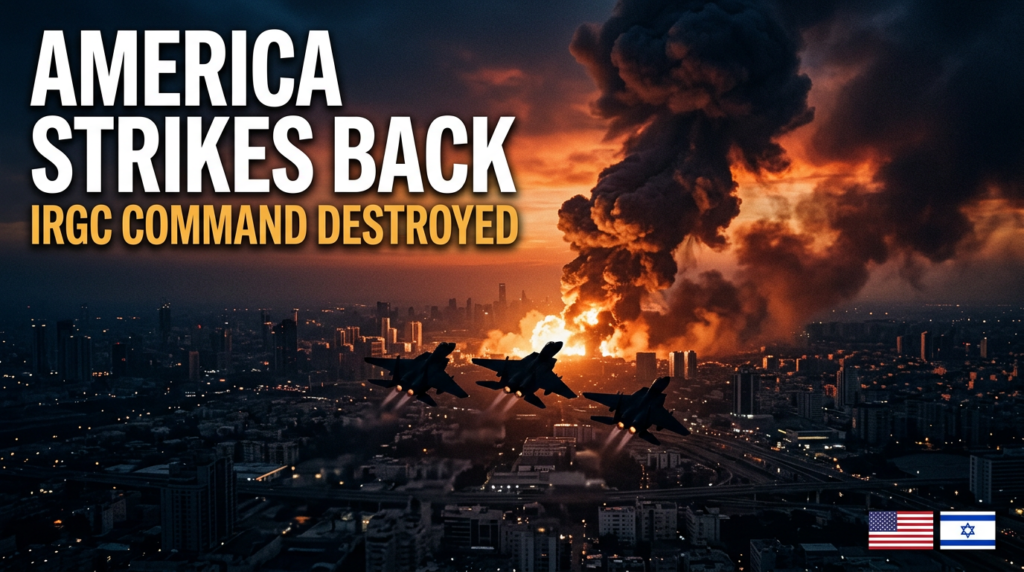
The United States and Israel have dismantled the command infrastructure of one of the world’s most dangerous terror-sponsoring regimes. Six weeks in, the question is no longer whether the campaign worked — it’s whether the West has the resolve to finish what it started.
For decades, the Islamic Revolutionary Guard Corps operated from the shadows — funding proxy wars, building underground bunkers, stockpiling ballistic missiles, and plotting the destruction of Western-aligned nations. Diplomats negotiated. Sanctions came and went. And the IRGC kept building. That era appears to be over.
On February 28, 2026, the United States and Israel launched Operation Epic Fury — a joint military campaign that delivered nearly 900 strikes in its first 12 hours alone. It was the most decisive military action against an adversarial state in a generation. Missile sites, air defense systems, IRGC command-and-control facilities, and ballistic missile launch platforms were systematically dismantled. Six weeks later, the campaign continues — and Iran’s war machine has never looked more exposed.
Support Independent Local Journalism
TheTownHall.News is a non-profit reader-supported journalism. Just $5 helps us hire local reporters, investigate important issues, and hold public officials accountable across Alameda County. If you believe our community deserves strong, independent journalism, please consider donating $5 today to support our work.Why This Moment Has Been Decades in the Making
The 2026 campaign did not emerge from a vacuum. It followed years of failed diplomacy, broken nuclear agreements, and escalating Iranian aggression — capped by a June 2025 preliminary strike on Iran’s underground nuclear facilities at Fordow, Natanz, and Isfahan. Even then, the CIA assessed that Iran had likely moved portions of its uranium stockpile in advance, limiting the strategic setback to months rather than years.
Iran spent those months not at the negotiating table, but rebuilding. US intelligence later confirmed that Iranian operatives had been restoring underground missile bunkers struck in 2025, returning them to operation with alarming speed.
The message from Tehran was clear: concessions were for show. The nuclear program would continue. The IRGC’s regional terror network — spanning Lebanon, Yemen, Iraq, and Gaza — would keep operating. And the West, they calculated, would keep tolerating it.
That calculation proved fatal.

What the Strikes Actually Accomplished
By early March, US Central Command confirmed it had struck more than 1,250 targets across Iran, destroyed 11 Iranian naval vessels, and eliminated IRGC command-and-control facilities in Tehran. Air defense installations and missile and drone launch sites were among the priority targets neutralized in the opening days.
The IRGC’s underground bunkers — once considered the regime’s ultimate insurance policy — became strategic liabilities. American GBU-57 “bunker buster” munitions, first deployed in the June 2025 strikes, proved devastatingly effective against fortified underground infrastructure. By mid-March, joint US-Israeli intelligence-driven operations had targeted senior IRGC leadership meeting in command facilities beneath Tehran.
Iranian Supreme Leader Ali Khamenei — the architect of four decades of state-sponsored terror — was killed in the first wave of strikes, along with dozens of top regime officials. IRGC General Mohammad Bagher Zolghadr assumed wartime leadership, inheriting a fractured command structure and a decimated air defense network.
The IRGC’s underground bunkers, once the regime’s ultimate insurance policy, became their tombs.
This is what strength through deterrence looks like when deterrence has already failed.
Iran’s Response — And Its Limits
Tehran has not been passive. Iranian forces launched hundreds of missiles and thousands of drones against US military bases and embassies across the Gulf — in Kuwait, Saudi Arabia, Bahrain, Qatar, Iraq, Oman, and Jordan. Global oil prices spiked as the Strait of Hormuz saw 95 percent of its normal traffic diverted.
Support Independent Local Journalism
TheTownHall.News is a non-profit reader-supported journalism. Just $5 helps us hire local reporters, investigate important issues, and hold public officials accountable across Alameda County. If you believe our community deserves strong, independent journalism, please consider donating $5 today to support our work.On April 3, Iran scored a symbolic — if limited — tactical victory by shooting down a US F-15E fighter jet, the first American warplane downed in the conflict. One crew member was recovered; a search operation for the second remained active as of April 4. The IRGC has also threatened retaliatory cyber and infrastructure attacks against 18 major American companies, and Iran-backed Hezbollah has re-engaged in Lebanon with drone strikes on Israeli air bases.
But here is the strategic reality: Iran’s retaliatory capacity is degrading. Every missile fired is one Iran cannot easily replace. Every command center destroyed is a coordination node gone dark. Every senior IRGC officer killed is institutional knowledge that cannot be rebuilt overnight.
What Critics Get Wrong
Opponents of the campaign raise legitimate concerns — civilian casualties, regional destabilization, the absence of a diplomatic off-ramp. These deserve serious answers.
Yes, civilians have been killed. UN officials expressed alarm over strikes near schools and hospitals, and Iranian authorities reported significant casualties across multiple cities. No serious person dismisses these costs lightly.
But critics who demand restraint must answer a harder question: What was the alternative? Two decades of multilateral diplomacy, five rounds of nuclear negotiations, and sanctions regimes produced a regime that used every concession as cover to advance its weapons program. The JCPOA, renegotiated as recently as 2025, collapsed when Iran refused a 15-point US framework. Meanwhile, the IRGC continued funding Hamas, Hezbollah, and Houthi forces responsible for thousands of civilian deaths across the region.
The choice was never between war and peace. It was between war now, on terms the West can control, or war later, against a nuclear-armed Iran that cannot be deterred.
The Cost of Inaction Would Have Been Higher
For Americans who believe in fiscal accountability and responsible governance, the calculus matters. The cost of this campaign — significant as it is — must be weighed against the long-term cost of a nuclear Iran: permanent forward military deployments, exponentially higher deterrence spending, and a Middle East in which every US ally faces existential threat.
The United States has spent billions annually maintaining Gulf forces precisely because Iran was never adequately contained. Every year the threat grew, the price tag grew with it. There is nothing fiscally responsible about indefinitely subsidizing the containment of a regime that was never going to be contained.
The Broader Principle at Stake
Beyond the military calculus, this conflict represents a test of Western resolve in a world where authoritarian regimes are watching closely. Russia, China, and North Korea are observing whether the United States and its allies will back their stated red lines with action.
A nuclear-armed Iran would not have stayed within its borders. It would have become an insurance policy for every terror proxy it funds — a guarantor of IRGC impunity from Beirut to Sanaa. The mullahs understood this. The West finally acted before that threshold was crossed.
The strongest deterrent against future aggression is demonstrating that aggression has consequences — now, not in a decade.
That principle rebuilt postwar alliances, kept NATO credible through the Cold War, and still defines responsible American engagement with the world.
Key Takeaway
Six weeks in, the IRGC’s command infrastructure has been severely degraded, its air defense network dismantled, and its leadership decapitated. Iran retains asymmetric retaliatory capacity, and the conflict is far from over. But the strategic reality has fundamentally shifted. The regime that once operated from the shadows with impunity is now fighting for survival. What comes next depends on whether Washington and Jerusalem — and the American public — have the resolve to see it through.
Stay Informed. Stay Engaged.
This story is evolving rapidly. Share this article with your network to ensure more Americans understand what is at stake in Iran — and why the outcome will shape our security environment for the next generation. Support independent journalism that reports the full picture. Stay connected. Stay engaged. An informed citizenry is the foundation of a republic worthy of defending.