Israel Strikes Iran’s Largest Petrochemical Plant, Kills IRGC Intelligence Chief as Trump Issues Tuesday Ultimatum
Israel’s precision strikes on Iranian infrastructure and senior IRGC commanders mark a dramatic escalation in the U.S.-Israeli campaign against Tehran — and the clock is now ticking on a Trump ultimatum that could reshape the Middle East.
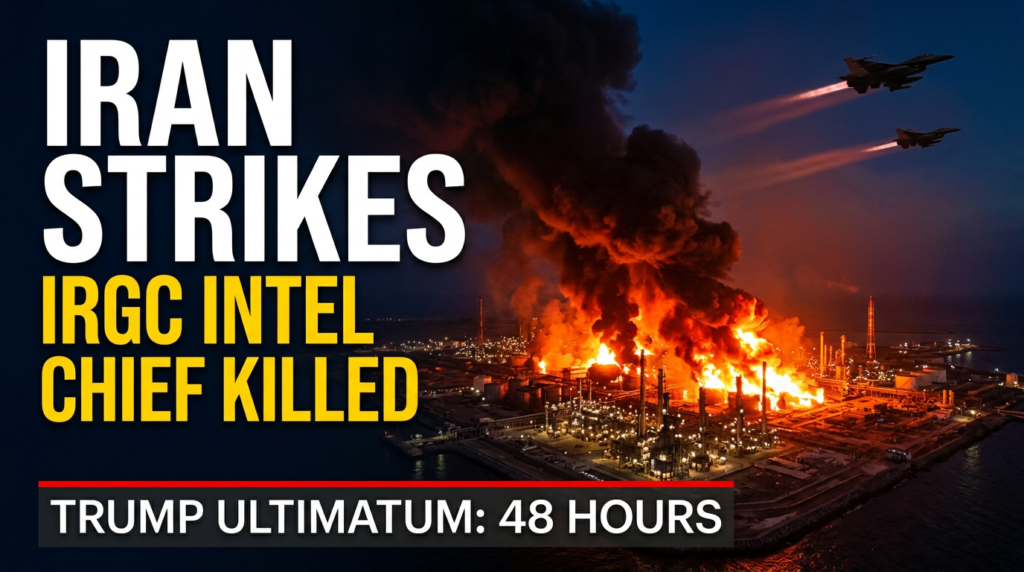
Monday, April 6, 2026, will be recorded as one of the most consequential days of the ongoing U.S.-Israeli conflict with Iran. In a sweeping series of coordinated strikes, Israel disabled Iran’s largest petrochemical complex, killed the Islamic Revolutionary Guard Corps’ top intelligence chief, and sent a clear message to Tehran: the cost of obstruction is no longer theoretical.
While diplomatic channels remain technically open — a Pakistan-brokered 45-day ceasefire proposal is still on the table — Iran’s rejection of a separate U.S. 15-point peace plan and its continued enforcement of illegal tolls on the Strait of Hormuz suggest the regime is betting on endurance over resolution. President Donald Trump, never one to let a bluff go uncalled, has now set a hard deadline of Tuesday, 8:00 p.m. ET: open the Strait or face what he is calling “Power Plant Day.”
Support Independent Local Journalism
TheTownHall.News is a non-profit reader-supported journalism. Just $5 helps us hire local reporters, investigate important issues, and hold public officials accountable across Alameda County. If you believe our community deserves strong, independent journalism, please consider donating $5 today to support our work.The Strike That Sent Shockwaves Through Tehran
The crown jewel of Monday’s operation was the destruction of the South Pars petrochemical complex in Asaluyeh — Iran’s largest such facility, responsible for roughly 50% of the country’s petrochemical production. The blast was heard for miles. Iran’s National Petrochemical Company confirmed a fire at the site, though it was eventually brought under control. The economic damage, however, is not so easily contained.
Analysts estimate the South Pars strike alone has taken offline approximately 85% of Iran’s petrochemical export capacity, depriving the regime of tens of billions of dollars in revenue it uses to fund proxies, ballistic missile programs, and its military apparatus. A second facility, the Marvdasht Complex, was also targeted.
This was not a symbolic strike. This was a deliberate, calibrated act of economic warfare designed to accelerate the collapse of a regime that has spent decades funding terrorism, threatening international shipping lanes, and destabilizing the broader Middle East.
Two IRGC Commanders Who Will Not Return
Alongside the infrastructure strikes, Israel confirmed the killing of Major General Majid Khademi, head of the IRGC’s Intelligence Protection Organization — one of the most powerful intelligence figures in the Iranian military structure. A second high-value target, Yazdan Mir, known by his alias Sardar Bagheri and chief of Quds Force Unit 840 — the IRGC’s clandestine overseas operations unit — was also eliminated in a separate strike in Tehran.

These are not mid-level operatives. Khademi oversaw counterintelligence operations across the entire IRGC — the same organization that has directed proxy attacks against U.S. forces in Iraq, Syria, and the Gulf for over two decades. Sardar Bagheri’s Unit 840 ran covert operations against foreign nationals and governments across three continents.
“You cannot negotiate security with a regime that uses its intelligence apparatus as a global weapon.”
Their deaths send a message that transcends battlefield tactics: Israel and the United States possess the intelligence reach to strike the inner sanctum of the IRGC, anytime, anywhere.
Trump’s Ultimatum and the Strait of Hormuz Standoff
The strategic backdrop to Monday’s strikes is the Strait of Hormuz crisis. Iran’s IRGC Navy has implemented what it calls a “new order” on the waterway — charging tolls on vessels and blocking American and Israeli ships from passing freely. Roughly 20% of the world’s oil supply transits this 21-mile-wide chokepoint. Interference there is not a regional issue — it is a global economic threat.
President Trump has responded with characteristic bluntness. Over Easter weekend, he publicly demanded Iran open the Strait. On Monday, his administration formalized that ultimatum: if Iran does not comply by Tuesday evening, the U.S. will target Iranian power plants and bridges — what Trump’s team is calling “Power Plant Day.”
The ceasefire window — a 45-day proposal mediated by Pakistan — remains open but fragile. Iran has already rejected the U.S.’s more detailed 15-point plan, demanding sanctions be lifted, reconstruction funding be provided, and new Hormuz protocols be established. In other words, Tehran wants to negotiate from a position it no longer occupies.
Support Independent Local Journalism
TheTownHall.News is a non-profit reader-supported journalism. Just $5 helps us hire local reporters, investigate important issues, and hold public officials accountable across Alameda County. If you believe our community deserves strong, independent journalism, please consider donating $5 today to support our work.The Human Cost — On All Sides
It would be dishonest to cover this story without acknowledging the human toll. Monday’s strikes killed at least 25 Iranians, including civilians. A residential building in Eslamshahr was struck, killing 13 people. The IAEA has raised alarms about a radiological risk after one strike landed approximately 75 meters from the perimeter of the Bushehr Nuclear Power Plant.
On the Israeli and allied side, four civilians were killed in Haifa on Monday — bringing Israel’s total civilian death toll in this conflict to 21. Iran’s proxy forces launched drone attacks on U.S. assets in Kuwait and missiles toward the UAE, wounding civilians in Abu Dhabi and Fujairah.
These figures matter. Every escalation carries a human cost that cold strategic logic cannot fully absorb. The question is not whether war is painful — it always is — but whether allowing a nuclear-aspiring, terror-sponsoring regime to close the world’s most critical waterway without decisive consequence is a more dangerous outcome in the long run.
What Critics Get Wrong
Critics of the U.S.-Israeli campaign argue that the strikes are counterproductive — that they harden Iranian public opinion and reduce the prospects for diplomacy. This argument has a surface plausibility that evaporates under scrutiny.
The IRGC is not an elected institution. It does not represent the will of the Iranian people — many of whom have spent years risking their lives protesting the regime’s brutality. Targeting IRGC commanders and the regime’s revenue infrastructure is not an attack on the Iranian people; it is a precise effort to degrade the apparatus that oppresses them.
Moreover, the diplomatic track has not been foreclosed. Pakistan’s 45-day ceasefire proposal remains active. Iran’s rejection of the U.S. 15-point plan — while simultaneously blockading international shipping and conducting proxy attacks on U.S. forces — is not the behavior of a government that wants peace.
“Strength and diplomacy are not opposites. In this theater, one requires the other.”
Why This Moment Demands American Clarity
There is a domestic dimension Americans should not overlook. The rescue of the downed crew known as “Dude 44” — an operation involving more than 150 aircraft and 200 munitions — demonstrates the extraordinary capability of U.S. forces and this administration’s commitment to bringing its people home. Trump called it “very historic.” That is not hyperbole.
At the same time, the conflict is placing pressure on global energy markets. Petrochemical disruption in Iran ripples through fertilizer production, plastics, and fuel refining worldwide. American families will feel it. Fiscal accountability demands the administration pair its military strategy with a credible plan to stabilize energy supply chains and prevent a prolonged conflict from becoming a burden on American taxpayers.
The Bottom Line
Monday’s strikes represent a strategic inflection point. Israel’s targeting of Iran’s petrochemical infrastructure and senior intelligence leadership was not impulsive — it was the product of operational planning aimed at denying the IRGC the financial and intelligence resources needed to sustain a long war.
The regime faces a stark choice: return to the international order or watch its economic foundations continue to crumble. For Americans who believe in law and order on the international stage — who understand that free navigation and treaty compliance are not optional — this moment is a test of resolve.
Stay informed. The next 48 hours will define the trajectory of this conflict.
📌 Key Takeaway
Israel killed Iran’s IRGC intelligence chief, disabled 85% of the country’s petrochemical export capacity, and forced a diplomatic crisis to a head — all while Trump’s Tuesday deadline for the Strait of Hormuz ticks closer. The next move belongs to Tehran.
Share this article to keep your network informed on one of the most consequential developing stories of 2026. Independent journalism depends on engaged readers. Subscribe, share, and stay involved.