SAVE America Act: House Passes Voter ID Bill 218–213 — Here’s What Comes Next
The House just passed the most significant federal election reform in years — and the battle now moves to a Senate where procedural gridlock threatens a principle 83% of Americans already support.
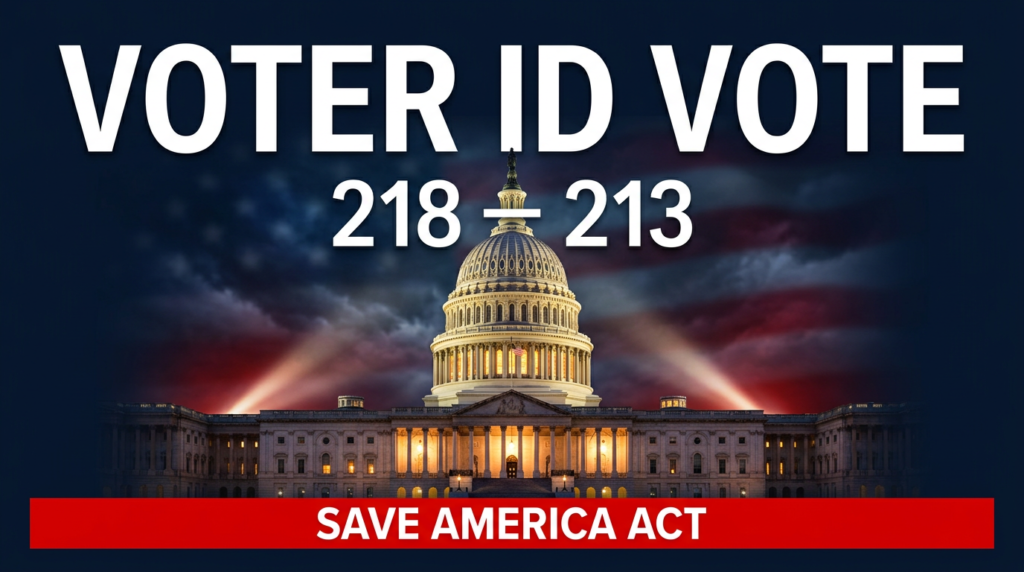
On February 11, 2026, the U.S. House of Representatives voted 218 to 213 to pass the Safeguard American Voter Eligibility (SAVE) America Act — a bill requiring proof of U.S. citizenship to register to vote in federal elections and a valid photo ID to cast a ballot. The margin was razor-thin. The debate was fierce. And the implications couldn’t be more consequential.
This isn’t just a legislative skirmish in Washington. It’s a defining test of whether the United States is serious about one of the most foundational responsibilities of self-governance: ensuring that only eligible citizens determine the outcome of American elections. The bill now sits in the Senate, stalled behind a procedural firewall — and the clock is ticking with the 2026 midterms on the horizon.
Support Independent Local Journalism
TheTownHall.News is a non-profit reader-supported journalism. Just $5 helps us hire local reporters, investigate important issues, and hold public officials accountable across Alameda County. If you believe our community deserves strong, independent journalism, please consider donating $5 today to support our work.What the SAVE America Act Actually Does
The SAVE Act is straightforward. To register to vote in a federal election, applicants must present documentary proof of U.S. citizenship in person — a passport, birth certificate, or naturalization certificate. At the polls, every voter must show a valid photo ID. States would also be required to submit voter registration lists to the Department of Homeland Security on a quarterly basis for verification. Mail-in voter registration would require the same in-person citizenship documentation.
These are not radical provisions. They are the kind of standard safeguards most Americans associate with secure systems — whether banking, boarding a commercial flight, or picking up a controlled-substance prescription. The question has never been whether identity matters in high-stakes transactions. It’s whether voting — the cornerstone of American democracy — deserves at least the same level of rigor as renting a car.
Rep. Chip Roy (R-TX), the bill’s chief architect, framed it simply: the SAVE Act gives states flexibility while establishing a federal baseline for federal elections. The Trump administration has designated it as its top legislative priority and launched a public campaign to pressure senators into action.
Why This Issue Matters Right Now
The 218–213 vote was not just a policy win — it was a signal about the state of civic confidence in America. Trust in election systems has eroded across multiple cycles and across both parties. The question of who is eligible to vote, and whether our systems reliably enforce that eligibility, sits at the heart of public legitimacy in democratic outcomes.

Noncitizen voting in federal elections is already illegal under the Illegal Immigration Reform and Immigrant Responsibility Act of 1996. But existing law doesn’t verify citizenship at registration — it relies on a self-reported attestation. The SAVE Act closes that gap by requiring documentary evidence instead of a declaration.
Election integrity isn’t a partisan talking point. It’s the baseline of a functioning republic. When citizens stop trusting the process, they disengage — and that disengagement is one of the most corrosive forces in democratic life.
The Shell Bill Controversy — and Why It Doesn’t Settle the Debate
The SAVE Act’s path to the House floor has drawn procedural criticism. S. 1383 originally passed the Senate unanimously as the Veterans Accessibility Advisory Committee Act of 2025 — a bipartisan measure sponsored by Sen. Rick Scott (R-FL) with Democratic cosponsors including Sens. Kirsten Gillibrand (D-NY) and Maggie Hassan (D-NH). The House stripped the original text entirely and replaced it with SAVE Act language — a legal maneuver commonly called a “shell bill.”
Democrats and veterans advocates have rightly noted that this move sidelined the original veterans accessibility provisions, which were supported by Paralyzed Veterans of America and the Wounded Warrior Project. That’s a legitimate grievance, and those veterans deserve congressional action on their own terms through a separate vehicle.
But the procedural objection — while valid — does not address the substance of the SAVE Act itself. Critics who lead with the shell bill complaint are answering a different question than the one on the table. The debate Americans deserve is direct: should proof of citizenship be required to vote in a federal election? That question stands independent of how the bill reached the floor.
Support Independent Local Journalism
TheTownHall.News is a non-profit reader-supported journalism. Just $5 helps us hire local reporters, investigate important issues, and hold public officials accountable across Alameda County. If you believe our community deserves strong, independent journalism, please consider donating $5 today to support our work.What Critics Get Wrong
Opponents of the SAVE Act, including Senate Minority Leader Chuck Schumer, have labeled it “Jim Crow 2.0” — a charged comparison that generates heat but produces little light. The Brennan Center for Justice estimates that more than 21 million Americans currently lack the specific documentation the bill would require at registration — a figure frequently deployed in opposition.
That statistic deserves scrutiny. The same categories of documentation — government-issued IDs, birth certificates, passports — are already required in numerous contexts that government mandates and most progressives broadly accept: obtaining a driver’s license, accessing federal benefits, enrolling children in public school, or opening a bank account. If the concern is that millions of Americans cannot obtain basic identification, that is a separate and legitimate policy problem. But the answer to a documentation access gap is expanding access to documentation — not eliminating documentation requirements for the single most consequential civic act a citizen performs.
If the real concern is access, the solution is removing barriers to documents — not removing the requirement to have them.
Sen. Lisa Murkowski (R-AK) became the first Senate Republican to publicly oppose the bill, citing concerns about federal mandates on state election systems. That’s a principled federalism argument. But the bill explicitly preserves state flexibility in implementation — it sets a floor for federal elections, not a centralized takeover of local voting infrastructure.
The Senate Filibuster: Where Reform Goes to Stall
The SAVE Act now faces its most formidable obstacle — the Senate’s 60-vote filibuster threshold. Senate Majority Leader John Thune (R-SD) has acknowledged that Republicans currently lack the votes to change the filibuster rules. With all Senate Democrats unified in opposition, the bill would need bipartisan support that has not materialized.
President Trump has publicly pressed Senate Republicans to consider a “talking filibuster” — a mechanism that would force opponents to hold the Senate floor continuously rather than register a procedural objection and walk away. Whether leadership pursues that route remains to be seen.
The political irony is hard to miss. A provision supported by 83% of Americans — per Pew Research data on photo ID requirements — may be blocked by a procedural rule whose arithmetic bears no relationship to public consensus. This is Washington dysfunction in its most recognizable form: popular policy defeated not on the merits, but on procedural math.
How This Affects Families and Communities
Beyond the legislative mechanics, the SAVE Act touches something fundamental about civic culture and the values we pass to the next generation. Teaching children that rights carry responsibilities — including the responsibility to participate in civic life as a verified, eligible citizen — is core to the social contract that holds communities together.
For parents who want their children to inherit a republic worth believing in, this debate is not abstract. Civic integrity is the invisible infrastructure beneath everything else — trustworthy elections, legitimate authority, functioning institutions. When that infrastructure erodes, everything built on it becomes unstable.
The principle embedded in the SAVE Act is not complicated: know who is voting, verify eligibility, maintain records, and protect the integrity of the count. These are not extraordinary demands. They are the minimum standards of a democracy that takes itself seriously.
Key Takeaway
The SAVE America Act passed the House 218–213 in February 2026. It requires proof of citizenship to register and a valid photo ID to vote in federal elections. It commands broad public support, enjoys White House backing as the administration’s top priority, and now stalls in the Senate behind a filibuster its supporters cannot currently overcome. With the 2026 midterms approaching, the debate over who gets to decide America’s future — and how that eligibility is verified — is only going to grow louder.
The question isn’t whether election integrity matters. It does. The question is whether Washington has the political will to act on what Americans have already decided.
Stay Informed. Stay Engaged. Make Your Voice Heard.
Democracy doesn’t run itself. Contact your senator. Share this article with neighbors, coworkers, and friends who believe civic accountability still matters. Subscribe for independent reporting on the issues that shape your community. And show up — in elections, in conversations, and in civic life.