America’s First Humanoid Robot Factory Opens — and It Took Zero Government Dollars
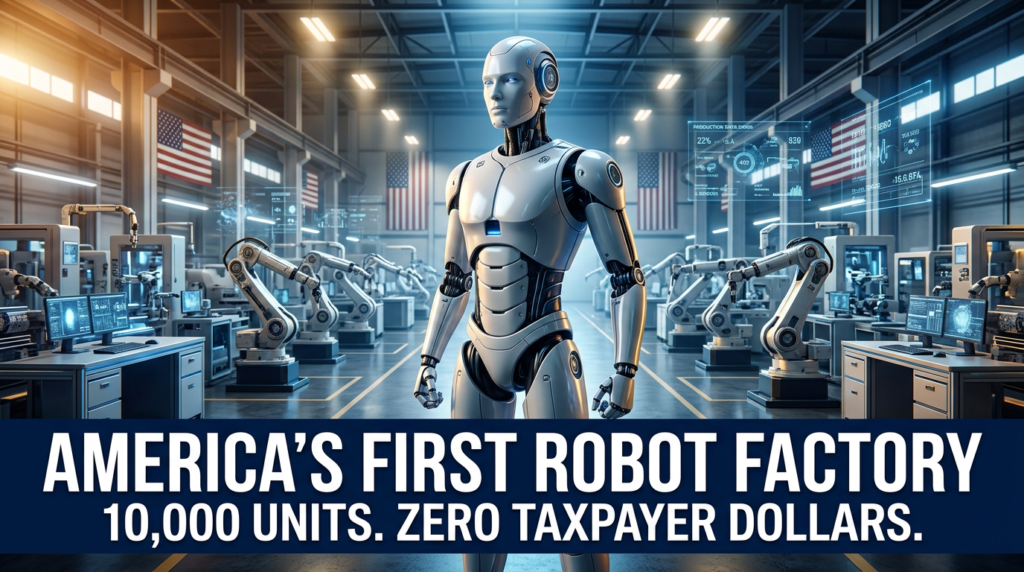
While Washington debates trillion-dollar spending bills, a Norwegian-American startup backed by private capital just did what government never could: built the future from the ground up, on American soil, without a taxpayer bailout.
On April 30, 2026, a 58,000-square-foot factory in Hayward, California quietly made history. No federal ribbon-cutting ceremony. No government grant announcement. Just a private company, private investment, and a product so compelling that its entire first year of production sold out in five days.
1X Technologies, the OpenAI-backed robotics startup founded in Norway and now building its future in America, has opened what it describes as the country’s first fully vertically integrated humanoid robot factory. The NEO robot — capable of lifting 70 kilograms, moving at 6.2 meters per second, and operating nearly silently at just 22 decibels — is priced at $20,000 or $499 per month on subscription. Consumer shipments are planned for late 2026. The company is targeting 100,000 units by the end of 2027. The market responded quickly: all 10,000 first-year units were claimed within five days of preorders opening in October 2025.
Support Independent Local Journalism
TheTownHall.News is a non-profit reader-supported journalism. Just $5 helps us hire local reporters, investigate important issues, and hold public officials accountable across Alameda County. If you believe our community deserves strong, independent journalism, please consider donating $5 today to support our work.This is not science fiction. This is private enterprise doing exactly what it does best — solving real problems with real capital, real risk, and zero government mandate.
What Private Capital Built That Government Never Would
The story of 1X Technologies is, at its core, a story about the power of private investment and entrepreneurial risk-taking — the kind rarely celebrated by a media culture more comfortable championing government programs as the engine of progress.
Founded in 2014 by Bernt Øivind Børnich under the name Halodi Robotics, the company rebranded as 1X in 2022 and has raised approximately $100 million in total funding. That includes a 2023 Series A2 round led by the OpenAI Startup Fund, with Tiger Global and other private investors participating. Not a dollar of it came attached to a federal mandate.
The Hayward facility employs over 200 people and manufactures critical components entirely in-house: motors, batteries, structural components, transmission systems, copper coils, and sensors. That vertical integration is a deliberate strategic choice. It keeps the supply chain domestic, reduces dependency on foreign manufacturers — particularly Chinese ones — and gives 1X direct control over quality and cost. This is American industrial strategy done right: executed by the private sector, not designed by a congressional committee.

Why the Free Market Beat Washington to the Punch
Here is a number worth sitting with: the United States federal government has spent billions over the past decade on advanced robotics research through agencies like DARPA and the Department of Energy. The results rarely reach ordinary consumers within a generation, if ever.
1X Technologies opened preorders in October 2025 and sold out 10,000 units in five days.
That is the free market working exactly as intended. When entrepreneurs are free to take risks, attract private capital, and compete for customers, innovation is incomparable. No procurement process. No environmental impact study. No lobbyist-driven delay. Just a product, a price, and a public ready to buy.
The company is already planning a larger facility in San Carlos to meet demand beyond 2027. A partnership announced in December 2025 with global private equity firm EQT will see up to 10,000 NEO units deployed across EQT’s portfolio companies worldwide between 2026 and 2030. Enterprise and consumer markets are being built simultaneously, entirely on private capital.
What This Means for American Families
The practical implications of an accessible household humanoid robot are significant — and they extend well beyond the technology itself.
Support Independent Local Journalism
TheTownHall.News is a non-profit reader-supported journalism. Just $5 helps us hire local reporters, investigate important issues, and hold public officials accountable across Alameda County. If you believe our community deserves strong, independent journalism, please consider donating $5 today to support our work.Consider the aging population. Millions of American families are quietly navigating a caregiving crisis: the staggering cost of assisted living, the burden on adult children, and the impossible choice between career and family duty. A household robot capable of lifting 70 kilograms, operating autonomously around the clock, at noise levels quieter than a library whisper, could be a genuine breakthrough for family independence.
This is personal responsibility made possible by innovation. The ability to care for aging relatives at home — without dependence on government programs or institutional care — is precisely the private-sector solution free markets were always expected to eventually deliver. NEO may be the first credible proof of concept.
The robot is already proving itself in the real world. Units are currently working inside the Hayward factory, handling logistics and stocking parts. In January 2026, 1X launched a world model enabling NEO to learn new tasks by watching videos, drawing on internet-scale data refined with real robot behavior. An earlier Redwood AI model, released in mid-2025, enabled autonomous household tasks including laundry and home navigation. NEO Gamma, introduced in February 2025, added improved conversational ability, whole-body motor control, and refined manipulation.
The Real Concerns — And Why They Deserve Honest Answers
Intellectual honesty demands the harder questions be addressed directly.
On labor displacement: the concern that humanoid robots will eliminate jobs is legitimate and deserves respect, not dismissal. History offers important context. Technological revolutions consistently displace certain roles while creating entirely new categories of work. The question is not whether change will come — it will — but whether Americans are positioned with the skills and economic freedom to adapt. That is an argument for strong vocational training and flexible labor markets, not for blocking the technology.
Heavy-handed government intervention — through “robot taxes” floated by some legislators or industry-wide regulatory moratoria — would accomplish one thing with certainty: it would export the innovation and the jobs to China, where manufacturers like Unitree and UBTECH are advancing rapidly with substantial state backing. America does not win that race by slowing itself down.
On privacy: a robot that sees and hears daily life inside your home raises legitimate concerns that deserve transparent corporate standards and targeted accountability. The answer is clear policy and genuine corporate responsibility — not government control of the technology itself.
The Global Stakes — and Why America Must Lead
The competitive landscape cannot be overstated. Tesla is targeting Optimus production in 2026. Figure AI and Agility Robotics are scaling aggressively. Chinese manufacturers are moving fast with state support.
America’s answer should not be to out-subsidize China with taxpayer dollars. It should be to out-innovate — by preserving the regulatory environment, capital markets, and entrepreneurial culture that allowed a Norwegian-founded startup to open a world-first factory in California on private funding alone. The NEO factory in Hayward proves the model works. A target valuation of $10 billion is now being discussed. The next facility is already planned. The orders are already in.
“The robots are coming. The only question is whether they will be built here — or somewhere else because America was too slow to get out of its own way.”
The Takeaway America Needs to Hear
The Hayward factory is more than a technology milestone. It is a case study in what free markets, private capital, and entrepreneurial ambition accomplish when not strangled by bureaucracy or sidelined by government overreach.
A company took a risk. Investors backed it. Engineers built something extraordinary. Consumers responded with their wallets before the factory floor was fully operational. Ten thousand pre-orders in five days carries more weight than any government feasibility report ever written.
The question for policymakers is simple: do we create the conditions for more stories like this, or do we regulate and tax this industry until it migrates to a country less reluctant to compete?
Protect intellectual property. Ensure fair competition. Invest in workforce education. Then step back and let American ingenuity do what it has always done when given the freedom to run.
The future of the American home may well be assembled in Hayward, California — not because Washington planned it, but because the market demanded it and private enterprise delivered.
Share this article if you believe America wins by competing, not by retreating. Stay informed, stay engaged, and support independent journalism that tells the full story.