DOGE Social Security Cleanup: What the 12.3 Million Record Purge Really Means for Taxpayers
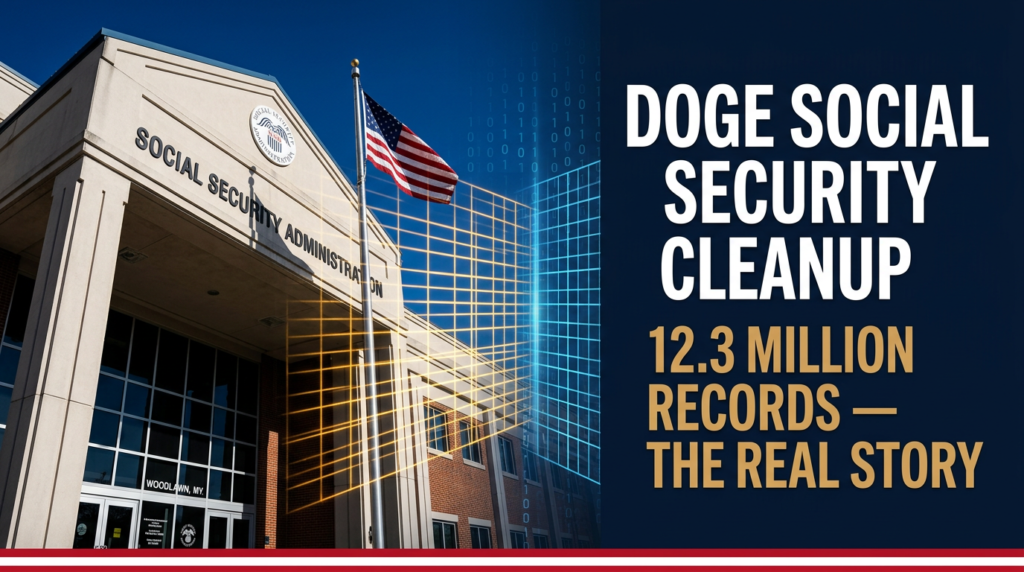
The Department of Government Efficiency marked 12.3 million outdated records as deceased in a long-overdue SSA cleanup. The work is legitimate and meaningful — but the viral savings math demands a closer look from anyone serious about fiscal accountability.
For decades, the Social Security Administration quietly maintained millions of records listing individuals as over 120 years old — some as old as 300 — not because these phantom Americans were alive, but because of a technical flaw buried deep in aging government code. Nobody fixed it. Nobody was held accountable. Taxpayers had no idea it existed.
Now, thanks to pressure from the Department of Government Efficiency, the SSA has completed a landmark database cleanup, officially marking approximately 12.3 million of those outdated records as deceased. That is real work. That is real accountability. For Americans who believe government should be held to the same standard of rigor expected of private citizens and businesses, it is a moment worth acknowledging — and understanding clearly.
Support Independent Local Journalism
TheTownHall.News is a non-profit reader-supported journalism. Just $5 helps us hire local reporters, investigate important issues, and hold public officials accountable across Alameda County. If you believe our community deserves strong, independent journalism, please consider donating $5 today to support our work.But here is what the viral claim circulating widely on social media gets wrong — and why getting the facts right actually makes the case for government reform even stronger.
What DOGE Actually Did at the Social Security Administration
The cleanup itself is legitimate. The SSA’s aging computer systems — built on COBOL, a programming language dating back to the 1950s — used default birth dates such as January 1, 1875 for individuals whose actual birth dates were never properly recorded. The result: millions of ghost entries making people appear to be 120, 150, or even 300 years old in federal databases.
On May 23, 2025, DOGE announced that after 11 weeks of work, the SSA had marked approximately 12.3 million of these aged-120-plus records as deceased. Crucially, this cleanup implemented recommendations from a 2023 SSA Inspector General report — a report the agency itself had dismissed as “low priority” because, it argued, these individuals were not actively receiving payments.
That is the key detail every taxpayer deserves to know. The SSA has automatically terminated benefits for anyone reaching age 115 since 2015. These 12.3 million records were not generating monthly checks to zombie recipients. The viral claim of $22 billion in monthly savings — calculated by multiplying 12.3 million records by an assumed $1,800 monthly benefit — does not reflect any reduction in active payment outlays. It is a mathematical conclusion built on a factual misunderstanding.

Why the Real Fraud Problem Still Demands Urgent Action
This is where the story gets more important, not less — and where the real taxpayer win actually lives.
If these records were not generating Social Security payments, why did they matter? Because dormant Social Security numbers attached to ghost records were being harvested by criminals to create synthetic identities — fake personas used to obtain small-business loans, open fraudulent financial accounts, and commit large-scale theft against institutions and taxpayers. That is a documented, ongoing problem, and eliminating those dead records makes that fraud significantly harder to execute.
“The value of cleaning up a broken government database isn’t always measured in benefits stopped — sometimes it’s measured in crimes prevented.”
The SSA’s own data also supports the case for broader vigilance. Improper payments — covering both fraud and administrative error — account for approximately 0.3% of SSA’s old-age, survivor, and disability insurance disbursements. In a program distributing trillions of dollars annually, even fractional percentages represent billions in preventable losses.
For Americans who believe every taxpayer dollar deserves accountability, the standard cannot be “it’s only 0.3%.” The standard must be relentless improvement — every year.
The Overpromise Problem — and Why It Hurts the Reform Cause
Here is the uncomfortable truth that supporters of genuine government reform must confront: when the numbers are exaggerated, critics win the argument, and real accountability loses ground.
Support Independent Local Journalism
TheTownHall.News is a non-profit reader-supported journalism. Just $5 helps us hire local reporters, investigate important issues, and hold public officials accountable across Alameda County. If you believe our community deserves strong, independent journalism, please consider donating $5 today to support our work.The $22 billion monthly savings figure has been widely amplified across social media. It does not survive scrutiny. And when fact-checkers fairly debunk an inflated claim, the natural reflex is to dismiss DOGE’s work entirely — including the parts that are legitimate, overdue, and genuinely valuable to taxpayers.
This is the self-inflicted wound serious reform movements cannot afford. Americans who believe in limited government and responsible public spending need credible arguments backed by verifiable numbers — not viral math that collapses under review.
“You cannot hold government accountable with numbers that don’t add up. Credibility is the currency of reform.”
DOGE’s accomplishments at SSA — completing an overdue database cleanup, reducing exploitable ghost identities, forcing action on a watchdog recommendation that sat ignored for two years — are real. They stand on their own merits and require no embellishment.
What Critics Get Wrong
Opponents of DOGE have framed the entire Social Security initiative as harmful political theater, pointing to a phone anti-fraud screening tool that slowed retirement claim processing by 25% — reportedly catching only two high-probability fraud cases out of more than 110,000 new claims reviewed.
Those numbers warrant honest consideration. Any reform that delays legitimate benefits for seniors carries a real human cost, and responsible oversight must weigh outcomes accurately. That is fair criticism.
But the broader argument — that SSA fraud is so statistically minor that aggressive pursuit causes more harm than good — deserves a direct response. That philosophy is precisely the institutional mindset that allowed 12.3 million phantom records to accumulate in a federal database for decades, with zero urgency, zero accountability, and an Inspector General report left to gather dust because the problem was deemed “low priority.”
Government agencies left to set their own fraud-detection standards, without external pressure, have a well-documented tendency toward minimal action. The value of external accountability — even when early execution is imperfect — is that it forces a culture shift away from comfortable complacency.
The Bigger Picture: Broken Systems and the Taxpayer’s Right to Demand Better
The SSA database cleanup is a window into a broader, systemic failure: federal technology infrastructure allowed to decay across decades and multiple administrations, creating vulnerabilities that cost taxpayers in ways that rarely make headlines.
COBOL-based systems running critical government programs. Databases carrying millions of inaccurate, exploitable records. Inspector General recommendations shelved for years because fixing them “would divert resources.” These are not partisan failures — they are basic governance breakdowns that every taxpaying American deserves to see fixed.
For those who believe in a government that answers to the people who fund it, the core question is not whether 12.3 million active fraudsters were removed from the benefit rolls. The core question is more damning: why did it take this long to act on something a government watchdog identified two years ago?
There is no comfortable answer. But it is the right question to keep asking — loudly, persistently, and with full facts in hand.
Key Takeaways
- ✅ DOGE completed a legitimate, long-overdue cleanup of 12.3 million outdated SSA records
- ✅ These records were not actively receiving Social Security payments
- ✅ The real win: eliminating dormant SSNs exploited for synthetic identity theft
- ✅ The $22 billion/month savings claim is not supported by the evidence
- ✅ True fiscal accountability requires honest numbers — not viral math that collapses under review
The Bottom Line
The Social Security database cleanup is a meaningful step toward the transparent, accountable government Americans have every right to demand. The phantom records are gone. The ghost identities that enabled synthetic fraud are harder to exploit. A watchdog recommendation shelved for two years has finally been implemented.
That is progress — and it deserves credit.
But fiscal accountability is not served by overstating results. It is served by demanding accurate reporting, sustained oversight, and the same rigorous standard that private citizens and businesses face every day. If the real measure of this cleanup is preventing synthetic identity fraud and beginning the modernization of broken federal databases, then make that case — clearly, loudly, and with the facts to back it up.
In the long campaign for responsible government, credibility is the most valuable asset reformers have. Guard it accordingly.
Stay informed. Share this article with someone who believes government should be held accountable. Support independent journalism that follows the facts — wherever they lead. And if you believe every dollar of public money deserves scrutiny, make your voice heard.