The Biggest Healthcare Fraud Bust in U.S. History Started With a Doctor Who Spent 11 Seconds on a Dying Teenager’s Heart Test
The 2026 National Health Care Fraud Takedown charged 455 people — including 90 doctors — in $6.5 billion in alleged schemes. What the numbers don’t show is what it cost in human lives.
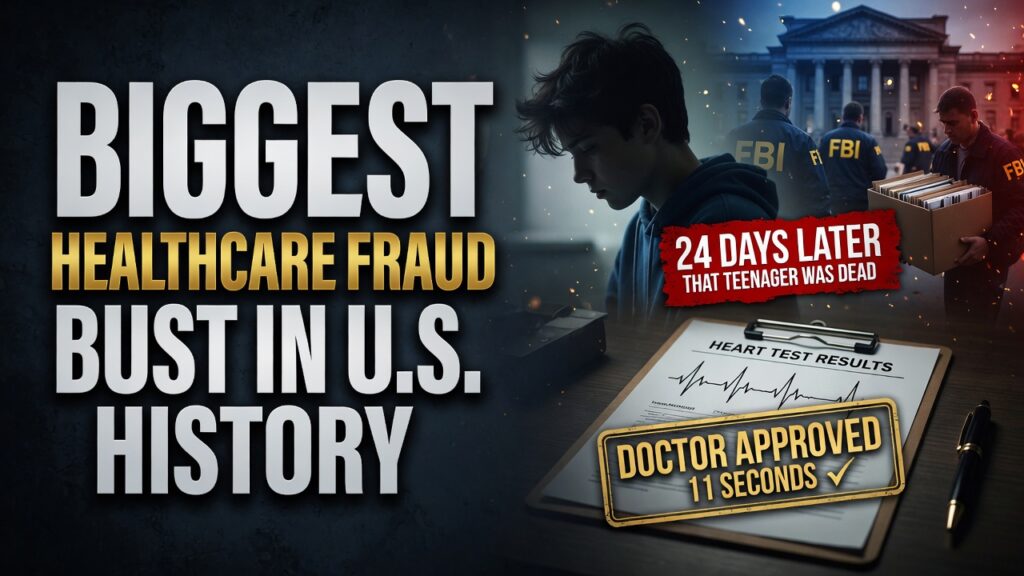
He had an enlarged heart. The test showed it clearly.
The doctor reviewed 63 cardiovascular images and signed off on the results as normal. According to federal prosecutors, the whole process took approximately 11 seconds.
Support Independent Local Journalism
TheTownHall.News is a non-profit reader-supported journalism. Just $5 helps us hire local reporters, investigate important issues, and hold public officials accountable across Alameda County. If you believe our community deserves strong, independent journalism, please consider donating $5 today to support our work.Twenty-four days later, that student athlete collapsed during basketball practice and died from complications related to an enlarged heart.
The doctor who allegedly approved those results in under the time it takes to read this sentence has now been charged with running an $89 million scheme to bill Medicare and other health benefit programs for unnecessary cardiovascular tests on student athletes at school campuses across South Florida. His marketing teams, prosecutors allege, were instructed to prey on parents’ fears that their children could die from sudden cardiac arrest — and then bill the government for tests no one properly reviewed.
That case is one of 455 charged in this week’s 2026 National Health Care Fraud Takedown, the largest coordinated healthcare fraud enforcement action in U.S. Department of Justice history.
The total alleged fraud: $6.5 billion. The total human cost: still being counted.

What Is the 2026 National Health Care Fraud Takedown — and Why Is It Different?
Every year, the DOJ announces a National Health Care Fraud Takedown. In prior years, those announcements generated a press cycle and then disappeared. This year is different in ways that matter.
The 2026 Takedown involved charges in 56 federal districts across 45 U.S. states and territories, with all 50 state Medicaid Fraud Control Units participating — the most in Department history. Two weeks of coordinated law enforcement action produced 455 defendants, including 90 doctors and other licensed medical professionals. International cooperation resulted in the extradition of fugitives from Turkey, Estonia, and the Philippines. The DOJ seized over $182 million in cash, luxury vehicles, and jewelry.
Acting Attorney General Todd Blanche, HHS Secretary Robert F. Kennedy Jr., CMS Administrator Dr. Mehmet Oz, FBI Director Kash Patel, and DHS Secretary Markwayne Mullin all appeared at Tuesday’s press conference.
This was not a routine announcement. The DOJ called it the greatest whole-of-government effort to combat healthcare fraud in the nation’s history.
The cases range from billion-dollar transnational criminal organizations to a personal care attendant who billed Medicaid for attending to a disabled patient while that same patient was hospitalized for severe neglect. What connects all of them is the same predatory logic: Medicare and Medicaid move so much money, so fast, through so many channels, that stealing from them at scale has been — until now — surprisingly easy.
Support Independent Local Journalism
TheTownHall.News is a non-profit reader-supported journalism. Just $5 helps us hire local reporters, investigate important issues, and hold public officials accountable across Alameda County. If you believe our community deserves strong, independent journalism, please consider donating $5 today to support our work.The Beach Resort, the Ferrari, and the Bulgari Necklace
To understand the scale of audacity at work, consider what prosecutors allege one Texas nurse practitioner did with her Medicare billing access.
She applied amniotic wound allografts — biological tissue used in wound treatment — to patients who did not need them, and billed Medicare more than $1 million per patient on average. The total alleged fraud from her practice alone: $906 million.
She used the proceeds to build a $4.6 million beach resort in the Philippines.
Federal agents seized a $594,000 Ferrari 296 GTS, seven other high-end vehicles, an $865,000 custom Bulgari necklace, over $1 million in additional luxury jewelry, and $30 million in bank accounts.
She is one of dozens charged in what has become the fraud industry’s hottest product: amniotic wound allografts. These are biological materials derived from placental tissue, legitimately used in some wound care applications, but weaponized in this case as a billing vehicle because Medicare was paying up to $1,450 per square centimeter. A company at the center of the scheme acquired tissue from banks, relabeled it, and marked it up 2,000 percent before selling it to providers who would apply it to patients who didn’t need it — including hospice patients who were never told what was being done to their wounds — and split the kickbacks.
From December 2021 through June 2024, providers billed Medicare over $4 billion for one company’s allografts, collecting over $2 billion in actual payments. The Vice President of Sales for that company — who received over $24 million personally and spent it on a $135,000 Maserati, multi-million-dollar homes, and luxury watches — has now been charged in the District of Arizona.
In a separate Florida case, a different nurse practitioner allegedly used her cut from a $118 million allograft scheme to pay for a luxury NFL stadium box and over $400,000 in fine art.
CMS ultimately realigned payment to $127 per square centimeter starting January 2026. Had it not acted, the allograft billing spike alone would have cost every single Medicare beneficiary in the country an extra $11 per month in Part B premiums.
That $11 a month is the most honest way to understand what healthcare fraud actually costs: it is not an abstraction. It comes directly out of the pockets of America’s elderly and disabled.
The Hospice Owner Who Paid a Funeral Home Employee for Names of the Recently Dead
In the Central District of California, a hospice owner is accused of running a $27.7 million Medicare fraud scheme involving patients who were not terminally ill. That alone is a familiar category of healthcare fraud.
What made his alleged scheme unusual was the countermeasure.
Medicare’s data analytics systems track the percentage of patients discharged from hospice alive — a known indicator of fraud, because legitimate hospice care is for patients who are genuinely dying. Concerned that his outlier metrics would trigger investigation, the defendant allegedly began paying a funeral home employee between $1,000 and $3,000 per name for recently deceased Medicare beneficiaries. He then allegedly billed Medicare for hospice services supposedly provided to those individuals — people who were already dead — and created backdated medical records showing a physician had seen them.
By flooding his data with deceased “patients,” he attempted to manipulate Medicare’s own fraud-detection ratios.
Federal prosecutors in Los Angeles charged him, along with two marketers who allegedly sold him both living and dead patients’ personal information to keep the scheme running.
The people whose names and Medicare numbers were used in this alleged scheme had just died. Their families were grieving. Someone was billing the federal government in their name.
The Illinois Clinic That Billed 500 Hours of Therapy Per Day
In the Northern District of Illinois, a behavioral health clinic owner is alleged to have submitted Medicaid claims for over 500 hours of counseling and therapy services per single day — more than every provider on staff could physically deliver even if all of them worked around the clock for 24 hours straight.
The scheme allegedly produced $67 million in fraudulent Medicaid claims.
The defendant allegedly diverted $27 million to personal brokerage accounts, $10 million to a luxury car dealership he set up for himself, $4 million for real estate and home improvements, and $1 million for jewelry, watches, and other luxury purchases.
He was arrested Sunday night at the airport attempting to leave the country.
The case was the first prosecution arising from the DOJ Health Care Fraud Unit’s newly formed Financial Intelligence Review Team, which combines data analytics with financial forensics. Data analysis established that patients were hospitalized at other institutions on the same days the defendant was billing Medicaid for their behavioral health sessions. From detection to arrest: less than seven months.
The Voicemail Opioid Line That Kept Running After Patients Died
In the Eastern District of Pennsylvania, three defendants — two doctors and a physician’s assistant — are accused of operating what prosecutors describe as a voicemail refill line for Schedule II controlled substances.
Patients would leave a message. Prescriptions for powerful narcotics would be issued. No physician interaction required.
Some of those patients overdosed and died.
The line kept running.
Drs. Joseph DiRenzo Jr. and Marc Matozzo, along with physician’s assistant Joseph Norris, have now been charged with conspiracy to unlawfully distribute controlled substances. They face additional individual counts for unlawful distribution, and Norris faces an additional charge of false statements related to healthcare matters.
In South Texas, a separate case charged a pharmacist and two clinic managers with distributing over 3.4 million opioid pills, many prescribed to patients brought in by street-level drug traffickers for resale.
36 defendants in this takedown — 28 of them licensed medical professionals — face charges related to opioid diversion. In every case, somebody signed the prescription.
The Transnational Dimension — and the Two Still Running
This week’s takedown is also directly connected to the case The Town Hall News covered Monday: the return of Ibrahim Hilmi, apprehended in Cyprus in connection with an alleged $3.7 billion urinary catheter fraud scheme. Hilmi fled the U.S. in May 2025 and was caught through an international law enforcement operation involving the FBI’s Critical Incident Response Group. [Read the full story here.]
Two other members of the same transnational criminal organization, first charged in last year’s takedown in connection with an alleged $10.6 billion scheme, were extradited from Estonia and made their initial appearance in federal court on June 12.
As part of this takedown, the FBI also announced two new additions to its Most Wanted Fraudsters List:
Khalid Satary is wanted in connection with an alleged $547 million genetic testing Medicare fraud scheme. He was released on bond over the government’s objection, then fled. He is believed to be in the United Arab Emirates.
Emylee Thai is wanted in connection with an alleged $90 million genetic testing scheme. She was released on bond, cut off her ankle monitor, and fled to Vietnam via private charter using a fake passport.
Two people accused of defrauding Medicare of nearly $650 million combined are currently abroad and free. The list exists. The arrests have not.
Is This the Accountability Moment — or Just the Biggest Press Conference?
To understand why this year’s takedown matters beyond its numbers, you need to understand the baseline.
Medicare has been on the Government Accountability Office’s high-risk list since 1990. That is 36 consecutive years of the federal government formally acknowledging that the program is structurally vulnerable to fraud, waste, and abuse. It is not a new problem. It is not a problem that prior administrations failed to notice. It is a problem so embedded in the architecture of the program that no single enforcement action, however historic, can solve it.
The DOJ’s Health Care Strike Force has, since its founding in 2007, charged over 6,200 defendants who collectively billed federal healthcare programs more than $45 billion. That is a substantial record of enforcement. It is also a record that coexists with estimated annual Medicare fraud losses of roughly $60 billion per year — meaning enforcement has never kept pace with the underlying problem.
What is genuinely new in 2026 is the detection infrastructure. CMS Administrator Dr. Oz announced that the agency’s fraud-fighting team produced 1,000 Medicare payment suspensions in the first half of 2026 — a 500 percent increase over the same period last year. The DOJ Fraud Division now has direct cloud computing access inside the CMS Integrated Data Repository, allowing prosecutors to run data analytics directly against billing records before money leaves the building. New data-sharing agreements with the FTC and DHS are designed to break down the information silos that fraudsters have historically exploited.
The allograft case illustrates what that shift looks like in practice. CMS’s Data Analytics Team detected an anomalous spike in allograft billing. That spike triggered prosecution. CMS simultaneously realigned payment rates to make the fraud less profitable going forward. In the Illinois behavioral health case, the Financial Intelligence Review Team identified the fraud within five days of flagging. The defendant was arrested seven months later.
The question is not whether accountability is arriving. It is whether this tempo holds after the cameras move on.
Critics will note, fairly, that the annual healthcare fraud takedown has been a fixture of DOJ press calendars under every administration since 2007. The political branding around the White House Task Force to Eliminate Fraud inflates the optics around what are, in many cases, multi-year career investigations. Career agents at the FBI, HHS-OIG, and the Health Care Fraud Strike Force built these cases over years. The Kimble arrest — four days after being added to the Most Wanted list — was the product of an international manhunt that predated the list by months.
Those objections do not cancel out the results. They contextualize them. The question that matters after any takedown is not who gets the credit. It is what happens to the 60 billion dollars that will be lost to fraud next year — and the year after that.
What Did This Actually Cost the People It Was Supposed to Help?
RFK Jr. put it directly at Tuesday’s press conference: some defendants allegedly fueled opioid addiction to increase their own revenue. In certain cases, patients died — believing they were receiving legitimate medical care from providers who viewed them only as billing opportunities.
A student athlete had an enlarged heart. A doctor took 11 seconds to look at 63 images and sent the kid back to the court. Twenty-four days later, that teenager was dead.
A personal care attendant in Alaska submitted false Medicaid claims for regularly attending to a recipient’s health and hygiene. At the same time, that recipient was hospitalized for severe neglect — soiled in urine, unable to care for herself. Someone was being paid for work no one was doing, and a vulnerable person was left to suffer the consequences.
A Brooklyn social adult day care claimed hundreds of beneficiaries received services per day. The facility’s permitted occupancy was 30 people.
These are not line items in a fraud database. They are the human cost of a system that was designed to move money quickly and trust providers to bill honestly — and that was exploited at every level by people who understood exactly how that trust worked.
$6.5 billion is the number the DOJ announced. The actual cost is what it took from the people who needed the money most.
Key Questions
- Medicare has been on the GAO’s high-risk list since 1990. If the 2026 Takedown represents the greatest whole-of-government fraud enforcement effort in U.S. history, what structural reforms — beyond prosecution — would actually close the underlying vulnerabilities?
- At least two defendants on the FBI’s Most Wanted Fraudsters List — accused of nearly $650 million in combined fraud — remain abroad and at large. What international pressure or extradition mechanisms are in place to bring them back, and how long has it typically taken in comparable cases?
- The Takedown’s new data analytics tools caught the allograft billing spike and the Illinois ghost clinic within months. Why did it take until 2026 to deploy these tools — and what other fraud categories are currently generating anomalies that haven’t yet triggered prosecution?
All defendants are presumed innocent until proven guilty beyond a reasonable doubt in a court of law. See also: FBI Catches $3.7 Billion Medicare Fraud Fugitive in Turkey