Axon Streetlight Surveillance Cameras: What to Know in 2026
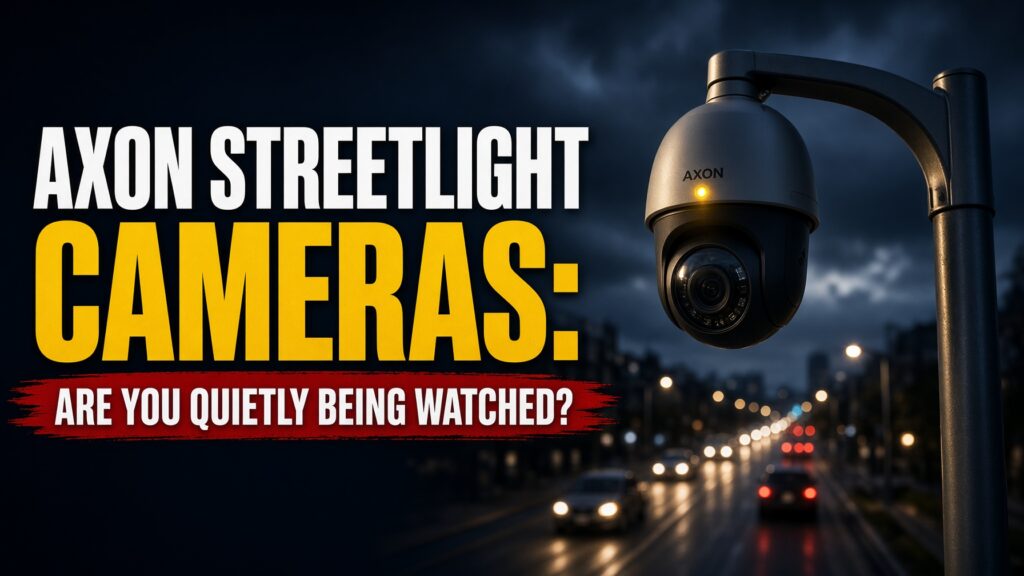
As cities across the country cancel one surveillance vendor’s contracts, a bigger one is quietly filling the gap — installed on the streetlight over your driveway. Who approved it, and did anyone tell you?
Streetlights are being turned into surveillance cameras. Most drivers have no idea it’s happening.
Axon, the company best known for Tasers and police body cameras, has spent the past year quietly rolling out a product called Lightpost. Built with infrastructure vendor Ubicquia, it clips onto an existing streetlight, plugs into the light’s own power socket, and turns it into a license plate reader, a live-streaming camera, and an AI system that logs vehicle make, model, and color. No new poles. No trenching. No public hearing required in most cities. Deployment takes under an hour.
Why does this matter right now? Because it’s happening at the exact moment communities across the country are fighting to get a different kind of camera taken down.
Is Anyone Watching What Replaced Flock?
Over the past two years, Flock Safety’s license plate readers became a flashpoint. Residents in dozens of towns pushed back over data retention, warrantless tracking, and vendor-run national databases, and some city councils responded by canceling contracts. That looked like a win for privacy advocates.
It wasn’t the end of the story. Axon spent years feeding plate data from Flock cameras into its own police systems, then ended that partnership in early 2025 and launched two direct competitors: Axon Outpost, a standalone pole camera, and Axon Lightpost, the streetlight retrofit. The pitch to cities was simple — same surveillance capability, tighter contract language, and seamless integration with the body cameras and cloud evidence systems many departments already use.
Cities aren’t ending license plate surveillance. They’re just switching which company runs it for them.
Denver is the clearest documented case. In March 2026, the city cut its Flock Safety contract and moved to Axon instead — 50 cameras instead of 100, 21-day data retention instead of 30, and no access to a vendor-run national database, according to local reporting. Grand Chute, Wisconsin made the same swap.
Support Independent Local Journalism
TheTownHall.News is a non-profit reader-supported journalism. Just $5 helps us hire local reporters, investigate important issues, and hold public officials accountable across Alameda County. If you believe our community deserves strong, independent journalism, please consider donating $5 today to support our work.What Do the Numbers Actually Tell Us About Who Profits?
Axon’s stock has more than doubled since 2023, and its ownership structure explains part of why. Institutional shareholders control roughly 80 percent of the company. The three largest are The Vanguard Group at around 10 to 11 percent, BlackRock at around 8 to 9 percent, and State Street at around 4 percent — a combined stake in the low-to-mid 20s [SEC filings].
That’s real money managed on behalf of pension funds, 401(k) accounts, and index investors — the vast majority of it passive, tracking the market rather than steering company policy. Critics have pointed to BlackRock CEO Larry Fink’s 2017 comment that the firm would “force behaviors,” though that remark was about diversity and hiring practices inside BlackRock, not surveillance policy at any company it invests in. Conflating the two oversells the connection.
$164.5 million. That’s what Axon’s CEO earned in 2024 — the highest pay package of any S&P 500 executive that year. The question taxpayers should ask: how much of that came from cities buying more cameras?
Most of that figure is a performance-based stock award tied to targets running through 2030, not cash already in hand, and the company has said as much publicly. Still, the incentive structure is worth understanding: Axon’s leadership is financially rewarded for growth, and government surveillance contracts are a growing share of that growth.
Is This Still Just “Public Safety”?
Axon markets Lightpost as a tool to help departments solve crimes faster — reading plates on stolen vehicles, tracking suspects fleeing a scene, giving officers live video before they arrive. Those are legitimate law enforcement functions, and no one disputes that police need tools to do their jobs.
The concern isn’t the existence of the technology. It’s the pace and quiet of the rollout. A camera that installs in under an hour, with no new construction and no dedicated budget line for a pole, is far easier to deploy without a public vote than a system that requires visible infrastructure. Cities can expand coverage fast, and residents may never notice the difference between a streetlight and a surveillance node until it’s already running.
Is a camera that no one voted on still “public safety” — or is it just surveillance with better branding?
What Does the Law Actually Say About This?
Regulation is scattered and inconsistent. Vermont’s licensing process has functionally blocked statewide ALPR deployment. Most states have no comparable protection at all. Two rulings in January 2026 — Schmidt v. City of Norfolk and State v. Simonson — upheld limited automated plate reader use, but both courts pointed to scale, data retention length, and how widely the data is shared as the factors that determine whether a program crosses a constitutional line.
If your license plate is logged every time you drive past a streetlight, who decided that was acceptable — and did anyone ask you?
That’s the real gap. Federal law hasn’t caught up, and most state legislatures haven’t either. The decision to convert a city’s streetlights into a tracking network is being made contract by contract, city council meeting by city council meeting, often with limited public awareness of what’s actually being installed overhead.
What Do Supporters of This Policy Actually Believe?
Advocates for expanded ALPR coverage make a straightforward case: plate readers solve crimes. They help recover stolen vehicles, locate missing persons, and give officers advance warning before responding to a scene. Departments argue that switching to Axon specifically tightens data retention and adds audit trails compared to some of the systems being replaced — as Denver’s shorter retention window and added logging requirements suggest.
That argument has merit, and it deserves a fair hearing rather than dismissal. But tighter rules from one vendor don’t answer the underlying question: who decides how much surveillance a city needs, and who reviews that decision once it’s made? A better contract is not the same as informed public consent. If plate-reading cameras are worth installing on every streetlight in a city, that is a decision significant enough to be made in the open, not folded into a routine procurement swap.

Key Questions This Raises
- Did your city council vote on Axon Lightpost cameras, or was it handled as a routine vendor contract?
- What happens to the plate and vehicle data collected — how long is it kept, and who can access it?
- If this counts as “public safety” infrastructure, why does it require no public infrastructure review?
Has the Surveillance State Just Gotten a Better Disguise?
Swapping Flock for Axon doesn’t roll back surveillance. It relocates it into infrastructure residents already trust and stop noticing — the streetlight over their driveway, the pole at the end of their block. The cameras got smaller, faster to install, and harder to spot. The tracking didn’t go anywhere.
The real question isn’t whether license plate cameras can help solve crimes. It’s whether that trade-off is being decided by the public it affects, or by contract renewals nobody reads. Until cities are required to hold an open vote before converting streetlights into surveillance nodes, residents will keep finding out after the fact — if they find out at all.
What do you think — should cities be required to hold a public vote before installing cameras like this? Share this article and let your city council know you’re paying attention. Still have questions about how this affects your neighborhood? Subscribe for daily coverage of accountability issues that matter. Want your voice to count? Check your city council’s upcoming meeting agenda and speak up before the next contract is signed.