Trump DHS Proposes 75% Citizenship Fee Hike — And Kills the Waivers That Helped the Poor
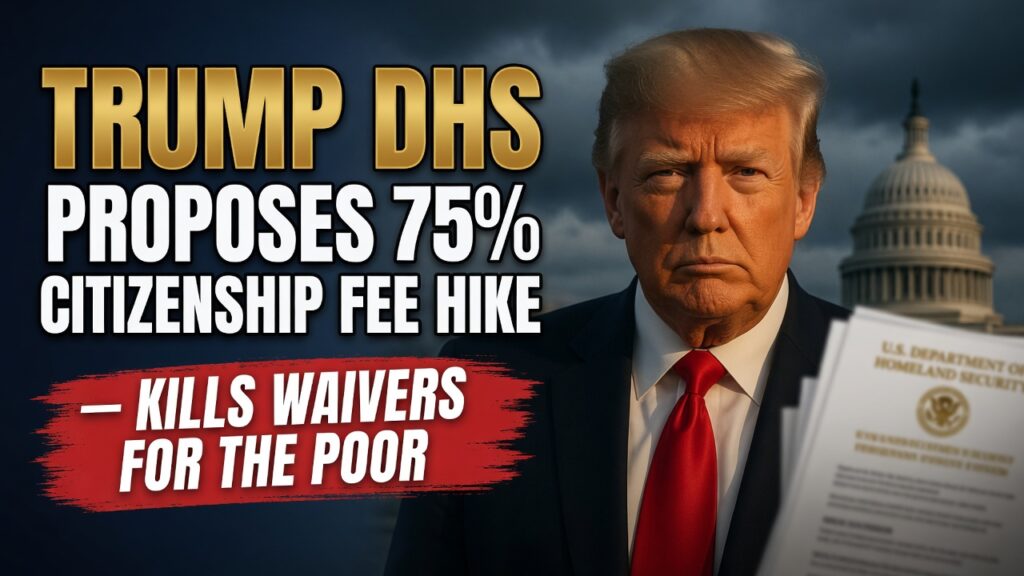
A proposed rule published in the Federal Register on June 22, 2026 would raise naturalization application fees by up to 80% and eliminate income-based fee waivers — pricing hundreds of thousands of legal immigrants out of the citizenship process just weeks before America’s 250th birthday.
The Trump administration has a message for the roughly one million legal immigrants who apply for U.S. citizenship every year: pay up — or wait.
On June 22, the Department of Homeland Security published a Notice of Proposed Rulemaking in the Federal Register that would raise the cost of filing Form N-400 — the primary citizenship application — from $760 to $1,330 on paper, a 75% increase. Online filers would see their fee jump from $710 to $1,280, an 80% hike. Applicants who were previously denied and are seeking a hearing through Form N-336 would face an even steeper climb: from $830 to $1,475, a 77.7% increase.
Support Independent Local Journalism
TheTownHall.News is a non-profit reader-supported journalism. Just $5 helps us hire local reporters, investigate important issues, and hold public officials accountable across Alameda County. If you believe our community deserves strong, independent journalism, please consider donating $5 today to support our work.If finalized, the rule would generate more than $430 million in additional annual revenue from prospective citizens — and shut the door on the low-income waivers that made naturalization possible for working-class immigrants.
What Does the Proposed Rule Actually Do?
The rule does three things that matter:
First, it nearly doubles the cost of filing for citizenship. The $570 increase on a paper-filed N-400 is not a rounding error — it is a structural price barrier imposed on a process that already includes years of legal fees, green card renewals, background investigations, and English and civics test preparation.
Second, it eliminates the reduced-fee option. Currently, immigrants earning up to 400% of the federal poverty level can file for citizenship at a reduced rate of $380. That option disappears entirely under the proposed rule.

Third, it kills income-based fee waivers. Right now, applicants who receive public benefits or can demonstrate financial hardship can receive a full fee waiver. DHS proposes to eliminate that pathway for virtually all applicants. The only group exempted: active-duty and former U.S. military members, who are exempt from naturalization fees by law.
The administration is not hiding its intent. The proposed rule states plainly that DHS “no longer believes naturalization benefit requests should get lower fees at the potential expense of other immigration benefits.” Translation: the government is done treating citizenship as something worth subsidizing.
Why Is DHS Doing This Now?
DHS frames the increase around cost recovery. USCIS is unusual among federal agencies in that it is funded almost entirely by application fees, not congressional appropriations. The agency argues that current fees “do not recover the full cost of thoroughly adjudicating applications for naturalization, including necessary screening and vetting checks” being expanded under Trump’s executive orders — including social media reviews now conducted on both green card and citizenship applicants.
The administration calls this a “full-cost, beneficiary-pays” model. The logic: if you want the benefit of U.S. citizenship, you should bear the full administrative cost of obtaining it.
That argument has a hole in it the size of the Capitol Rotunda.
Support Independent Local Journalism
TheTownHall.News is a non-profit reader-supported journalism. Just $5 helps us hire local reporters, investigate important issues, and hold public officials accountable across Alameda County. If you believe our community deserves strong, independent journalism, please consider donating $5 today to support our work.Congress recently approved a $70 billion spending package to fund ICE and the Border Patrol. The administration has not proposed that immigration enforcement operations be funded solely by the people being detained. The “beneficiary pays” principle, it seems, applies selectively — to those trying to become Americans legally, not to the enforcement apparatus targeting those who aren’t.
What Critics Are Saying
The reaction from immigration attorneys and policy experts was swift and pointed.
Doug Rand, a former senior USCIS official under the Biden administration, did not mince words: “The only credible explanation for jacking up citizenship fees in isolation is that Trump 2.0 is in a hurry to create even more undue barriers for legal immigrants.”
Aaron Reichlin-Melnick, a senior fellow at the American Immigration Council, noted the historical context in a post on X: “For generations, the U.S. government deliberately kept citizenship application fees low in an effort to encourage the millions of people with green cards to apply. No longer.”
Murad Awawdeh, president and CEO of the New York Immigration Coalition, called the near-doubling of fees “yet one more undue hurdle that burdens those who only want to be recognized in the last step of their American Dream,” warning that “for some, it will effectively shut the door to attaining the promise of America.”
Immigration attorney Rosanna Berardi, speaking to ABC News, placed the proposal in its proper context: “This is entirely consistent with the Trump administration’s broader message of making legal immigration harder, more expensive, and less accessible — not just illegal immigration.”
Even a former DHS official acknowledged the tension. Adam Klein, co-founder of Globali.ai and an ex-DHS appointee, told Newsweek that “what is less clear is what additional services applicants themselves will receive in return. For many applicants, the perception may be that they are paying significantly more while receiving less in the way of accessibility and customer service.”
A Deliberate Reversal of Decades of Federal Policy
This is not a fee adjustment. It is a policy reversal.
For decades, administrations of both parties treated low naturalization fees as a matter of public interest. Citizens vote. Citizens serve on juries. Citizens pay taxes with full participation in civic life. Researchers have consistently found that naturalization correlates with higher economic mobility, civic participation, and long-term integration — benefits that accrue to the country, not just the individual applicant.
The Trump administration has made a different calculation: that the cost of vetting applicants should be borne entirely by the applicants themselves, and that those who cannot afford the higher price simply must wait.
The timing is notable. The proposed rule lands two weeks before the United States celebrates its 250th anniversary — a moment of national reflection on what it means to be American and who gets to become one.
What Happens Next?
The proposed rule is not final. A 60-day public comment period opened June 22, 2026, with comments accepted through August 24, 2026. Members of the public — including the roughly one million people who apply for naturalization each year — may submit comments electronically before DHS decides whether to finalize the changes.
Current fees remain in place throughout this process. Applicants who file before any final rule takes effect lock in the current, lower fee — provided they meet all eligibility requirements.
Researchers who have studied previous fee hikes — including a major increase under the George W. Bush administration — found measurable reductions in naturalization rates among lower-income immigrant groups in the years that followed. If this rule is finalized, the data suggests it will not just delay citizenship for hundreds of thousands of legal immigrants. For some, it will end the process entirely.
Key Questions
- Will the rule survive legal challenge? The proposal follows standard federal rulemaking procedures, but advocacy groups are already signaling opposition. Any final rule could face litigation over its disparate impact on low-income immigrants.
- How will Congress respond? The $70 billion border security bill passed with bipartisan support. Whether Congress takes any action to block or constrain this fee rule is an open question.
- What does research show about the effect of fee hikes on naturalization rates? Past increases have measurably reduced naturalization among lower-income immigrant populations. DHS acknowledges the possibility in the proposed rule itself, describing citizenship demand as “inelastic” — a claim critics dispute.
- Will the comment period produce any changes? DHS is required to review and respond to substantive public comments. Whether the administration will revise the rule in response remains to be seen.