US Supreme Court Ruling: Freight Broker Liability Upheld in Unanimous 9-0 Decision
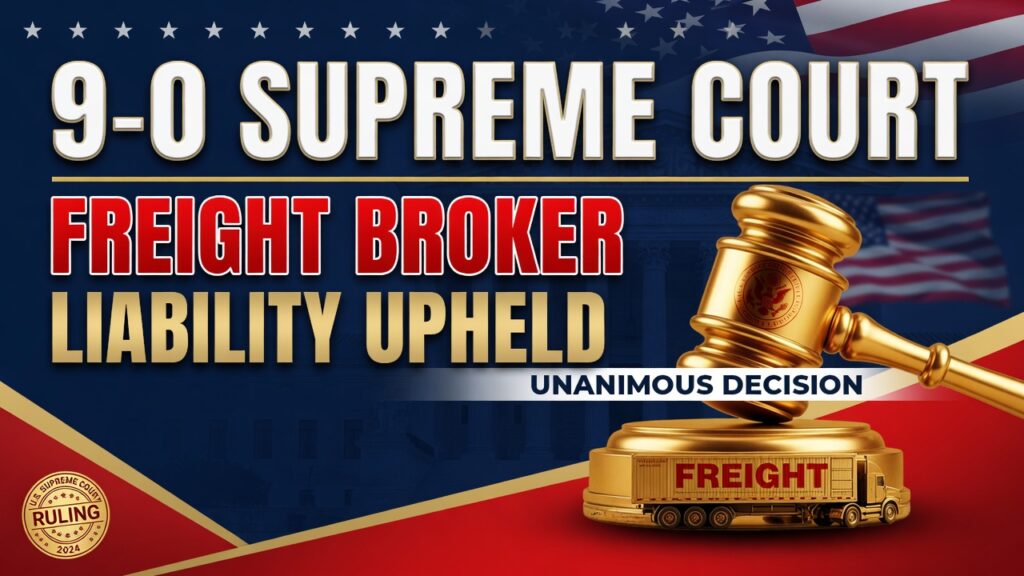
The unanimous 9-0 decision in Montgomery v. Caribe Transport II signals a new era of law and order for the logistics industry, stripping away the federal legal shields that allowed brokers to profit from negligence.
The American highway system is the lifeblood of our economy, a vast network that facilitates the commerce and freedom we cherish. Yet, for decades, a legal loophole has allowed multi-billion-dollar freight brokers to prioritize profit over public safety by hiring the cheapest, least-qualified carriers available. These brokers often claimed that federal law shielded them from the consequences of their hiring decisions, effectively leaving families devastated by preventable accidents with no recourse and no accountability.
That era of legal immunity came to a definitive end today. In a landmark 9-0 ruling in Montgomery v. Caribe Transport II, the United States Supreme Court confirmed that the “safety exception” in federal law means exactly what it says: brokers can be held liable under state negligence laws for hiring unsafe trucking companies. Delivered by Justice Amy Coney Barrett, the opinion is a resounding victory for the principles of personal responsibility and the rule of law.
The End of Federal Overreach in Logistics
For years, the freight brokerage industry leaned heavily on the Federal Aviation Administration Authorization Act (FAAAA) of 1994. The industry argued that this federal statute “preempted”—or blocked—state-level negligence lawsuits. They claimed that allowing a jury to decide if a broker was negligent would interfere with the “prices, routes, and services” of the shipping industry. It was a classic example of using federal preemption as a shield to dodge local accountability.
Support Independent Local Journalism
TheTownHall.News is a non-profit reader-supported journalism. Just $5 helps us hire local reporters, investigate important issues, and hold public officials accountable across Alameda County. If you believe our community deserves strong, independent journalism, please consider donating $5 today to support our work.Justice Barrett’s opinion dismantled this overreach. The Court clarified that while the FAAAA protects the free market from state-mandated pricing or routing, it does not grant a “get out of jail free” card to companies that ignore basic safety standards. By upholding the safety exception, the Court has returned power to the states and the people, ensuring that the traditional “police power” to protect citizens remains intact.
Why Personal Responsibility Matters for Brokers
At the heart of this case is the fundamental American value of personal responsibility. When a broker selects a carrier to haul 80,000 pounds of steel at 70 miles per hour, that broker is making a choice. If they choose a carrier with a history of safety violations, unlicensed drivers, or a pattern of ignoring federal hours-of-service rules, they are introducing a known risk into our communities.
Under the previous legal interpretation, brokers were incentivized to look the other way. By hiring the lowest bidder—regardless of their safety record—brokers could maximize margins while passing the risk onto the American public. This ruling flips that script. Now, the entity making the profit must also bear the responsibility for the vetting process. It is no longer enough to simply “click a button” and hire the cheapest truck; brokers must now perform the due diligence that safety and common sense require.
Cleaning Up the CDL System
The trucking industry has faced growing concerns regarding the integrity of the Commercial Driver’s License (CDL) system. Reports of fraudulent schools and carriers operating with “fly-by-night” credentials have flooded the industry. In some instances, carriers have been found to employ drivers who lack proper legal status or the necessary linguistic and technical training to navigate American roads safely.

This Supreme Court ruling acts as a market-based “crackdown.” Because brokers now face massive financial liability, they will be forced to scrutinize every carrier in their network. Carriers that cannot prove they are operating with legal, fully-vetted, and compliant drivers will find themselves unable to get work. This is not government bureaucracy at work; it is the civil justice system holding the private sector to a standard of excellence.
How This Protects American Families
Safety on the road is a pro-family issue. Every day, parents drive their children to school and commuters head to work alongside massive tractor-trailers. The “Wild West” atmosphere of the brokerage market, where safety was often treated as an optional secondary concern, put every one of those families at risk.
By allowing negligence lawsuits to move forward, the Court has ensured that the “real cost” of an accident is borne by those who could have prevented it. When a broker ignores a carrier’s “unsatisfactory” safety rating from the Department of Transportation, they are gambling with other people’s lives. This ruling ensures that when that gamble fails, the broker—not just the potentially insolvent trucking company—is held to account for the damages.
Addressing the Economic Counterargument
Critics of the ruling, including some industry trade groups, argue that this will lead to a “patchwork” of state regulations that will drive up the cost of shipping. They suggest that the threat of litigation will force smaller brokers out of business and lead to higher prices for consumers. Some even argue that this is a win for “trial lawyers” rather than the public.
However, this argument ignores the fiscal reality of negligence. The costs of highway accidents—healthcare, infrastructure repair, and loss of life—are already being paid, often by the victims and taxpayers. Shifting that cost back to the negligent parties is not “inflationary”; it is an exercise in fiscal accountability. A free market only functions correctly when participants are responsible for the risks they create. Protecting brokers from the consequences of their own negligence is a form of corporate welfare that the Supreme Court has rightly rejected.
Support Independent Local Journalism
TheTownHall.News is a non-profit reader-supported journalism. Just $5 helps us hire local reporters, investigate important issues, and hold public officials accountable across Alameda County. If you believe our community deserves strong, independent journalism, please consider donating $5 today to support our work.Restoring Law and Order to the Supply Chain
The logistics industry is the backbone of the American economy, but a backbone must be strong and well-regulated by the principles of law. For too long, the lack of broker liability created a “race to the bottom.” Companies that invested in high safety standards were undercut by those who cut corners, knowing the brokers wouldn’t be held responsible for the fallout.
This 9-0 decision levels the playing field. It rewards carriers that play by the rules and maintain impeccable safety records. It also encourages brokers to invest in better technology and more rigorous vetting processes. In the long run, this will create a more stable, professional, and law-abiding supply chain. Law and order are not just for the streets; they must apply to the commercial contracts that move our nation’s goods.
The Role of Traditional Civic Values
We live in an age where many feel that large corporations have become disconnected from the communities they serve. By affirming that state negligence laws apply to freight brokers, the Supreme Court has reinforced the importance of local civic values. It acknowledges that a community in Iowa or Florida has the right to set safety standards for the vehicles passing through its towns.
This ruling is a victory for the idea that “common law” still matters. The duty to act with reasonable care toward one’s neighbor is a cornerstone of Western legal tradition. By refusing to let a federal statute erase that duty, the Court has preserved a vital part of our legal heritage.
A Key Takeaway for the Industry
The message to freight brokers is now crystal clear: You are your brother’s keeper when you put them on the road. The Supreme Court has signaled that the era of “ignorance is bliss” is over. Every broker in America must now review their carrier selection protocols.
“Federal law does not provide a safe harbor for negligence. If you profit from the selection of a carrier, you must answer for the safety of that selection.” — A core implication of the Barrett Opinion.
Moving Toward a Safer Future
As we look forward, the impact of Montgomery v. Caribe Transport II will be felt in every boardroom and dispatch office in the country. We can expect to see a “purge” of the CDL system as brokers demand higher standards. We will see an end to the practice of hiring carriers with “chameleon” DOT numbers—carriers that shut down and reopen under new names to hide bad safety records.
This is a win for the rule of law, a win for the states, and most importantly, a win for the safety of every American traveler. The Supreme Court has reminded us that in a free society, with great opportunity comes great responsibility.
Call to Action
The fight for safer roads and corporate accountability doesn’t end with one court ruling. It requires an informed and engaged citizenry to ensure these standards are upheld in every statehouse and courtroom.
- Stay Informed: Follow the implementation of this ruling and how it affects your local state laws.
- Share the News: Help others understand why this ruling is a victory for personal responsibility.
- Support Accountability: Encourage your representatives to maintain high standards for the CDL system and carrier vetting.