The Adam Hoffman Sentence: Why Paxton’s Plea Deal Fails Texas Families
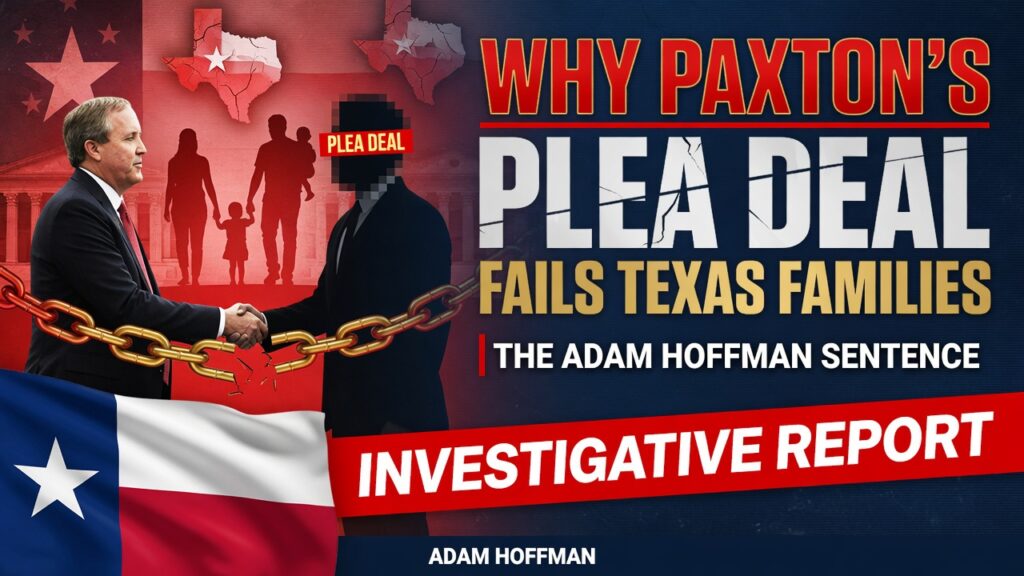
A visiting judge’s decision to reject a lenient plea deal from Ken Paxton’s office exposes a critical breakdown in institutional accountability. Discover why this case represents a pivotal moment for parental rights, judicial integrity, and the rule of law in Texas.
The foundation of a free society relies on a simple, unwavering principle: the law must be applied equally, justly, and with absolute transparency. When the justice system functions properly, it protects the vulnerable, punishes the guilty, and reinforces the traditional civic values that bind communities together. However, when institutional overreach or administrative leniENCY compromises that foundation, the public’s trust in government is deeply shaken.
The recent sentencing of former Waco attorney Adam Hoffman has brought these core principles into sharp, agonizing relief. What should have been a straightforward application of justice instead turned into a stark demonstration of institutional failure, narrowly averted by a courageous judiciary. The fallout from this case extends far beyond the borders of McLennan County, raising urgent questions about how justice is administered in the Lone Star State.
The Shocking Details of the Hoffman Case
On Monday, April 27, 2026, visiting Judge Roy Sparkman took the unusual step of intervening in a highly controversial plea agreement. The deal, brokered by Texas Attorney General Ken Paxton’s office, would have permitted Adam Hoffman, a prominent local attorney, to serve a mere 30 days in a county jail. Hoffman had been accused of the sexual abuse of a minor—a charge that carries severe moral and legal weight.
Support Independent Local Journalism
TheTownHall.News is a non-profit reader-supported journalism. Just $5 helps us hire local reporters, investigate important issues, and hold public officials accountable across Alameda County. If you believe our community deserves strong, independent journalism, please consider donating $5 today to support our work.Recognizing the profound inadequacy of the state’s recommendation, Judge Sparkman effectively doubled the sentence to 60 days. In delivering his decision, the judge issued a stinging rebuke to the prosecutors, declaring that “the system has to work” and expressing deep concern over the leniency of the state’s agreement. While the judge’s intervention provided a modicum of accountability, the structure of the underlying plea bargain remains deeply troubling to local families and legal observers alike.
Why This Plea Deal Threatens the Rule of Law
The primary outrage surrounding the Hoffman case stems not just from the brevity of the jail sentence, but from the long-term legal concessions granted to the defendant. Because the Attorney General’s office allowed Hoffman to plead guilty to two Class A misdemeanors—indecent assault and displaying harmful materials to a minor—rather than felony charges, a critical accountability mechanism was bypassed.
Tweetable Quote: True law and order cannot exist when institutional shortcuts allow the well-connected to bypass the permanent consequences of their actions.
As a direct result of this misdemeanor arrangement, Hoffman is completely exempt from registering as a sex offender. The sex offender registry is not an arbitrary bureaucratic hurdle; it is a vital public safety tool designed to protect neighborhoods, schools, and families. By structuring a deal that avoids this requirement, the state has effectively prioritized the rehabilitation and convenience of a perpetrator over the long-term protection of the community.
How This Case Affects Families and Parental Rights
For parents, the details of the Hoffman agreement are nothing short of alarming. Parental rights encompass more than just educational choices and healthcare decisions; they include the fundamental right to raise children in an environment where predators are held fully accountable. When the state minimizes crimes against minors, it erodes the protective framework that parents rely on to keep their children safe.

The community reaction in Waco has been swift and severe, characterized by public protests outside the McLennan County Courthouse. Local grass-roots organizations and outraged citizens are demanding to know why a licensed attorney, who understood the boundaries of the law, was extended such an extraordinary degree of leniency. This public backlash demonstrates that everyday citizens still hold a deep commitment to traditional civic values and will not quietly accept the dilution of justice.
The Broken Promise of Limited Government and Accountability
Proponents of limited government frequently argue that state institutions must remain tightly constrained, transparent, and strictly accountable to the people they serve. The Texas Attorney General’s office holds a massive amount of power, funded entirely by hardworking taxpayers. When that power is used to broker backroom deals that defy common-sense standards of justice, it represents a profound failure of fiscal and moral accountability.
Taxpayers expect their resources to be used to vigorously prosecute crimes, particularly those committed against the most vulnerable members of society. A system that expends public funds to secure a 30-day jail stay for abuse charges is not operating efficiently or justly. It suggests a bureaucratic disconnect where institutional convenience takes precedence over public safety and constitutional duty.
What the Critics Get Wrong About Plea Bargaining
Defenders of the state’s strategy often argue that plea bargains are an indispensable component of a heavily burdened judicial system. They contend that securing a guaranteed misdemeanor conviction and a brief jail sentence is preferable to risking a lengthy, expensive trial where an acquittal is always a statistical possibility. In their view, expediency and resource preservation justify the compromise.
However, this pragmatic defense completely misses the broader purpose of criminal justice. Efficiency should never be chased at the expense of equity. When a plea bargain undermines public safety by omitting mandatory sex offender registration, the deal ceases to be a practical tool and becomes a liability. Furthermore, the argument that trials are too risky implies a lack of confidence in the state’s own investigative and prosecutorial capabilities.
Support Independent Local Journalism
TheTownHall.News is a non-profit reader-supported journalism. Just $5 helps us hire local reporters, investigate important issues, and hold public officials accountable across Alameda County. If you believe our community deserves strong, independent journalism, please consider donating $5 today to support our work.Grace, Forgiveness, and the Demand for Secular Justice
One of the most extraordinary aspects of the April 27 hearing occurred during the delivery of the victim impact statements. In an act of profound personal grace, the victim and his mother stated publicly that they forgave Hoffman. They even presented the former attorney with a personalized Bible, embossed with his name and the phrase “Truth that set you free.”
While this display of faith and personal forgiveness is deeply moving on an individual level, it does not absolve the state of its secular duty to enforce the law. The spiritual forgiveness extended by a victim belongs to the realm of personal conscience. The legal system, conversely, operates in the realm of public safety and deterrence. The state’s job is to ensure that justice is served to protect the collective community, regardless of the victim’s extraordinary capacity for mercy.
Key Takeaways from the Hoffman Sentencing
To understand the full scope of this developing story, citizens must keep several core facts in mind:
- Judicial Intervention: Judge Roy Sparkman rejected the state’s lenient timeline, doubling the jail sentence from 30 days to 60 days.
- Professional Consequences: As part of the final agreement, Adam Hoffman was forced to surrender his law license for a period of five years.
- The Registry Loophole: Because the charges were reduced to Class A misdemeanors, Hoffman will completely avoid the state’s sex offender registry.
- Public Outrage: The perceived leniency of the deal has sparked ongoing protests in Waco, with citizens demanding prosecutorial reform.
Reclaiming Integrity in the Texas Legal System
The Adam Hoffman case must serve as an urgent wake-up call for legal reformers across Texas. To prevent this type of institutional failure from recurring, the state legislature should examine guidelines regarding prosecutorial discretion in cases involving minors. There must be strict boundaries that prevent felony-level offenses from being bargained down to standard misdemeanors when public safety mechanisms are at stake.
Furthermore, local district attorneys and state-level prosecutors must be reminded that they are accountable to the electorate. Transparency shouldn’t be an afterthought; it must be the default standard. When deals are made behind closed doors that shock the conscience of local judges and communities alike, the individuals responsible must face rigorous public scrutiny.
Conclusion: The Path Forward for Law and Order
The rule of law is a fragile construct, maintained only through the continuous exercise of institutional integrity and personal responsibility. When Judge Roy Sparkman stepped in to double Hoffman’s sentence, he performed a vital service to the state of Texas, signaling that the judiciary will not always act as a rubber stamp for questionable prosecutorial decisions. Yet, the fact remains that a dangerous loophole was utilized to spare a perpetrator from long-term public accountability.
If we wish to preserve a society rooted in traditional civic values, limited government, and parental rights, we cannot afford to remain silent when the system falters. True justice requires vigilance from everyday citizens who insist that the law protect the innocent and punish the guilty without fear or favor.
Call to Action
Stay informed, stay engaged, and join the conversation. Share this article on social media to shed light on the structural flaws within our legal system. If you believe in protecting parental rights and maintaining true law and order, support independent, fact-checked journalism by subscribing to our newsletter today. Leave your thoughts in the comments below—how can we better hold our elected prosecutors accountable?