Government Shutdown Congressional Pay: Senate Votes 99-0 to Stop Lawmaker Salaries
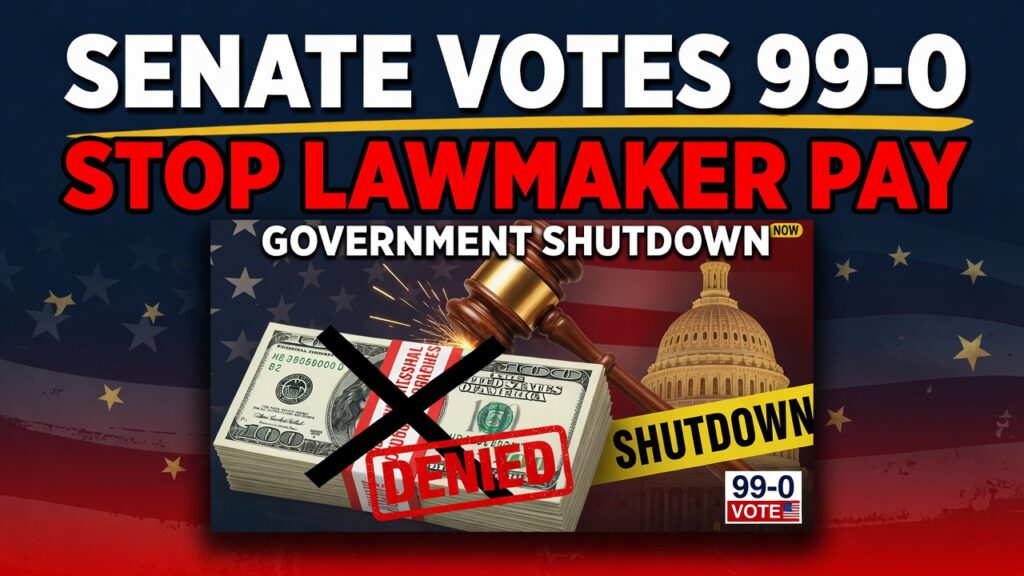
In a historic 99–0 vote, the U.S. Senate advanced a resolution to halt congressional pay during federal funding lapses, signaling a long-overdue return to fiscal accountability and basic fairness.
For decades, the American public has watched the same exhausting political theater play out in Washington. Government funding deadlines approach, partisan brinkmanship intensifies, and the threat of a government shutdown looms over the nation. When the gears of government grind to a halt, the consequences are immediately felt by the people. National parks close, vital regulatory services pause, and hundreds of thousands of federal employees—from TSA agents to military personnel—are forced to work without pay or face mandatory furloughs.
Yet, amidst this financial chaos, one group has historically remained entirely insulated from the fallout: the lawmakers who caused it. Under current rules, members of Congress continue to receive their taxpayer-funded salaries, completely untouched by the crises they engineer. It is a striking double standard that alienates everyday citizens and undermines the foundational civic principle that leaders should be accountable to the people they serve.
Why This Unanimous Vote Matters Now
Change may finally be on the horizon. In a rare display of total bipartisan unity, the U.S. Senate voted 99–0 to advance Senate Resolution 526. Introduced by Senator John Kennedy (R-LA), this measure aims to fundamentally alter Senate rules by withholding lawmakers’ paychecks during any future government shutdown. The unanimous vote to clear a crucial procedural hurdle indicates that the era of consequence-free governance may be drawing to a close.
Support Independent Local Journalism
TheTownHall.News is a non-profit reader-supported journalism. Just $5 helps us hire local reporters, investigate important issues, and hold public officials accountable across Alameda County. If you believe our community deserves strong, independent journalism, please consider donating $5 today to support our work.This legislative momentum follows a series of grueling funding battles between late 2025 and early 2026. The nation witnessed a historic 43-day full shutdown, followed closely by a 74-day partial lapse that crippled the Department of Homeland Security. Throughout these extended crises, citizens watched in disbelief as families of federal workers scrambled to pay rent, while the politicians responsible for the gridlock faced zero personal financial repercussions. The Senate’s recent vote recognizes that Washington can no longer operate under a separate set of rules from the rest of America.
Restoring the Principle of Personal Responsibility
At its core, the debate over congressional pay during a government shutdown is a matter of personal responsibility. In the private sector, if a management team fails to produce a budget, secure operational funding, or keep the lights on, they do not get rewarded with a bonus. In fact, they usually lose their jobs.
“If we can’t do our jobs and fund the government, we don’t deserve a paycheck—plain and simple.” — Senator John Kennedy
By aligning the financial incentives of lawmakers with the well-being of the public, S. Res. 526 introduces a healthy dose of free-market accountability to Capitol Hill. For too long, the political class has treated government funding deadlines as low-stakes games of chicken. When politicians have skin in the game, their willingness to compromise increases exponentially. This resolution forces senators to experience a fraction of the real-world pressure felt by their constituents during a fiscal crisis.
The Mechanics of Fiscal Accountability
To understand the impact of this resolution, one must look at how it navigates the complex legal framework of Washington. The U.S. Constitution, specifically the Twenty-Seventh Amendment, strictly regulates changes to congressional compensation to prevent sitting lawmakers from arbitrarily altering their own pay. Because of these constitutional protections, S. Res. 526 cannot permanently cancel a senator’s salary.

Instead, the resolution utilizes a clever, legally sound workaround: escrow. If a shutdown occurs, the Secretary of the Senate is directed to withhold and lock away all senators’ paychecks. The funds remain frozen for the duration of the funding lapse. Senators will only be allowed to collect their back pay after they successfully pass appropriations bills and reopen the government. Furthermore, to remain ethically compliant, the rule change is set to take effect immediately following the 2026 midterm elections, ensuring that voters have their say before the new mandate governs the chamber.
The Problem with a Divided Capitol
While the Senate’s 99–0 vote is a massive step forward, it highlights a structural vulnerability in the legislative branch. Because S. Res. 526 is an internal Senate resolution rather than a statutory bill, it only applies to the upper chamber. It changes the operating rules for senators, but it lacks the legal mechanism to bind the House of Representatives.
This leaves a glaring loophole where members of the House could still receive their full, uninterrupted salaries during a national funding crisis. House Speaker Mike Johnson (R-LA) has acknowledged the growing public pressure, stating that his members have “some ideas on that as well.” Rank-and-file House members have introduced companion legislation, such as the No Work, No Pay Act, to mirror the Senate’s efforts. However, until the House formally adopts similar internal rules, the job of holding all of Congress accountable remains incomplete.
What Critics Get Wrong About the Resolution
Detractors of the “no pay during shutdowns” concept often raise practical objections. The most common argument is that withholding pay would disproportionately harm less-wealthy lawmakers. Critics claim that independently wealthy members of Congress can easily survive months without a paycheck, while lawmakers who rely solely on their official salary would be pressured into signing bad spending bills just to keep their personal finances afloat.
This argument, however, misjudges the reality of modern congressional dynamics and insults the integrity of public service. Lawmakers enter public office fully aware of the responsibilities and fiscal cycles of the federal government. Furthermore, the argument ignores the vast safety net available to lawmakers compared to the average federal employee or military family. Suggesting that elected officials cannot manage their personal finances through a temporary escrow period—while expecting everyday citizens to endure the same—is the pinnacle of political elitism.
Support Independent Local Journalism
TheTownHall.News is a non-profit reader-supported journalism. Just $5 helps us hire local reporters, investigate important issues, and hold public officials accountable across Alameda County. If you believe our community deserves strong, independent journalism, please consider donating $5 today to support our work.Restoring Traditional Civic Values
The overwhelming public support for this resolution reflects a deeper cultural desire to restore traditional civic values to American governance. A healthy republic requires mutual trust between the governing body and the governed. When politicians exempt themselves from the hardships caused by their own administrative failures, that trust is shattered.
By voluntarily subjecting themselves to financial escrow during a shutdown, senators are signaling a return to the ideal of the citizen-legislator. Public service was never intended to be a career path insulated from the economic realities of the working class. True leadership requires shared sacrifice. When Washington elite are forced to sit at the same table of fiscal reality as the rest of the country, it strengthens the democratic bond and reinforces the rule of law.
The Path Forward for True Reform
The unanimous Senate vote is an undeniable victory, but the American public must remain vigilant to ensure this momentum is not lost. For S. Res. 526 to truly change the culture of Washington, it must become a baseline standard for all branches of government.
Key Takeaways of the Congressional Pay Reform
- Unanimous Bipartisan Support: The Senate voted 99–0 to advance the rules change, proving that fiscal accountability is a unifying issue.
- The Escrow Mechanism: Lawmakers’ pay will be legally frozen, not canceled, complying with constitutional limits while maintaining pressure.
- The House Loophole: The resolution currently only applies to the Senate; the House of Representatives must pass matching rules to close the loop.
- Effective Date: The accountability measures are structured to take effect following the 2026 midterm elections.
Citizens must now turn their attention to the House of Representatives. The momentum generated in the Senate should be used to demand immediate action from House leadership. Voters have a right to know exactly where their representatives stand on the issue of fundamental fairness.
Conclusion
The U.S. Senate’s unanimous decision to advance S. Res. 526 is a monumental shift toward genuine government accountability. By removing the financial safety net that politicians enjoy during self-inflicted fiscal crises, this measure incentivizes efficient governance and respects the taxpayer. It proves that when the public demands higher standards of personal responsibility from their leaders, Washington is forced to listen. We must continue to champion these reforms, ensuring that our elected officials always answer to the same economic realities as the citizens they represent.
Call to Action
Stay Informed and Engaged: The fight for fiscal responsibility and political accountability requires continuous public oversight. Share this article on social media to keep the pressure on the House of Representatives to pass matching legislation. Support independent journalism that exposes bureaucratic overreach, and talk to your local representatives about making congressional pay reform a permanent reality.