Hayward Advances Depot Road Housing Plans on Key City-Owned Parcels
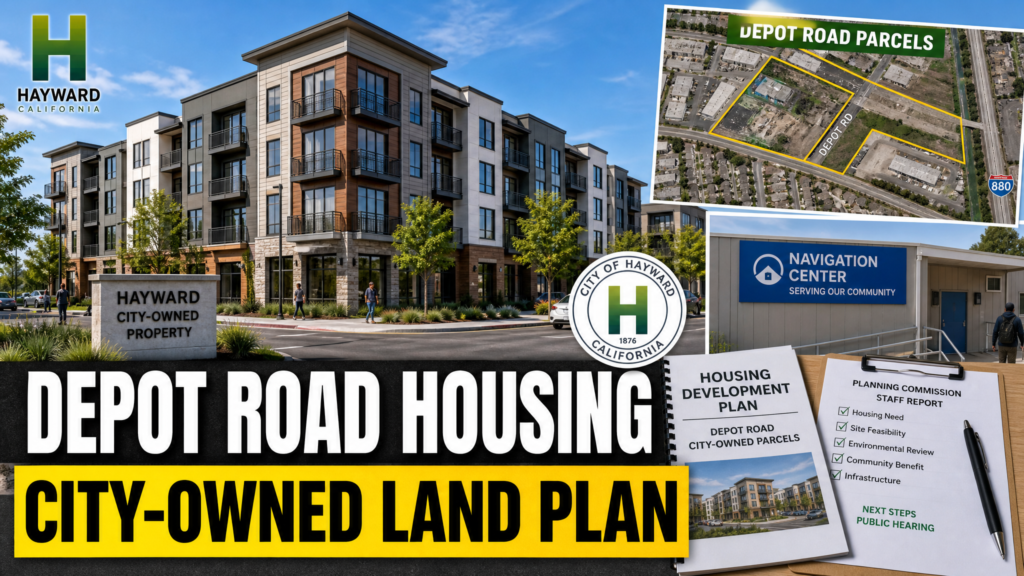
Hayward is moving ahead with plans for two city-owned Depot Road parcels tied to Bay Area Community Services, homelessness response, and affordable-housing goals—raising a bigger question about whether public land will be used for lasting public benefit or simply managed as another city asset. Source
Hayward’s push to develop key city-owned parcels on Depot Road is more than a routine land-use item. It is a test of what local government does with scarce public land when housing costs are high, homelessness remains visible, and taxpayers are being asked to trust City Hall’s long-term judgment.
In December 2025, the Hayward City Council authorized a disposition and development agreement for two city-owned Depot Road parcels with Bay Area Community Services, or BACS, according to the public-interest watchlist covering the Nov. 2025-Apr. 2026 council agenda. That move did not just advance a housing concept. It signaled that the city wants to use public land in the Depot Road area as part of a broader strategy connecting housing, supportive services, and homelessness response. Source
Support Independent Local Journalism
TheTownHall.News is a non-profit reader-supported journalism. Just $5 helps us hire local reporters, investigate important issues, and hold public officials accountable across Alameda County. If you believe our community deserves strong, independent journalism, please consider donating $5 today to support our work.Why This Issue Matters Now
Hayward is not debating an abstract housing theory. It is deciding what should happen on land the public already owns. That matters because public land is one of the few tools local government fully controls in a region where land prices often make affordable housing difficult to build.
The city’s current surplus-land materials identify two Depot Road sites: 3788 Depot Road, a 0.73-acre parcel currently used as the Hayward Navigation Center/Interim Housing, and a nearby Depot Road/Whitesell Street parcel of 0.24 acres that is listed as vacant. Both are designated Industrial Corridor in the General Plan and zoned General Industrial. Source
That alone makes this a consequential local-government story. When City Hall moves from owning land to positioning it for disposition and development, the public deserves to know what is being promised, what is being protected, and what conditions will follow the land after the deal is done.
What the City Actually Controls
The strongest fact in this story is simple: the land is already public. The Navigation Center sits on city-owned land at the corner of Depot Road and Whitesell Street, and the center exists specifically to address Hayward’s homelessness crisis. It provides outreach services, short-term housing for 45 people at a time, intensive case management, and housing-placement services. The center is operated 24 hours a day, seven days a week by BACS. Source

That matters because it shows the Depot Road corridor is not random. It is already a place where Hayward has concentrated homelessness-response infrastructure and supportive housing activity.
The city also has a recent nearby example of public-land-driven housing policy in action. At 2595 Depot Road, Hayward and Allied Housing opened Depot Community Apartments, a 125-unit micro-studio affordable supportive-housing development. Nearly half the units were reserved for people experiencing homelessness and extremely low-income households referred through Alameda County’s Coordinated Entry System, while the rest were reserved for residents earning 30 to 60 percent of Area Median Income. The development was backed in part by Hayward’s full $18 million share of Alameda County Measure A1 affordable-housing funds and $6 million from the city’s affordable-housing trust funds. Source
That track record is important. It suggests the city is not improvising on Depot Road. It is building on an existing strategy of pairing land control, supportive services, and subsidized housing.
A Public-Land Strategy—or a Public-Land Gamble?
Supporters of the Depot Road plan can make a fair case. When a city owns land, it can shape outcomes more directly than when it waits for private developers to bring proposals. It can require affordability. It can prioritize people exiting homelessness. It can align land use with services already nearby.
But public control only matters if officials use it well.
Support Independent Local Journalism
TheTownHall.News is a non-profit reader-supported journalism. Just $5 helps us hire local reporters, investigate important issues, and hold public officials accountable across Alameda County. If you believe our community deserves strong, independent journalism, please consider donating $5 today to support our work.Hayward’s surplus-land process is governed by California law, and the city states that priority goes to housing proposals in which at least 25 percent of units are affordable to lower-income households. If more than one qualifying proposal is submitted, priority goes first to the one with the highest number of affordable units and then to the one with the deepest affordability. Interested entities receive a 60-day window to express interest, followed by at least 90 days of negotiation. Source
That legal structure is useful, but it is not enough by itself. A city can comply with the letter of the law while still leaving the public in the dark about the real stakes: unit counts, long-term affordability covenants, service obligations, operating subsidies, security plans, neighborhood impacts, and what happens if the original development concept changes.
Public land should produce public value.
If taxpayers carry the risk, residents deserve the terms.
Those are not anti-development slogans. They are the minimum standard for accountable local government.
How BACS Fits Into the Picture
BACS is not a peripheral player. It already staffs the Hayward Navigation Center around the clock and has deep experience in homelessness and behavioral-health services in the city. The organization’s role in the Depot Road parcels therefore connects housing development to an existing service-delivery network rather than creating a brand-new arrangement from scratch. Source
The city’s March 2026 acceptance of a $1,908,067 Proposition 47 grant further reinforced that relationship. According to the Hayward council watchlist, $1,528,600 of that grant was directed to BACS for enhanced services at the Hayward Navigation Center. That link matters because it shows the Depot Road discussion is not just about buildings. It is also about operations, service capacity, and the city’s preferred nonprofit partner. Source
This is where supporters see opportunity. A city that wants to move people from crisis to shelter to stable housing should want service providers and housing plans to work together. A scattered, disconnected system often fails the very people it claims to help.
Still, that coordination does not remove the need for scrutiny. It increases it.
What Critics Get Wrong—and What They Get Right
Critics of supportive housing projects often default to the same argument: that any project connected to homelessness services will bring disorder, depress surrounding property values, or lock neighborhoods into permanent dysfunction. That case is too simplistic.
Hayward’s recent Depot Road housing model undercuts that argument. Depot Community Apartments was built with on-site management, wraparound services, social workers, case management, and amenities designed to support stability rather than chaos. The project was created precisely to move vulnerable residents into structured housing with support. Source
But critics are right about something else: local government should not get a blank check merely because a project uses the words “affordable housing” or “supportive services.” Good intentions do not erase the need for oversight. If city-owned land is being transferred, leased, or committed under a disposition and development agreement, residents should know the financial terms, the development obligations, and the enforcement mechanisms.
The public also has a right to ask whether the city is concentrating too many homelessness-related uses in one corridor, whether industrial-zoned parcels are the best long-term fit for residential or mixed supportive uses, and how neighborhood infrastructure will handle future growth.
Those are not obstructionist questions. They are responsible ones.
The Counterargument: Isn’t This Exactly What Public Land Is For?
Yes—up to a point.
The best argument for Hayward’s Depot Road strategy is that public land should be used to solve public problems. Housing scarcity is real. Homelessness is real. Cities that sit on land while waiting for the private market to fix both problems are not being prudent. They are being passive.
Hayward already has evidence that targeted public-land partnerships can produce results. The Navigation Center serves people in immediate need. Depot Community Apartments added 125 supportive affordable units near existing services. And the city’s legal surplus-land framework explicitly prioritizes affordability. Source Source Source
But that argument only holds if the city is honest about tradeoffs. Once public land is encumbered or transferred, the public’s leverage can shrink. If terms are weak, the city may lose flexibility for decades. If affordability rules are vague, “public benefit” can become a marketing slogan rather than a binding outcome. If oversight is lax, taxpayers may subsidize plans they cannot meaningfully evaluate.
In other words, the answer is not “stop building.” The answer is “build with enforceable public conditions.”
Key Takeaway
Hayward’s Depot Road plan is a revealing test of local-government priorities. The city is trying to turn public land into housing and service capacity rather than leaving it idle. That is a defensible goal. But because the land is public, the standard must be higher than it would be for a private real-estate deal.
Residents should watch for four things: the exact development terms in the Depot Road agreement, how much affordability is guaranteed, how BACS’ service role is structured over time, and whether public reporting keeps pace once approvals move from concept to construction.
If City Hall wants credit for using public land creatively, it also has to accept the burden of proving the public is getting full value in return.
Conclusion
Depot Road has become one of Hayward’s clearest examples of how housing policy, homelessness response, and public-land management now overlap. The city has already placed a Navigation Center there. It has already helped deliver supportive housing nearby. And now it has advanced development plans for additional city-owned parcels with a familiar nonprofit partner. Source Source
That may turn out to be smart, disciplined government. Or it may become another case where broad promises outrun the public details. The difference will come down to transparency, enforceable affordability, and whether city leaders treat public land as a long-term civic asset rather than a short-term transaction.
Stay Involved
Want to track how Hayward uses public land, housing funds, and homelessness programs? Stay informed, share this article, support independent local journalism, and follow City Council land-use and housing items closely. The public does not need less visibility into development deals on city-owned land. It needs more.
Sources
- Hayward city-owned surplus land page: https://www.hayward-ca.gov/business/doing-business-with-hayward/surplus-land
- Hayward Housing Navigation Center: http://www.hayward-ca.gov/services/city-services/hayward-housing-navigation-center
- Depot Community Apartments application announcement: https://www.hayward-ca.gov/discover/news/jun23/new-affordable-supportive-housing-community-hayward-accepting-applications
- Depot Community Apartments first residents update: https://www.hayward-ca.gov/discover/news/jan24/depot-community-apartments-welcomes-first-residents
- Hayward City Council public-interest watchlist: https://www.genspark.ai/api/files/s/CwtQofCm