New Protections for Renters: Hayward Officially Amends Residential Rent Stabilization Ordinance
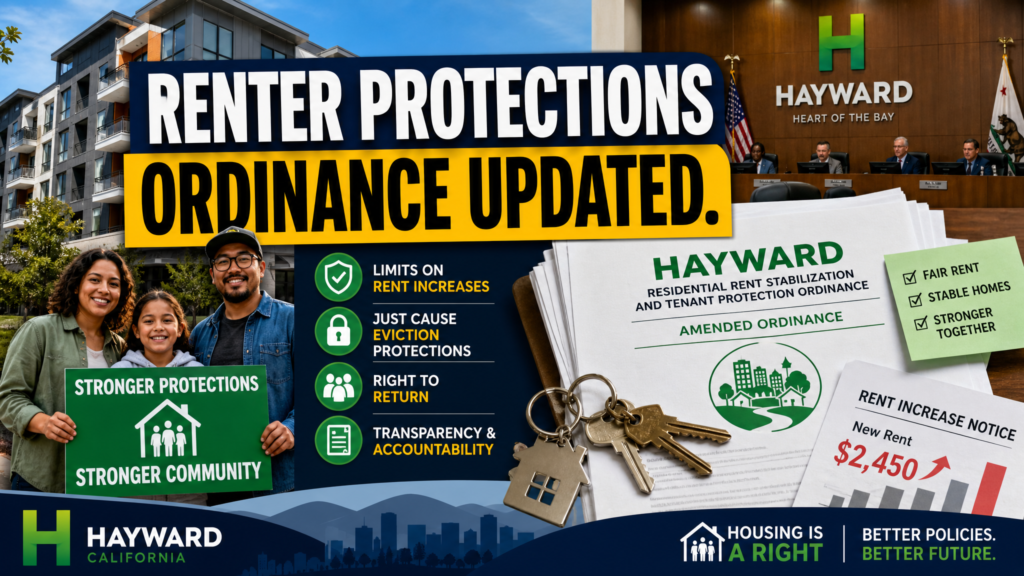
Hayward officials say the city’s updated Residential Rent Stabilization and Tenant Protection Ordinance will make the system work better for tenants and landlords alike. The real test is whether the amendments deliver fairer, faster enforcement without turning a legitimate protection law into another slow-moving local bureaucracy. Source
Hayward’s City Council did not rewrite the city’s rent rules from scratch in February 2026. It did something quieter, but still important: it tightened the machinery behind them. On Feb. 17, 2026, the council moved to adopt an ordinance amending Chapter 12, Article 1 of the municipal code relating to residential rent stabilization and tenant protection, after the measure had been introduced on Feb. 3. The official city summary said the update would extend arbitration decision deadlines and add a cost-recovery process consistent with other housing program fees. Source
That may sound procedural. It is not. When a city changes the timetable for rent disputes and creates stronger enforcement for unpaid program fees, it is changing how much leverage both renters and property owners have in the real world. Paper rights that cannot be enforced are weak rights. But regulations that become arbitrary, slow, or punitive can also backfire. The question for Hayward is whether this ordinance strikes the right balance between tenant protection and accountable government.
Support Independent Local Journalism
TheTownHall.News is a non-profit reader-supported journalism. Just $5 helps us hire local reporters, investigate important issues, and hold public officials accountable across Alameda County. If you believe our community deserves strong, independent journalism, please consider donating $5 today to support our work.Why This Issue Matters Now
Housing fights in the Bay Area are no longer just about whether rent control exists. They are about whether the rules are understandable, enforceable, and fair. Hayward’s ordinance matters because it governs the everyday relationship between tenants and property owners in a city where rental housing is a major part of the local market.
Hayward describes its Residential Rent Stabilization Ordinance, or RRSO, as a response to housing shortages and rising rents. The city says the law covers rent protections, the rent-review process, anti-harassment and anti-retaliation protections, just-cause eviction requirements, and a ban on source-of-income discrimination, including discrimination against Section 8 voucher holders. Covered units are generally housing units built before July 1, 1979, with major exemptions for single-unit properties exempt under state law, some owner-occupied properties with ADUs, regulated affordable housing, transitional housing, hotels and motels, and certain nonprofit cooperatives. Source
The city’s current summary says landlords generally may raise rent once in a 12-month period by 5 percent or less on covered units, with banked increases subject to limits. That means Hayward’s system is not just symbolic. It creates a real ceiling, a formal petition process, and a dispute path when tenants believe an increase exceeds what the law allows. Source
What the February 2026 Amendment Actually Changed
The clearest official description comes from the City Council legislation page. Hayward said the ordinance was intended to “extend the arbitration decision deadlines and include a cost recovery process consistent with other housing program fees.” That is the city’s own summary of the policy change. Source

A local news report added more detail, stating that Hayward extended the arbitration process for rent disputes from 20 days to 30 days and created a penalty structure for property owners who do not pay the annual RRSO fee, including assessments that could ultimately affect property-tax bills. That report aligns with the city’s broader description of deadline extensions and fee cost recovery, even though the publicly accessible official summary page does not spell out every line of the ordinance text. Source Source
That matters because administrative changes are often where policy becomes real. A longer arbitration window can give decision-makers more time to review disputes properly. A cost-recovery mechanism can prevent the system from becoming a free rider problem where compliant landlords subsidize those who ignore program fees. Done correctly, those are not radical changes. They are housekeeping reforms with real consequences.
Why Supporters Say the Amendments Help Renters
Supporters of stronger tenant rules often make a basic point that is hard to dismiss: a right delayed can become a right denied. If the city’s dispute system moves too fast for evidence to be gathered or too slowly for renters to obtain relief, confidence in the law collapses.
Hayward’s own framework already centers formal dispute resolution. Tenants and landlords can file petitions with the Rent Review Office, begin with mediation, and move to arbitration if needed. In arbitration, the landlord must show that the rent increase follows the RRSO, and an arbitrator sets the amount of the increase based on evidence from both sides. Source
That structure gives renters something many cities still lack: process. It also gives landlords a defined legal path rather than leaving disagreements to social media outrage or hallway confrontation. The February 2026 update appears designed to make that process more workable and more enforceable. If the system is funded properly and disputes are resolved on a realistic timeline, tenants gain something more valuable than a slogan. They gain a usable remedy.
Support Independent Local Journalism
TheTownHall.News is a non-profit reader-supported journalism. Just $5 helps us hire local reporters, investigate important issues, and hold public officials accountable across Alameda County. If you believe our community deserves strong, independent journalism, please consider donating $5 today to support our work.Rules only matter when ordinary people can use them.
A fair housing law must be enforceable, not ornamental.
What Critics Get Wrong
Critics of local rent rules often argue that every amendment is another step toward heavy-handed government. That criticism is too broad to be persuasive here.
Hayward did not announce a brand-new rent cap in February 2026. It did not impose an entirely new tenant-rights regime. It amended an existing system that already included rent review, just-cause eviction rules, anti-harassment protections, and source-of-income protections. The city had already built that framework, and even hosted free educational workshops for tenants and landlords on rent increases, eviction rules, habitability, and the RRSO petition process. Source
That outreach matters. A city that regulates without educating creates confusion. A city that educates both sides at least signals that the law is meant to be understood, not weaponized. Critics who pretend Hayward’s amendment is simply an anti-landlord political gesture ignore that administrative clarity can benefit responsible property owners too. Predictable timelines and fee enforcement can produce a cleaner system than ad hoc exceptions and inconsistent compliance.
The Stronger Criticism Hayward Should Take Seriously
Still, not every criticism is wrong. The real danger in local housing policy is mission creep. A city begins with a narrow promise to stabilize rents and prevent abuse. Then the program grows more complex, the fee structure gets thicker, the paperwork expands, and small property owners feel they are trapped in a maze built for larger players.
That concern deserves respect. Hayward’s own housing workshops suggest the city knows landlords and tenants both struggle to navigate the rules. Source
The better answer is not to scrap tenant protections. It is to demand discipline from government. If Hayward is going to extend deadlines, it should explain why the extra time produces better decisions. If it is going to use assessments to recover unpaid program fees, it should show how often that tool is used, against whom, and under what due-process safeguards. If the city claims the system is about fairness, then fairness must apply to both compliant renters and compliant landlords.
Limited government does not mean no rules. It means clear rules, narrow rules, and accountable enforcement.
Counterargument: Do Stronger Tenant Rules Hurt Housing Supply?
This is the central objection in nearly every rent-stabilization debate. Opponents say tighter tenant protections discourage investment, reduce maintenance incentives, and eventually shrink rental supply. There is truth in that warning when local rules become arbitrary or confiscatory.
But Hayward’s current ordinance does not ban rent increases. The city says allowable increases of up to 5 percent remain in place for covered units, with banked increases possible under set limits. The ordinance also preserves formal review and exemptions for many categories of housing not covered by the rent cap. Source
More important, the February 2026 amendment appears focused on administration, not on slashing returns or imposing sweeping new caps. Extending arbitration timelines and strengthening fee collection may inconvenience some landlords, but those changes are not the same as rewriting the economics of the local rental market. The stronger critique is not that Hayward has declared war on property owners. It is that local government must prove it can administer these rules competently and transparently.
That is the standard residents should insist on.
Key Takeaway for Renters, Owners, and Taxpayers
Hayward’s February 2026 amendment is best understood as a system-repair measure. It reinforces the city’s tenant-protection framework by making the dispute process more workable and by tightening enforcement around program fees. For renters, that likely means a sturdier process. For landlords, it means the city expects compliance and may use stronger financial tools to collect what it is owed. Source Source
The key question going forward is competence. Will Hayward administer this ordinance in a way that is predictable, understandable, and evenhanded? Or will renters and owners be left with a more complicated code and the same old frustrations?
Conclusion
Hayward’s amended Residential Rent Stabilization and Tenant Protection Ordinance is not the kind of headline-grabbing law that sparks instant statewide attention. But it is exactly the kind of city-level change that affects whether local housing policy works in ordinary life. If deadlines are too short, cases become sloppy. If fees go uncollected, responsible owners subsidize irresponsible ones. If enforcement becomes too loose, tenant protections become symbolic. If it becomes too heavy-handed, trust in City Hall erodes.
Hayward has chosen to strengthen the mechanics of its rent-stabilization system rather than abandon it. That is a defensible move. But the city now owes residents proof that the system will be administered with fairness, transparency, and restraint. In a healthy city, renters should know their rights, landlords should know the rules, and government should know its limits.
Call to Action
If you rent in Hayward, learn whether your unit is covered and understand the petition process before your next rent notice arrives. If you own rental property, make sure you know the current fee and compliance requirements before the city escalates enforcement. And if you care about serious local journalism, stay informed, share this article, support independent reporting, and keep watching City Council decisions that shape daily life long after the meeting agenda disappears.