Hayward Sidewalk Repair Ordinance Shifts Costs and Liability to Homeowners as City Tightens Liability Rules
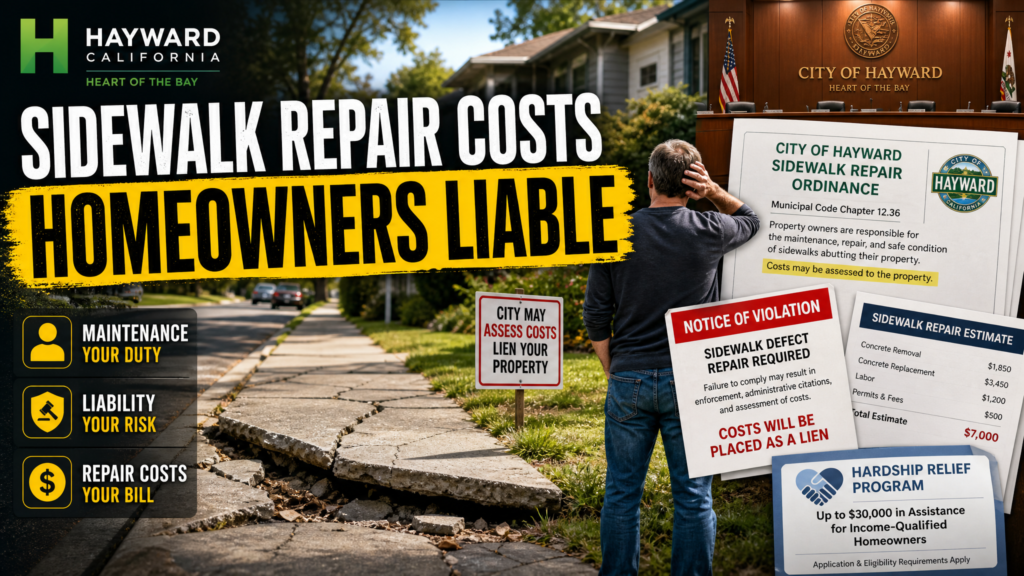
Hayward’s updated sidewalk ordinance makes adjacent property owners formally responsible for keeping sidewalks in safe condition, exposes them to liability for injuries tied to neglected defects, and allows the city to recover repair costs through assessments and tax-roll collection—while pairing the move with a modest hardship fund for low-income owners. Source
Hayward’s sidewalk ordinance is the kind of local-government decision that can look technical on paper and feel very personal the moment a homeowner gets a notice, a bill, or a lawsuit. City leaders did not just tweak a maintenance rule. They formally clarified that the owner or “responsible person” for property fronting a public street, alley, or way must keep the adjacent sidewalk safe and non-dangerous—and that failure to do so can trigger both civil liability and city enforcement. Source
The ordinance was introduced on Oct. 28, 2025 and scheduled for adoption on Nov. 18, 2025, according to the city’s public notice. By early December, the city was publicly stating that the new legislation made clear that maintenance and repair of sidewalks is the responsibility of adjacent property owners under state law and was intended to protect Hayward from legal liability for injuries caused by dangerous sidewalk conditions. Source Source
Support Independent Local Journalism
TheTownHall.News is a non-profit reader-supported journalism. Just $5 helps us hire local reporters, investigate important issues, and hold public officials accountable across Alameda County. If you believe our community deserves strong, independent journalism, please consider donating $5 today to support our work.This is a consequential shift in practice and expectation. For residents, it means the city is drawing a firmer line: public walkway, private responsibility. For taxpayers, it means City Hall is trying to offload part of its legal and maintenance exposure. For critics, it raises a familiar question: when governments face pressure, do they solve problems—or transfer them downhill?
Why This Issue Matters Now
Sidewalk policy may not sound like front-page news, but it goes directly to quality of life, neighborhood safety, disability access, and property-owner obligations. A cracked or lifted sidewalk is not just unattractive. It can create trip-and-fall hazards, trigger legal claims, and become a recurring source of tension between residents and city government. Source
Hayward’s amended ordinance goes well beyond a general reminder to “keep sidewalks tidy.” It rewrites Chapter 7, Article 2 of the municipal code into a full enforcement structure, including findings, definitions, owner duty, abatement notice, repair procedures, administrative hearing, reporting of costs, confirmation hearing, assessment, lien notice, and tax-roll collection. That is not casual housekeeping. It is a formal legal architecture for shifting responsibility and recovering costs. Source
The city’s own public-service pages also show why officials wanted this issue cleaned up. Hayward already invites residents to report unsafe sidewalks the city can patch or grind within the public right-of-way, while also noting that only limited financial assistance is available for repair of private sidewalks. That means the city was already operating in a hybrid world of partial public action and selective owner responsibility. The ordinance makes that division much sharper. Source

What the Ordinance Actually Does
The key provision is blunt. The “Responsible Person” for premises fronting a public street, alley, or way owes a duty to members of the public to keep the adjacent sidewalk in a safe and non-dangerous condition. The ordinance says that if a person is injured or property is damaged because that responsible person failed to maintain the sidewalk, the responsible person is liable for the resulting damages or injury. It further states that failure to maintain the sidewalk constitutes negligence and a public nuisance. Source
Just as important, the ordinance explicitly says the City shall not be liable for injuries caused by the negligence of the responsible person. That is the legal heart of the policy. Hayward is not merely asking residents to help out. It is repositioning liability away from the city and toward adjacent property owners. Source
The city did preserve a defense for property owners in some cases. The duty does not apply where the unsafe condition exists because of some act of the city or a third party and that act is the proximate cause of the sidewalk defect. But that still leaves owners carrying a substantial burden, because they may need to prove the city or someone else caused the hazard. Source
This is where the ordinance’s language matters. The default assumption is no longer that the city handles the sidewalk because it sits in the public realm. The default assumption is that the adjacent owner must deal with it unless the owner can show the city or another party caused the problem.
How Enforcement Works—and Why Homeowners Should Pay Attention
Hayward did not stop at defining duty. It created a collection mechanism. Under the ordinance, the enforcement officer may notify the owner or responsible person of the need to repair the sidewalk and of the city’s intent to undertake the work if the owner fails to do so. If the responsible person does not repair the problem after notice, the city can step in, perform the work, and recover the costs. Those costs can become a lien against the property and can be collected on the tax roll. Source
Support Independent Local Journalism
TheTownHall.News is a non-profit reader-supported journalism. Just $5 helps us hire local reporters, investigate important issues, and hold public officials accountable across Alameda County. If you believe our community deserves strong, independent journalism, please consider donating $5 today to support our work.That is a serious power. A city repair bill is one thing. A city repair bill that can be converted into a property-based assessment is another. This gives the ordinance real teeth and ensures that owners cannot simply ignore notices without consequence. It also means the city now has a stronger financial pathway to recover costs rather than leaving unresolved hazards in place or absorbing the expense. Source
There is a practical argument for this approach. Sidewalk hazards do not fix themselves, and cities that cannot compel repair often end up with repeated complaints, injury claims, and deferred maintenance. From a fiscal-accountability standpoint, Hayward can argue that it is drawing a cleaner line between public resources and private obligations.
But the other side is obvious too. Many homeowners do not think of the sidewalk out front as a de facto repair liability sitting one uneven slab away from a legal notice.
The Hardship Fund Shows City Hall Knows the Burden Is Real
If this were truly a painless clarification of existing law, Hayward would not have needed a hardship program. Yet after the ordinance was introduced on Oct. 28, 2025, the City Council directed staff to establish one. A related resolution appropriated $30,000 from Fund 450, the Street System Improvement Fund, to create a Sidewalk Repair Financial Hardship Program. The resolution states that at least 23 percent of owner-occupied units in Hayward are considered low-income households. Source
That single fact tells the story. City Hall understood immediately that many residents might not be able to absorb repair costs easily. At the Nov. 18, 2025 council meeting, the sidewalk repair hardship program appeared as consent-calendar item 5 and passed unanimously; staff confirmed on the record that it was not funded from the general fund, but from Fund 450, the street repair fund. Source Source
That was a prudent political move and a necessary moral one. Personal responsibility matters. So does basic realism. A city cannot credibly say homeowners must shoulder sidewalk obligations while pretending every homeowner has the cash on hand to do it.
Still, the size of the hardship fund raises obvious questions. $30,000 is not much in a citywide program if multiple owners need substantial sidewalk replacement. It may help at the margins. It is unlikely to eliminate the broader tension between legal responsibility and financial capacity. Source
What Critics Get Wrong—and What They Get Right
Some critics will frame this as an outrageous privatization of public space. That goes too far. Sidewalk-adjacent owner responsibility is not a brand-new legal theory in California, and Hayward’s public messaging specifically says the legislation was intended to clarify that adjacent owners bear maintenance and repair responsibility under state law. In that sense, the city is not inventing the concept from nothing. Source
There is also a commonsense argument behind the rule. Owners are often the first to notice lifted concrete, root damage, or deteriorating frontage. A system that gives them clear duty can speed response and reduce injury risk. Local government should not be forced to act as the universal first responder for every cracked slab in front of every parcel if a workable owner-responsibility model exists.
But critics are right about one larger concern: governments under fiscal stress often redefine “clarification” in ways that conveniently reduce their own exposure. Hayward’s ordinance does exactly that. It protects the city from liability caused by owner negligence and equips the city to recover repair costs more aggressively. That may be lawful and practical, but it is also a policy choice. Residents are not imagining things when they see City Hall shifting risk outward. Source
Counterargument: Isn’t This Just Personal Responsibility?
Yes—and no.
There is a strong argument for personal responsibility here. Homeowners should not expect taxpayers citywide to subsidize hazards adjacent to private property forever. If a property owner benefits from frontage, parking access, curb appeal, and neighborhood stability, it is not irrational to say that owner also bears upkeep duties. Limited government does not mean government ignores hazards. It means it assigns responsibility where it belongs and uses public money carefully.
But government still has responsibilities too. It controls the public right-of-way. It regulates trees, permits, and many conditions that can affect sidewalks. It also writes the enforcement rules. So while Hayward is justified in demanding accountability from owners, it also has an obligation to administer the ordinance fairly, keep hardship relief real rather than symbolic, and avoid using bureaucratic muscle where cooperation would work better.
That balance is the real test. A city that champions responsibility should model it.
Key Takeaways
- Hayward introduced the sidewalk ordinance on Oct. 28, 2025 and set it for adoption on Nov. 18, 2025. Source
- The ordinance says adjacent property owners or other “responsible persons” must keep sidewalks safe and can be liable for injuries caused by neglect. Source
- Failure to maintain a sidewalk is defined as negligence and a public nuisance, and the city says it is not liable for injuries caused by the owner’s negligence. Source
- If owners do not repair hazards after notice, the city can do the work and recover costs through assessments, liens, and tax-roll collection. Source
- Hayward paired the policy with a $30,000 hardship fund for low-income property owners, funded from Fund 450, not the general fund. Source Source
Conclusion
Hayward’s sidewalk ordinance is not really about concrete. It is about civic philosophy. Who bears the burden when public-facing infrastructure deteriorates: the city, the taxpayer at large, or the owner closest to the problem?
Hayward has now answered that question more clearly than before. Adjacent owners are on the hook unless they can show the city or a third party caused the defect. For some residents, that will feel like overdue accountability. For others, it will feel like City Hall handing off costs and legal risk during a period of broader fiscal pressure.
Both reactions are understandable. What matters now is whether the city enforces the law with fairness, keeps the hardship relief meaningful, and remembers that “personal responsibility” is strongest when government practices institutional responsibility too.
Source Links
- Hayward ordinance text: https://hayward.legistar.com/gateway.aspx?M=F&ID=1ba06b40-2bfd-45fe-94cb-bfae6ff350b9.pdf
- Public notice of ordinance introduction/adoption timing: https://hayward.legistar.com/gateway.aspx?M=F&ID=2631fe9d-3a90-4411-91a2-d5083fa1e0bf.pdf
- Sidewalk repair hardship resolution: https://hayward.legistar.com/gateway.aspx?M=F&ID=2f51ebc5-5f73-46cd-a65a-61e83aa5733b.pdf
- City sidewalk reporting/assistance page: http://www.hayward-ca.gov/services/city-services/report-sidewalk-issues-or-concerns
- City Facebook statement on ordinance purpose: https://www.facebook.com/cityofhayward/posts/the-hayward-city-council-recently-approved-legislation-to-make-clear-that-mainte/1273122344861056/
- Nov. 18, 2025 council meeting transcript summary: https://www.youtube.com/watch?v=xVZLRfPVi48