13 Hayward City Council Decisions That Could Cost Residents More, Reshape Neighborhoods, and Limit Oversight
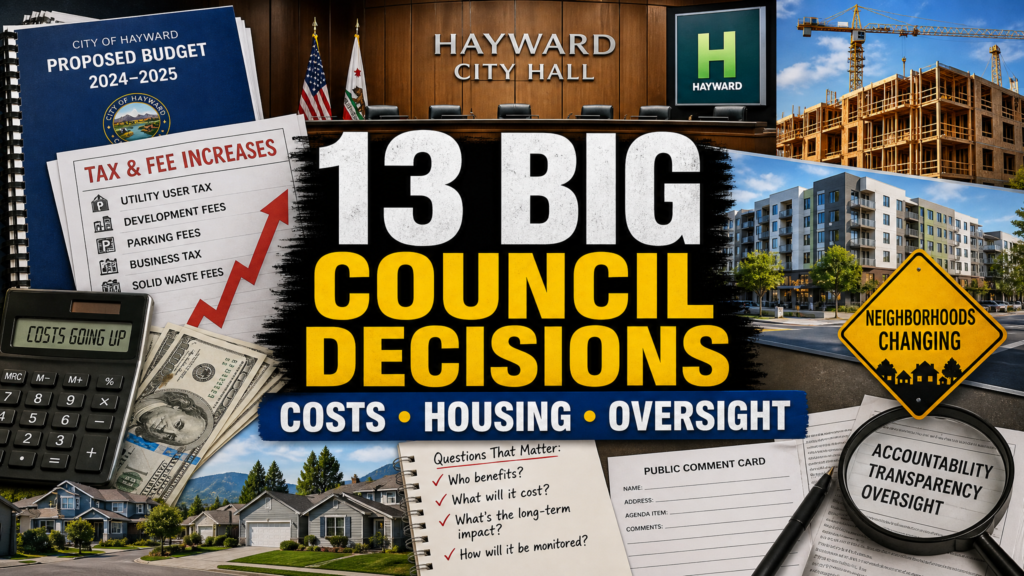
A budget squeeze, new taxes, major infrastructure contracts, housing fights, public-safety spending, and transparency concerns are all converging in Hayward. This hub page introduces a 13-part series built to help readers track the decisions most likely to shape the city over the next several years. Source
If you want to understand where Hayward is heading, do not just watch the speeches. Watch the agenda items that move money, shift liability, sell public land, rewrite zoning rules, and reduce the number of routine opportunities residents have to question the people running the city. From November 2025 through April 2026, the City Council’s docket is packed with decisions that go well beyond routine housekeeping. Source
This series is designed as a public-interest watchlist for readers who want more than summaries and talking points. Each article focuses on one major council action, but together they tell a larger story about how Hayward governs under financial strain: who pays more, who gets protected, who gets flexibility, and who is asked to absorb the risk when City Hall redraws the rules. Source
Support Independent Local Journalism
TheTownHall.News is a non-profit reader-supported journalism. Just $5 helps us hire local reporters, investigate important issues, and hold public officials accountable across Alameda County. If you believe our community deserves strong, independent journalism, please consider donating $5 today to support our work.Hayward residents are being asked to pay closer attention because the stakes are no longer limited to one vote, one contract, or one narrow policy fight. What is unfolding at City Hall is a broader pattern of governing under pressure—using new fees, delayed compensation, regulatory rewrites, public-land decisions, and procedural changes to manage competing demands without fully escaping the city’s larger fiscal and political constraints. Read separately, these items can seem technical. Read together, they reveal a council agenda with real consequences for household costs, neighborhood change, and the public’s ability to keep watch.
Why This Series Matters Now
Hayward is not wrestling with one isolated controversy. It is managing a structural budget problem while simultaneously moving on taxes, labor concessions, public-works spending, homelessness services, downtown land-use decisions, renter protections, and council-process changes. That makes this a moment when individual agenda items cannot be understood in isolation. They are part of one broader governing strategy. Source Source
That is why this overview is organized into five buckets: Budget & Local Taxes, Infrastructure & Megaprojects, Public Safety & Public Health, Housing & Public Land Use, and Neighborhood Impact & Governance. Readers can jump to the section that affects them most, but the deeper value is seeing how these categories overlap. In Hayward, the budget story is also a tax story, the tax story is also a land-use story, and the land-use story is also a transparency story. Source
Budget & Local Taxes
The first cluster of stories centers on the city’s struggle to close budget gaps without admitting that temporary fixes alone will not solve a structural problem. Hayward has already used labor concessions, tax changes, and discussions of new ballot measures as part of that effort. These are not abstract policy ideas. They are decisions with direct consequences for workers, businesses, visitors, and residents who will ultimately bear the costs of city government. Source Source

Article 1: Hayward City Workers Defer and Modify Pay Raises to Help Close Looming Five-Year Budget Gap
This piece examines Hayward’s decision to lean on labor concessions as part of a fiscal-stabilization strategy. It asks whether deferred and modified raises represent shared sacrifice and discipline, or whether they simply buy time before a deeper reckoning over spending and long-term obligations. Source
Article 2: Hayward Hikes Hotel Tax to 14% and Eyes New Ballot Measure to Modernize Business License Fees
This story follows the city’s search for new revenue through a higher transient occupancy tax and a possible overhaul of business-license rules. The central question is whether Hayward is modernizing its tax structure responsibly or defaulting to higher charges because city leaders have run out of easier options. Source Source
Infrastructure & Megaprojects
The second group tracks the council decisions most likely to shape Hayward’s physical systems for years. These are the projects residents may not think about every day, but they affect water quality, streets, utility reliability, traffic, construction disruption, and future rate pressure. Together they reveal how expensive it has become for cities simply to maintain the basic systems that modern life depends on. Source Source
Article 3: Inside Hayward’s Half-Billion Dollar Wastewater Megaproject and the State Loan Funding It
This article goes inside the Water Resource Recovery Facility Phase II project, a nearly half-billion-dollar undertaking tied to environmental compliance, long-range capacity, and layered borrowing. It focuses on fiscal scale, financing structure, and what a project this large means for ratepayers and public oversight. Source Source
Article 4: Hayward Awards Massive $10.06 Million Pavement Contract to Repair Local City Streets
Road repair is always politically easy to sell, but the real story is where the money goes, how the city manages change orders, and whether neighborhoods see the results equitably. This piece treats the pavement contract as both a quality-of-life issue and a test of execution. Source
Support Independent Local Journalism
TheTownHall.News is a non-profit reader-supported journalism. Just $5 helps us hire local reporters, investigate important issues, and hold public officials accountable across Alameda County. If you believe our community deserves strong, independent journalism, please consider donating $5 today to support our work.Article 5: Major Utility Upgrades Ahead: Hayward Approves $4.15 Million Contract for A Street Sewer Line Replacement
This is a classic underground-infrastructure story: expensive, disruptive, easy to ignore until something fails, and vital to long-term reliability. The article follows the A Street sewer replacement as a case study in how Hayward is sequencing utility work before even more visible street improvements. Source Source
Public Safety & Public Health
This section looks at how the city is framing safety, street design, development policy, and homelessness response as part of one broader public-well-being agenda. Some of these decisions are openly described as safety measures. Others are being sold as economic-development or service-delivery reforms but still have direct consequences for neighborhood order, quality of life, and public confidence. Source
Article 6: Hayward Commits $1.2 Million to Redesign Streets and Tackle ‘High Injury Network’ Traffic Fatalities
This piece looks at the city’s move to treat dangerous streets as a design failure, not just a driver-behavior problem. It follows the money, the planning logic, and the question of whether Hayward’s response matches the severity of the traffic-safety challenge. Source
Article 7: From Temporary Freeze to Permanent Rules: Hayward’s ‘Business-Friendly’ zoning rewrite could reshape development citywide
Though framed as a regulatory modernization effort, this zoning rewrite has major public-safety, quality-of-life, and neighborhood consequences because it changes what can happen where, under what rules, and with how much public friction. This article asks whether Hayward is genuinely improving civic function or simply making the development process easier to steer from the top. Source
Article 8: Hayward Accepts $1.9 Million Prop. 47 State Grant to Boost Local Navigation Center Homeless Services
This story tracks Hayward’s acceptance of Proposition 47 funding and its relationship with Bay Area Community Services at the Navigation Center. The deeper question is whether the city’s homelessness-response spending is producing measurable results, stronger public order, and a clearer sense of accountability. Source Source
Housing & Public Land Use
Housing politics in Hayward are no longer limited to whether more units should be built. The bigger fight now is over where growth happens, what public land is worth, who benefits from city-owned parcels, and how much leverage the public still has once land is transferred, leased, or rezoned. This section groups the stories where housing policy and land-control decisions are most visible. Source Source
Article 9: Selling the Core: Hayward Designates Prime Downtown Properties at City Center Drive and Cinema Place as ‘Surplus Land’
This piece focuses on what happens when prime city-owned downtown property stops being viewed as a civic asset and starts being positioned for sale or long-term redevelopment. It treats the surplus-land process as a test of transparency, affordability priorities, and whether the public is getting full value for what it already owns. Source
Article 10: Hayward Advances Housing Development Plans for Key City-Owned Parcels on Depot Road
This article examines Hayward’s push to use public land on Depot Road for housing tied to service delivery, affordability, and homelessness response. The core issue is whether the city is turning public land into durable public value or simply moving assets through a politically convenient pipeline. Source Source
Article 11: New Protections for Renters: Hayward Officially Amends Residential Rent Stabilization Ordinance
This story follows Hayward’s updates to its Residential Rent Stabilization and Tenant Protection framework, including dispute timelines and enforcement mechanics. It asks whether the city is making renter protections more usable and credible or simply building a thicker administrative system that both tenants and landlords will struggle to navigate. Source Source
Neighborhood Impact & Governance
The final category is where city policy becomes most personal. Here the issue is not just spending or planning. It is whether local government is pushing costs, liability, and reduced access directly onto the people who live in the city. These are the stories that most clearly test Hayward’s commitment to accountability at the neighborhood level. Source
Article 12: Shifting Liabilities: Hayward Ordinance Formally Moves Sidewalk Repair Costs and Duties to Homeowners
This article follows the city’s decision to formally place sidewalk maintenance responsibility and much of the related liability on adjacent property owners, backed by assessments and a modest hardship fund. It is a story about personal responsibility, yes, but also about government transferring legal and financial exposure outward. Source Source
Article 13: Less Face Time for Watchdogs? Hayward Cuts Back the Frequency of Public City Council Meetings
The last story turns the lens on the council itself. By reducing the number of regular preset meetings, Hayward may have made city operations more flexible, but it also made public oversight less routine. This piece explores whether efficiency is being used as a cover for weaker transparency. Source Source
Key Takeaway
Taken together, these 13 articles show a city government under pressure trying to manage money, growth, liability, public order, and political trust all at once. The recurring pattern is not hard to see: when Hayward says change is necessary, someone is always being asked to pay more, give something up, accept more uncertainty, or trust a process that is becoming harder to monitor closely. Source
Conclusion
This hub page is meant to do more than summarize the series. It is meant to frame the stakes. Hayward’s council agenda from Nov. 2025 to Apr. 2026 is not just a list of municipal actions. It is a blueprint for how the city responds when budgets tighten, infrastructure ages, housing pressures intensify, and public confidence becomes more fragile. Source
Readers can jump straight to the category that matters most to them. But the real value comes from reading across the package and recognizing how these stories connect. Budget fixes affect taxes. Tax pressure affects land-use politics. Land-use politics affect neighborhoods. Governance changes affect how well the public can challenge all of it. That is the larger story at Hayward City Council, and it is why this series deserves to be read as one whole. Source
Call to Action
Use this page as the front door to the full series. Read the deeper pieces, share the reporting, support independent local journalism, and keep tracking the Hayward City Council calendar. In local government, the most important decisions are often the ones made before most people realize they should be watching.