Fake News Has No Legal Consequences — Is the First Amendment to Blame?
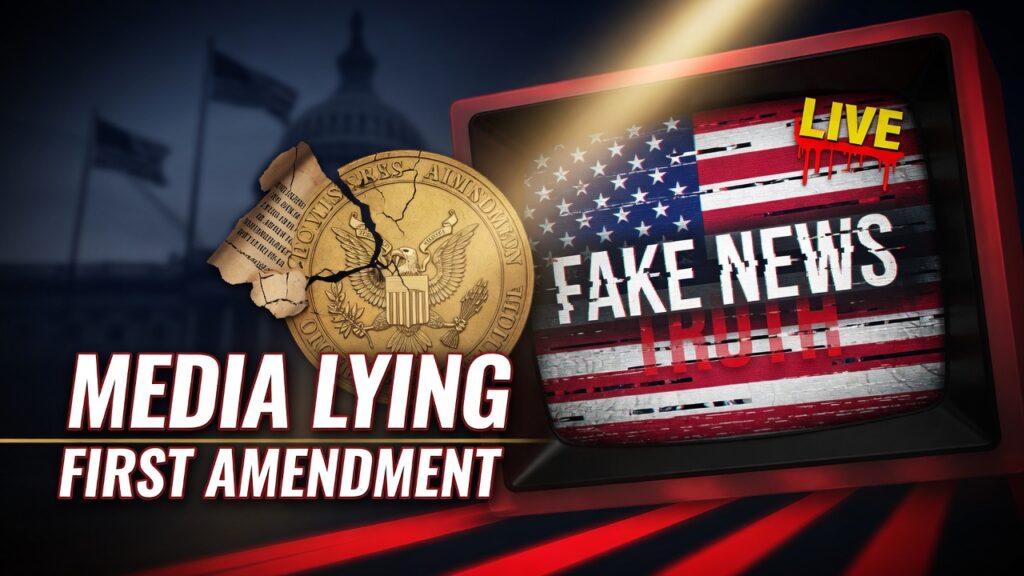
A court confirmed there are no criminal penalties for deliberate falsehoods on broadcast news. That ruling didn’t come from nowhere — and the story of how we got here should alarm every American who still believes the press has a duty to the truth.
Eleven minutes. That’s how long it took to dismantle the legal framework that required America’s broadcast networks to tell you both sides of every story.
That was 1987. Nearly four decades later, a Delaware court confirmed what many already suspected: in the United States, a news network can knowingly broadcast a lie, settle a lawsuit for nearly $800 million, and never issue a single on-air correction. No criminal charges. No license revoked. No anchor fired. If that’s not a crisis of civic accountability, what is?
Support Independent Local Journalism
TheTownHall.News is a non-profit reader-supported journalism. Just $5 helps us hire local reporters, investigate important issues, and hold public officials accountable across Alameda County. If you believe our community deserves strong, independent journalism, please consider donating $5 today to support our work.What Was the Fairness Doctrine — And Why Was It Quietly Buried?
The Fairness Doctrine wasn’t a fringe regulation. It was the backbone of American broadcast accountability for nearly four decades.
Introduced by the Federal Communications Commission in 1949, it required that any broadcaster holding a federally issued license — a license to use the public’s airwaves — present contrasting viewpoints on controversial public issues. If you gave a platform to one side of a political debate, you were legally obligated to give the other side a fair hearing. This wasn’t about government controlling speech. It was about ensuring the public, who owned those airwaves, received a full picture.
The Supreme Court agreed. In Red Lion Broadcasting Co. v. FCC (1969), the Court unanimously upheld the Doctrine as constitutional, ruling it served the public interest. The FCC itself called it, in 1970, “the single most important requirement for operating in the public’s interest.”
Then came the 11-minute meeting.

In August 1987, the FCC — under new chairman Dennis Patrick — voted 4-0 to abolish the Doctrine. The meeting received almost no news coverage, partly because it was overshadowed by Iran-Contra hearings unfolding the same day. Congress reacted swiftly, passing legislation to reinstate the rule through both chambers. President Ronald Reagan vetoed it. The Fairness Doctrine was dead, and the ideological media explosion of the 1990s — partisan talk radio, then cable news — followed almost immediately.
Is the First Amendment a Shield for Truth — or a License to Deceive?
The First Amendment protects free speech. But at what point does that protection become a legal loophole that lets powerful media corporations deliberately mislead millions of Americans?
Here’s what U.S. defamation law actually says. To win a lawsuit over a false statement, a public figure must prove “actual malice” — meaning the broadcaster knew the statement was false and published it anyway. This standard comes from the landmark 1964 Supreme Court case New York Times Co. v. Sullivan, and it set the bar extraordinarily high.
In United States v. Alvarez (2012), the Supreme Court went even further, ruling 6-3 that even deliberate lies can be constitutionally protected speech in certain contexts. The Court’s reasoning: the government cannot broadly criminalize false statements without a compelling, narrowly tailored interest.
The practical result? A news organization can broadcast something its own hosts privately doubt, face a civil lawsuit, write a nine-figure check — and keep broadcasting as if nothing happened.
Support Independent Local Journalism
TheTownHall.News is a non-profit reader-supported journalism. Just $5 helps us hire local reporters, investigate important issues, and hold public officials accountable across Alameda County. If you believe our community deserves strong, independent journalism, please consider donating $5 today to support our work.“A court confirmed there are no criminal consequences for deliberately lying on news channels, citing First Amendment protections. The question every American should be asking: is that what the Founders intended?”
The $787 Million Proof Point Nobody Wants to Talk About
$787,500,000
That is what Fox News paid in April 2023 to settle a defamation lawsuit brought by Dominion Voting Systems. Internal communications revealed Fox hosts and executives had privately questioned the accuracy of 2020 election fraud claims — while continuing to broadcast them. That is the textbook legal definition of actual malice.
The settlement was historic. But here’s what didn’t happen: no on-air retraction, no anchor termination, no criminal referral, no license review. Fox returned to its normal programming the next day.
$787.5 million paid. Zero editorial accountability delivered. Is that what a functioning free press looks like?
What Do Supporters of Broad Media Protections Actually Believe?
This is a fair question, and it deserves a fair answer.
Defenders of the current legal framework argue — with genuine constitutional grounding — that allowing the government to adjudicate “truth” in journalism is far more dangerous than tolerating media bias or even media error. Who decides what’s true? A government empowered to punish false reporting is a government that can punish any reporting it dislikes.
They also point out that civil defamation law isn’t toothless. The Dominion settlement proves that consequences exist — they’re just financial and civil, not criminal. The marketplace of ideas, they argue, is ultimately self-correcting: audiences can and do seek out alternative sources.
These are serious arguments. But they have a critical vulnerability: the marketplace-of-ideas theory assumes consumers have access to competing, credible information. When three or four dominant media companies reach the vast majority of Americans and face no obligation to present balance, the “marketplace” isn’t functioning freely — it’s monopolized. Personal responsibility requires access to accurate information. You cannot make responsible civic choices on a diet of deliberately curated half-truths.
Is the FCC Now Being Used as a Political Weapon Instead of a Public Guardian?
The most alarming development isn’t what happened in 1987. It’s what’s happening right now.
In May 2026, ABC filed its broadcast license renewal applications with the FCC “under protest,” accusing the agency of “unconstitutional retaliation” and a deliberate chilling of First Amendment freedoms. The FCC, under Chairman Brendan Carr, had ordered early license reviews targeting ABC’s stations — an extraordinary and rare regulatory move. ABC called it “an extraordinary demonstration of power and coercion.”
The FCC’s sole Democratic commissioner, Anna Gomez, called the reviews an “egregious assault on the First Amendment.” First Amendment advocacy organizations echoed that alarm. The FCC reportedly warned all broadcasters they risked being treated like ABC if they failed to comply with the administration’s expectations.
Here is the devastating irony: the same regulatory body that abolished the Fairness Doctrine — citing fears of government overreach into editorial decisions — is now being accused of using license threats to punish specific editorial choices. The agency designed to serve the public has, critics argue, become a tool for political pressure rather than accountability.
If the FCC won’t hold broadcasters accountable for lying, but will threaten licenses over programming it dislikes — who exactly is the agency serving?
What Happens to a Democracy When the Truth Has No Legal Standing?
Civic life depends on a shared reality. It’s why the Founders protected the press — not to give corporations a blank check to deceive, but to ensure citizens received the independent, accountable information democracy requires.
The collapse of broadcast accountability standards has real-world consequences for values that transcend partisan lines. Parental rights mean nothing if parents cannot access accurate information to make informed decisions for their families. Fiscal accountability is impossible if media coverage of government spending is ideologically filtered rather than factually anchored. Law and order erodes when public trust in institutions — already damaged — is further corroded by demonstrably false narratives that face no correction mechanism.
Traditional civic values were built on an informed citizenry. The Founders never imagined a framework where deliberate broadcast deception would be constitutionally untouchable.
Key Questions This Story Raises
- If a broadcaster can knowingly lie and face only a civil fine — never criminal accountability and never a license consequence — does the First Amendment protect the press or protect corporations from the press’s own ethical obligations?
- Should Congress revisit a modernized version of the Fairness Doctrine, tailored for the streaming and cable era, to restore some minimum standard of balance on public airwaves?
- If the FCC can threaten license revocation over programming it dislikes, but cannot act against demonstrably false reporting, what is the agency’s actual mandate — and who does it answer to?
The real question isn’t whether the collapse of media accountability affects you — it’s whether enough Americans will demand answers before the damage becomes irreversible.
What do you think — has broadcast media accountability gone too far to fix? Share this article and tell us where you stand.
Still have questions? Subscribe for daily coverage of the media, law, and civic accountability stories that matter.
Think this deserves a wider audience? Share it — and let the conversation begin.
Want to make your voice count? Contact your congressional representative and ask where they stand on media accountability reform. You can find your representative at house.gov/representatives/find-your-representative.