Federal Grant Oversight Rule: What Congress and OMB Are Proposing
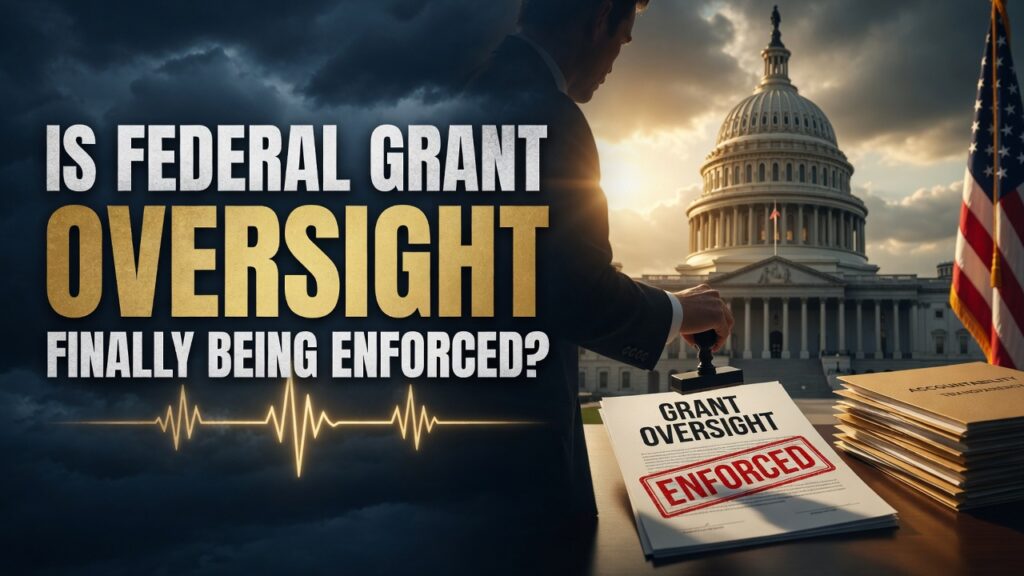
As 34 lawmakers push OMB to close the gaps in federal grant spending, taxpayers are left asking a simple question: who’s actually checking where the money goes?
When people think of federal spending, they think of numbers too big to matter. This week, 34 members of Congress made those numbers matter again.
Led by Sen. Jim Banks, R-Ind., and Rep. Michael Cloud, R-Texas, the group submitted a formal comment letter to the White House Office of Management and Budget on July 17, backing a proposed rule to tighten oversight of federal grant spending. The timing matters because OMB’s public comment window on the rule is closing soon, and the outcome will decide whether federal agencies keep sending taxpayer money out the door with little verification that it was spent lawfully.
Support Independent Local Journalism
TheTownHall.News is a non-profit reader-supported journalism. Just $5 helps us hire local reporters, investigate important issues, and hold public officials accountable across Alameda County. If you believe our community deserves strong, independent journalism, please consider donating $5 today to support our work.Who Signed the Letter, and What Do They Want?
The 34 signers include Reps. August Pfluger of Texas and Byron Donalds of Florida alongside Banks and Cloud. Their letter tells OMB plainly that recipients of government assistance must comply with federal law, and that Congress has an interest in making sure grant dollars do not fund projects or organizations that violate the laws Congress itself passed. Cloud put it more bluntly, telling reporters that federal grants have funded activity built around discrimination, gender ideology, and open-border advocacy. Whatever a reader thinks of that framing, the underlying claim is testable: is federal grant money currently tracked well enough to catch misuse before it happens, or only after?
Right now, the honest answer is: not well enough. That is the gap this proposed rule is designed to close, and it is why 34 lawmakers put their names on a public letter instead of a quiet memo.
What Would the New Rule Actually Change?
The proposal makes two concrete changes worth understanding. First, it links data across federal agencies so a scammer flagged for defrauding one program cannot simply move to another program undetected. The congressional letter, as an example, describes a fraud ring in Minnesota that worked its way from child nutrition funds into housing assistance, then into programs for children with autism, exploiting the fact that agencies rarely talk to each other.
Second, the rule would expand the Treasury Department’s “Do Not Pay” screening tool, which cross-checks recipients against fraud, debarment, and eligibility databases before money goes out. That tool already helped recover $11.7 billion in fiscal year 2025 [figure cited in the congressional letter]. A third proposed change would require grant recipients to certify that services were actually rendered before receiving payment, replacing a “pay first, chase fraud later” model that has cost taxpayers for years.
If your tax dollars funded a program you’d never approve of, would anyone even tell you?
That question sits at the center of this fight, and it is exactly why the rule has drawn 34 co-signers instead of a handful.
Why Does This Matter Right Now?
Federal grantmaking is not a small line item. Washington distributes hundreds of billions of dollars a year through grants to states, universities, nonprofits, and local governments, often with minimal after-the-fact verification. When oversight is weak, the result is not just waste — it is a slow erosion of the basic promise that public money serves the public.
$11.7 billion recovered in a single year through better fraud screening. The question no one in Washington wants to answer: how much more is still slipping through?
That is not a rhetorical flourish. It is the plain implication of the numbers already on the record.
What Happens If OMB Backs Down?
If OMB weakens or withdraws the proposed rule under pressure, the status quo continues: agencies operating largely on the honor system, fraud caught only after the money is gone, and Congress left writing oversight letters instead of seeing results. That outcome would not be neutral. It would be a choice to keep the current system exactly as it is, discovered fraud and all.

“OMB has clear legal authority to deny federal funding in support of these projects.”
That line, drawn directly from the congressional letter, is the crux of the legal argument. Supporters say existing law already gives the executive branch the power to withhold funding from unlawful activity. The rule simply builds the process to use that power consistently.
What Do Critics of the Grant Oversight Rule Actually Believe?
It would be dishonest to pretend this rule is uncontested. Every Senate Democrat signed a separate letter to OMB on July 1 demanding the proposal be rescinded entirely. Their argument deserves a fair hearing: they say OMB is claiming authority Congress never gave it, specifically under the Chief Financial Officers Act, and that courts in Rhode Island and Washington, D.C. have already ruled against OMB’s attempts to unilaterally pause or cancel grants. Research universities, through the Association of American Universities, have raised a related concern — that the rule could let the executive branch condition federal research funding on political litmus tests rather than legal compliance.
These are serious objections, not talking points, and they deserve a direct answer rather than dismissal. The strongest response is this: verifying that recipients follow existing law is not the same as inventing new law. Requiring proof of lawful compliance before disbursing public funds is a baseline accountability measure, not a partisan weapon — and the same verification tools, once built, apply regardless of which party controls the White House. Courts remain free to strike down any specific application that exceeds statutory authority. That check already exists. It does not require abandoning oversight altogether.
Are Our Leaders Even Watching the Money?
For years, the pattern in Washington has been simple: appropriate first, ask questions later, and hope nobody notices the gap. This letter represents 34 lawmakers refusing to accept that pattern as permanent. It is a small, procedural act — a comment letter, not a bill — but procedural accountability is often where real reform starts.
Key Questions This Story Raises
- Will OMB finalize the rule, or water it down under political pressure?
- How much taxpayer money is currently going to recipients who would fail a basic compliance check?
- If courts strike down parts of the rule, will Congress step in to codify oversight into statute?
What Do the Numbers Actually Tell Us?
The Minnesota fraud case that lawmakers cited [per the congressional letter, July 17] is not an isolated anomaly — it is a case study in what happens when federal agencies cannot see across their own programs. The $11.7 billion recovered through the “Do Not Pay” tool in fiscal year 2025 shows both how much fraud exists and how much can be recovered once agencies actually look. Every dollar recovered is a dollar that did not have to be borrowed, taxed, or cut from somewhere else.
Thirty-four lawmakers just told OMB, in writing, that the current system isn’t good enough. Shouldn’t that be the headline, not a footnote?
Support Independent Local Journalism
TheTownHall.News is a non-profit reader-supported journalism. Just $5 helps us hire local reporters, investigate important issues, and hold public officials accountable across Alameda County. If you believe our community deserves strong, independent journalism, please consider donating $5 today to support our work.Is This the Accountability Moment Taxpayers Have Been Waiting For?
Maybe. The letter is not a law, and OMB has already rejected requests to extend the public comment period, meaning the rule could move forward, get revised, or stall in litigation within weeks. What is different this time is that lawmakers put their names on the record before the outcome was decided, rather than reacting after a scandal broke.
That is what accountability is supposed to look like: elected officials stating a position clearly, in public, before the crisis rather than after it.
The real question isn’t whether federal grant fraud exists — it’s whether Washington will finally build the system to catch it before your money is already gone.
Still have questions about where your tax dollars are going? Stay informed — subscribe for daily coverage. Think others need to see this? Share the article. Want your voice heard directly? Submit your own comment to OMB’s public docket on the proposed grantmaking rule before the comment period closes, or contact your representative and ask where they stand on this letter.