

Burned Ballots in Los Angeles Raise Urgent Questions About Mail-In Voting Security
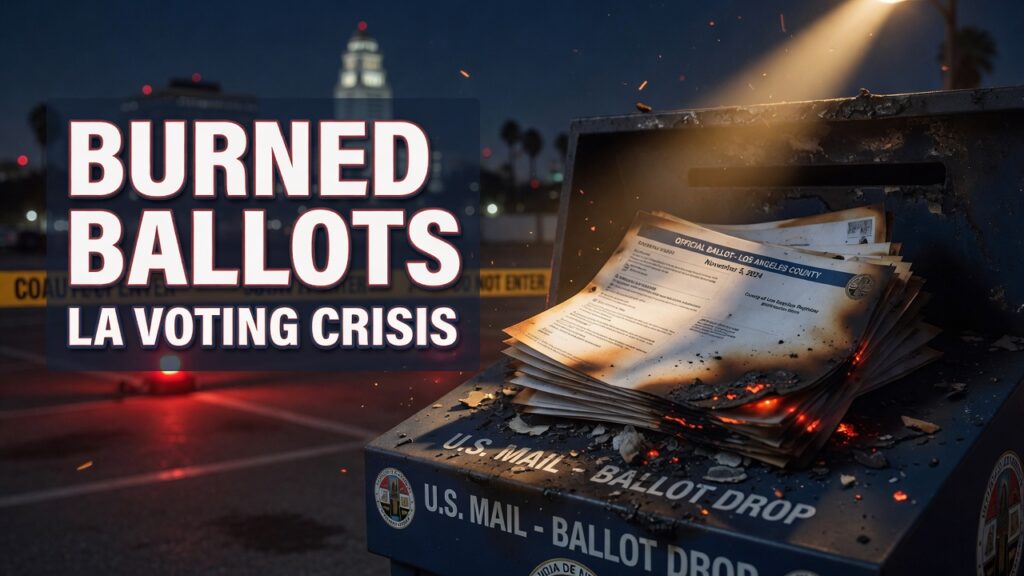
Days before California’s June 2 primary, election officials confirmed burned ballots and a vandalized vote center — and millions of Americans are now asking: is the mail-in voting system actually secure enough to protect your voice?
Your vote was supposed to be untouchable.
Yet on the morning of May 31, 2026 — just two days before California’s statewide primary — election workers conducting a routine pickup at a downtown Los Angeles ballot drop box made a disturbing discovery: a small number of mail-in ballots bearing fire-related damage. Someone, it appears, had set them ablaze. The same day, a vote center at Cesar E. Chavez Park in Long Beach was reported vandalized. Two separate incidents. One unmistakable message: the infrastructure holding up California’s mail-in voting system is more vulnerable than officials have been willing to admit.
Support Independent Local Journalism
TheTownHall.News is a non-profit reader-supported journalism. Just $5 helps us hire local reporters, investigate important issues, and hold public officials accountable across Alameda County. If you believe our community deserves strong, independent journalism, please consider donating $5 today to support our work.What Actually Happened at the Downtown L.A. Drop Box?
The burned ballots were discovered by staff from the Los Angeles County Registrar-Recorder/County Clerk’s Office during what should have been an unremarkable morning collection at the Department of Public Social Services building in the Civic Center area. The ballots, according to an official news release, “appeared to have sustained fire-related damage inside an Official Ballot Drop Box.”
Los Angeles County Registrar Dean Logan responded with a statement: “Any attempt to interfere with voting or election operations is taken seriously.” His office confirmed that a police report had been filed with the LAPD and that officials were working to identify affected voters, who would be offered replacement ballots.
As of June 1, 2026, no arrests had been confirmed in either case. The investigation remains active.
This is not the first time. In October 2020, a ballot drop box at Baldwin Park Library in L.A. County caught fire in a suspected arson — firefighters had to cut the metal box open to extinguish the blaze, and multiple ballots were burned beyond recognition.

Is This an Isolated Incident — Or a Pattern Officials Are Downplaying?
The uncomfortable truth is that this is not unprecedented. California has now recorded multiple incidents of ballot drop box fires within a single election cycle and across different election years. Each time, officials reassure the public that safeguards exist. Each time, the vulnerability of placing thousands of unattended metal boxes on city sidewalks is quietly set aside.
Drop boxes across L.A. County are typically bolted into concrete or chained in place. They are collected on a regular schedule by two election workers. There are no live security personnel stationed at most locations. In a county of over 10 million people, that is a significant gap between promise and protection.
“The infrastructure holding up California’s mail-in voting system is more vulnerable than officials have been willing to admit — and burned ballots are the proof.”
When a physical ballot is destroyed before it is counted, there is no automatic digital backup. A voter’s participation in democracy simply disappears — unless officials can identify who was affected and reach them in time to cast a replacement. In a close race, even a small number of suppressed ballots can matter.
What Do the Numbers Actually Tell Us About Voter Confidence?
58%. That’s the share of Americans who still support mail-in voting — down sharply from 70% just six years ago. [[Pew Research Center, August 2025]]
The question no one in Sacramento wants to answer: what happens to that number after images of charred ballots circulate on social media the week of a primary election?
Support Independent Local Journalism
TheTownHall.News is a non-profit reader-supported journalism. Just $5 helps us hire local reporters, investigate important issues, and hold public officials accountable across Alameda County. If you believe our community deserves strong, independent journalism, please consider donating $5 today to support our work.According to the same Pew Research survey of 3,554 adults conducted in August 2025, 80% of Americans — including majorities of both Republicans and Democrats — support making early, in-person voting available for at least two weeks before Election Day. That is a broader consensus than any other voting method tested in the survey. It suggests that when Americans think about what security and accessibility actually look like together, in-person voting remains the gold standard in their minds.
Support for mail-in voting, meanwhile, has collapsed among Republicans — from 49% in 2020 to just 32% in 2025 [[Pew Research]] — and incidents like the ones in L.A. County are unlikely to reverse that trend.
What Do Supporters of Mail-In Voting Actually Believe?
This is a fair question, and it deserves a fair answer.
Proponents of universal vote-by-mail — including California election officials — argue that the system dramatically expands access to the ballot, particularly for shift workers, the elderly, the disabled, and those without reliable transportation. They point out that the overwhelming majority of ballots cast by mail are processed without incident and that California has some of the nation’s most robust signature-verification and tracking systems.
They are right that mail-in voting, at scale, functions without catastrophic failure in most elections. They are also right that in-person voter suppression has a long and documented history in American politics.
But here is the core tension: accessibility and security are not automatically in conflict — unless you refuse to invest equally in both. A system that mails ballots to every registered voter but leaves the return infrastructure unguarded on a sidewalk is not a fully secured system. It is a convenience that has been mistaken for a solution.
If officials truly believe mail-in voting is secure, why does the same county have multiple documented incidents of drop box fires across multiple election cycles?
Are California’s Election Officials Moving Fast Enough to Respond?
Logan’s office stated that voters whose ballots may have been destroyed would be “contacted directly and provided information about available options, including replacement ballots if necessary.” That is the correct response — but it raises an obvious follow-up.
How does an election office identify which specific ballots were in a drop box at a given time? How quickly can replacement ballots be issued two days before Election Day? And how many affected voters may not have received notification before the polls closed on June 2?
These are not rhetorical gotchas. They are operational questions that go to the heart of whether this system can deliver on its central promise: that every eligible citizen’s vote will be counted.
Burned ballots don’t just suppress votes — they suppress trust. And in a democracy, trust is the infrastructure that matters most.
Why Are More Americans Returning to the Case for Election Day Voting?
Personal responsibility is a cornerstone of civic life. So is accountability. In-person voting on Election Day — or during a robust early in-person period — provides both in ways that unattended drop boxes simply cannot match. You show up, you verify your identity, you cast your ballot in a supervised environment, and you walk away with a receipt of participation.
Pew Research data shows that in the 2024 presidential election, 34% of voters cast their ballots in person on Election Day, 32% voted early in person, and 34% voted by mail [[Pew Research, 2025]] — a virtual three-way tie. Americans are not abandoning one method for another. But the growing bipartisan support for expanded in-person early voting — 80% in favor [[Pew Research]] — suggests there is a commonsense middle ground available.
That middle ground looks like this: expand supervised, in-person early voting windows to two or more weeks. Reduce the reliance on unguarded drop boxes. Maintain mail-in options for those who genuinely need them, with stronger verification and security protocols around collection.
The goal is not to restrict voting. The goal is to protect it.
Key Questions This Story Raises
- Who is accountable when a voter’s mail-in ballot is destroyed before it is counted — the individual, the county, or the system?
- Why has California not implemented mandatory security cameras at all official ballot drop box locations after multiple documented arson incidents?
- If in-person voting offers a cleaner chain of custody, why are more states not expanding early in-person options as a security-first alternative to drop boxes?
The real question isn’t whether burned ballots are a tragedy — they obviously are. The real question is whether we are willing to have an honest conversation about the tradeoffs of a system that prioritizes convenience over security, before the next drop box fire decides the outcome of a race that matters.
What do you think — is it time to rethink mail-in voting infrastructure? Share this article and tell us where you stand.
Still have questions about election security in your state? Subscribe for daily coverage of the issues that affect your vote.
Think your community needs to hear this? Share the article — and contact your county elections office or state representative to ask what security protocols are in place at ballot drop box locations near you.