3D-Printed Spinal Implants: The Medical Breakthrough Regulators Can’t Ignore
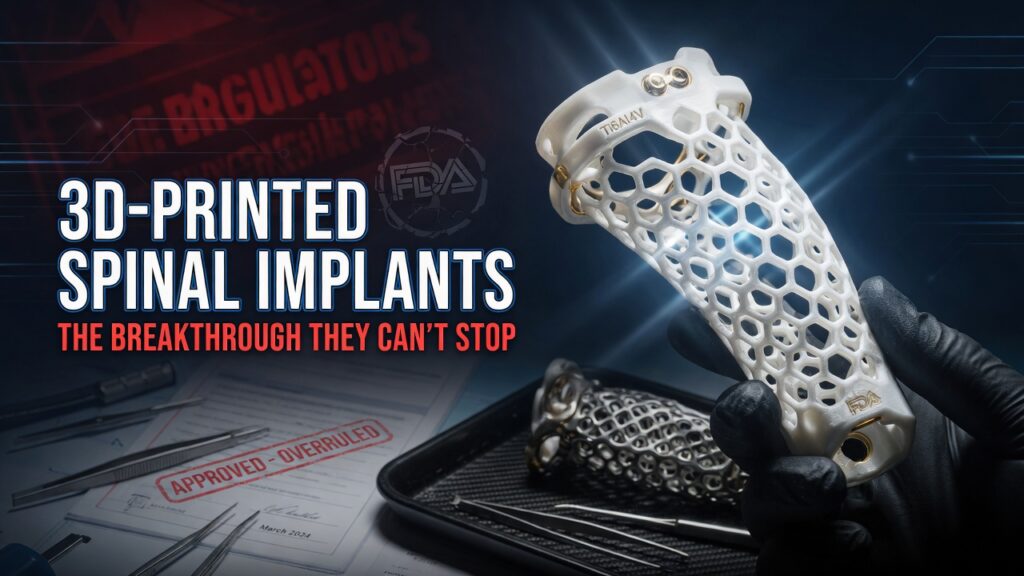
A man in China walked again after surgeons rebuilt 19 centimeters of his spine with a custom titanium implant. As this technology accelerates globally, millions of patients and taxpayers are asking: who is deciding how fast life-saving innovation reaches the people who need it most — and why?
A man couldn’t walk. Then engineers printed him a spine.
That is not science fiction. That is what happened when Chinese surgeons removed five vertebrae destroyed by a malignant tumor and replaced them with a custom-designed, 3D-printed titanium implant engineered precisely to fit one human body. The patient walked again. The surgery lasted six hours. The implications could last a generation.
Support Independent Local Journalism
TheTownHall.News is a non-profit reader-supported journalism. Just $5 helps us hire local reporters, investigate important issues, and hold public officials accountable across Alameda County. If you believe our community deserves strong, independent journalism, please consider donating $5 today to support our work.This breakthrough arrives at a moment when the entire architecture of modern medicine is being stress-tested. Costs are spiraling. Wait times are growing. Patients are being handed generic solutions for deeply personal medical crises. And yet, in research labs and operating theaters across the world, engineers and surgeons are proving that a radically better alternative already exists — one built on personal precision, not institutional convenience.
What Actually Happened — and Why It Matters Right Now
The facts are remarkable in their specificity. The implant measured approximately 19 centimeters — nearly the length of a standard ruler — and replaced five vertebrae in a single reconstructive procedure. Using medical imaging and computer modeling, engineers built a porous titanium structure that matched the patient’s unique spinal anatomy with extraordinary accuracy. That porosity wasn’t decorative: it was engineered to invite bone tissue to grow into and through the implant, creating biological integration over time rather than a permanent foreign object simply bolted in place.
Titanium has long been the workhorse of surgical implantry — valued for its strength, its resistance to corrosion, and its compatibility with human biology. But what 3D printing adds to titanium is something no factory floor ever could: the ability to treat every patient as an individual, not a size on a shelf.
This is what personalized medicine actually looks like — not a slogan on a hospital brochure, but a spine rebuilt from scratch for a single human being.

The procedure is now being cited widely in medical and engineering communities as a landmark in additive manufacturing’s march into mainstream clinical practice.
Is America Keeping Pace — or Falling Behind?
China’s achievement did not emerge from a vacuum. It reflects years of sustained investment in biomedical engineering, additive manufacturing infrastructure, and a willingness to move decisively from research into operating rooms. The question for American patients, taxpayers, and policymakers is direct: are we building the conditions that allow this kind of innovation to flourish here — or are we constructing the bureaucratic barriers that will slow it down?
In January 2026, Youngstown, Ohio-based Nivalon Medical Technologies announced it had produced the world’s first fully patient-specific, motion-preserving, metal-free spinal implant — the EvoFlex™. Built from zirconia-toughened alumina ceramic and printed using XJet’s NanoParticle Jetting™ technology, the device eliminates the metal-related complications that have plagued titanium implants for decades: corrosion, ion release, stiffness mismatch, and imaging interference. Independent testing at the University of South Florida confirmed the implant withstands compressive loads equivalent to approximately 1,490 kilograms of force.
First-in-human trials are planned for 2026. Two U.S. patents have been issued. Six more are pending. The science is ready.
“We were trying to treat a living biological structure with industrial metal hardware that was never designed to behave like bone.” — Todd Hodrinsky, CEO, Nivalon Medical Technologies
The private sector, driven by individual ingenuity and market accountability, is delivering answers. The harder question is whether the regulatory and insurance architecture surrounding American medicine will move at the same speed — or whether patients will wait years while innovation sits in bureaucratic queues.
Support Independent Local Journalism
TheTownHall.News is a non-profit reader-supported journalism. Just $5 helps us hire local reporters, investigate important issues, and hold public officials accountable across Alameda County. If you believe our community deserves strong, independent journalism, please consider donating $5 today to support our work.What Do Supporters of a Cautious Regulatory Approach Actually Believe?
To be fair, there is a serious argument on the other side — and it deserves honest engagement.
Proponents of rigorous pre-market review argue that speed can kill. Novel materials, custom geometries, and untested manufacturing processes carry real risks that only long-term clinical data can fully reveal. A ceramic spinal implant that performs brilliantly in a biomechanics lab may behave differently inside a living body under decades of physiological stress. The FDA’s Premarket Approval (PMA) process exists precisely because the consequences of a failed spinal implant are catastrophic and often irreversible.
These concerns are not frivolous. Medical device history contains genuine cautionary tales of products rushed to market with devastating results for patients.
But the counterargument is equally powerful: the cost of excessive caution is not neutral. Every year a proven technology spends in regulatory limbo is a year real patients receive inferior generic implants, face higher complication rates, and endure additional revision surgeries. Fiscal accountability cuts both ways — and the bill for failed generic implants, revision surgeries, and extended hospital stays is ultimately paid by patients, insurers, and taxpayers.
The standard should not be “slow enough to be safe.” It should be “fast enough to be responsible.” Those are not the same thing, and conflating them has real human costs.
Who Is Really Paying When Innovation Is Delayed?
The answer is not abstract. Research published in Materials Today Bio in 2025 notes that low back pain alone affected 619 million people worldwide in 2020 — with projections reaching 843 million by 2050 [peer-reviewed global burden of disease data]. Spinal disorders are among the leading causes of disability globally. China’s spinal surgery market, valued at approximately $916 million in 2025, is projected to nearly double to $1.79 billion by 2035 [industry market analysis data].
$916 million in spinal surgery — in a single country. The question worth asking: how much of that spending goes toward implants that don’t fit the patient they’re placed in?
The economics of generic, one-size-fits-all implants are not just a clinical problem. They are a fiscal one. Custom implants have been associated with significantly lower rates of revision surgery. Patients with properly fitted devices recover faster, return to work sooner, and consume fewer downstream healthcare resources. The argument for personalized medicine is not just compassionate. It is fiscally responsible.
What Happens If No One Asks These Questions?
Parental rights advocates, patient advocacy groups, and fiscal conservatives share a common interest here that rarely gets named explicitly: the right of individuals and families to access the best available medical technology without being rationed by institutional inertia or financial gatekeeping.
A parent whose child faces spinal surgery deserves to know whether the best available implant — one designed specifically for that child’s anatomy — is accessible or whether it’s sitting in a regulatory holding pattern. A taxpayer funding Medicare and Medicaid deserves to know whether the system is purchasing optimized outcomes or simply defaulting to the cheapest shelf option.
If the technology to rebuild a human spine already exists — and it does — the question of who controls access to it is no longer a medical question. It’s a civic one.
Personal responsibility in healthcare means informed patients advocating for the best possible care. But that responsibility requires the system to be transparent about what is available, what works, and what is being held back — and why.
🗝️ Key Questions This Story Raises
- How long should a patient wait for a custom implant when the technology already exists — and who bears accountability for that delay?
- Are American regulatory pathways equipped to handle the speed at which AI-driven, patient-specific medical devices are now being developed?
- When generic implants lead to revision surgeries and longer recoveries, who calculates — and who carries — the true fiscal and human cost?
The Question That Shouldn’t Wait for an Answer
The story of a man walking again because engineers printed him a spine is not just inspiring. It is a signal flare. It tells us what is possible. It tells us what is available. And it asks us — directly — whether the institutions entrusted with delivering healthcare to millions of people are capable of moving at the speed that human suffering demands.
The private sector is producing answers. Researchers are producing evidence. Surgeons are producing results.
The real question isn’t whether 3D-printed medicine will transform spinal care — it already has. The question is whether the system protecting patients will adapt in time, or whether it will protect itself instead.
What do you think — should patients have the right to access personalized implant technology the moment clinical evidence supports it? Share this article and weigh in.
Still have questions? Stay informed — subscribe for daily coverage of the innovations reshaping medicine and the policy decisions that determine who can access them.
Think others need to hear this? Share the article and start the conversation.
Want to make your voice count? Contact your congressional representative and ask where they stand on FDA modernization for patient-specific medical devices. The Senate HELP Committee and the House Energy and Commerce Committee both have jurisdiction — and both have contact forms online.