Democrats Vote Against Child Trafficking Funding: What the Senate Vote Really Means
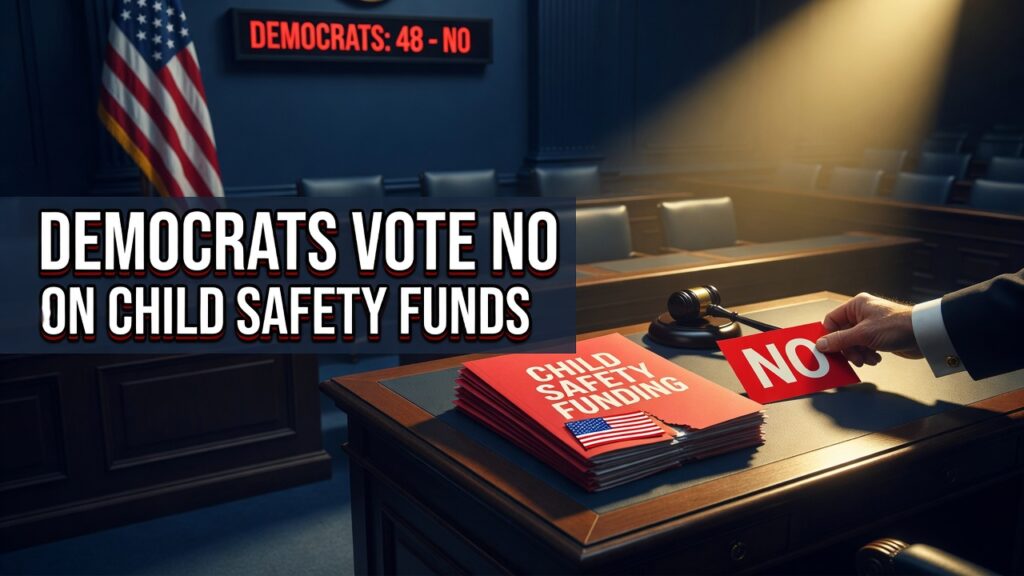
The Senate just secured $108.5 million to rescue exploited children and hire 200 new investigators. Every Democrat voted against the bill that made it happen. The full story is more complicated — and more revealing — than either side wants to admit.
Every child rescued from a trafficking ring represents a failure the system almost allowed to become permanent. That framing matters right now.
Last week, the U.S. Senate passed a sweeping $69.5 billion reconciliation package that included one of the most significant federal investments in child exploitation enforcement in American history — a provision championed by Sen. Josh Hawley (R-MO) and inspired by Tim Tebow’s Senate testimony. The bill passed 52–47. Not a single Democrat voted yes. Understanding why that happened — and what it actually means — is the conversation Americans should be having instead of the one social media is giving them.
Support Independent Local Journalism
TheTownHall.News is a non-profit reader-supported journalism. Just $5 helps us hire local reporters, investigate important issues, and hold public officials accountable across Alameda County. If you believe our community deserves strong, independent journalism, please consider donating $5 today to support our work.The $108.5 Million Provision: What Was Actually at Stake?
The numbers here are staggering, and they deserve to stand on their own.
The Department of Homeland Security’s Homeland Security Investigations unit — the agency most responsible for identifying child victims in exploitation cases — currently employs just seven full-time forensic specialists to identify victims nationwide. Seven. For the entire country.
7 specialists. 338,000 unique IP addresses traced to child rape image distribution in the U.S. in a matter of months. Someone should have to answer for that gap.
Sen. Hawley’s provision, modeled on the bipartisan Renewed Hope Act, addresses this catastrophic shortfall directly. The $108.5 million would fund 40 new forensic analysts at the Victim Identification Laboratory, 30 new child exploitation investigators at the same unit, 130 additional analysts and investigators at field offices across the country, and a dedicated federal-state-local training and coordination program. [Federal legislative record, Senate Judiciary Subcommittee, March 2026]

Tim Tebow testified before Hawley’s Senate Judiciary Subcommittee in March 2026 that as many as 89,000 unidentified child victims appear in materials currently sitting in evidence databases — children whose identities remain unknown because there are not enough analysts to process the cases. [Senate Judiciary hearing testimony, March 2026]
“89,000 unidentified child victims. The question no investigator should ever have to ask is: where are all the people whose job it is to find them?”
This provision is now law. That is the unambiguous good-news headline buried beneath the political warfare.
Why Did Democrats Vote No — And Is That the Real Story?
Here is where honest journalism has to do the work that social media will not.
Democrats did not vote against this bill because of the child exploitation provision. They voted against a $69.5 billion immigration enforcement package for reasons that had been building for months before Hawley’s amendment was ever attached to it.
In January 2026, Senate Democrats announced they would block all DHS funding unless the Trump administration agreed to reforms — including requiring judicial warrants before ICE officers could enter private homes and prohibiting agents from wearing masks during operations. The standoff intensified after federal officers shot and killed 37-year-old Alex Pretti during Operation Metro Surge in Minneapolis, an incident that became a rallying point for Democratic opposition.
Support Independent Local Journalism
TheTownHall.News is a non-profit reader-supported journalism. Just $5 helps us hire local reporters, investigate important issues, and hold public officials accountable across Alameda County. If you believe our community deserves strong, independent journalism, please consider donating $5 today to support our work.A secondary controversy — the Justice Department’s creation of a $1.8 billion “anti-weaponization” fund that critics across both parties argued would be used to compensate Trump political allies — pushed several Republicans to the brink of defecting. Sen. Susan Collins (R-ME), Sen. Bill Cassidy (R-LA), and Sen. Jon Husted (R-OH) all crossed party lines on various amendments, underscoring that the bill’s controversies extended well beyond child trafficking.
The child trafficking provision was real. The political packaging around it was also real. Voters deserve to understand both.
Democrats were voting against ICE funding policy, due process disputes, and a controversial DOJ fund — not against protecting children. The conflation of those separate issues into a single moral indictment is a tactic, not an argument.
What Do Supporters of This Policy Actually Believe?
To be fair — and fairness is required here — Democratic opposition to the broader bill was not without legitimate grievances.
Supporters of the Democratic position argue that funding a $69.5 billion enforcement package without accountability measures is fiscally and constitutionally reckless. They point out that ICE and Border Patrol already had substantial cash reserves — Senate Democratic Leader Chuck Schumer cited “a hundred billion dollars in cash on hand” — and questioned why emergency reconciliation authority was needed. [Congressional floor record, June 2026] They further contend that attaching popular provisions like the child trafficking funding to a contested immigration bill is itself a political strategy designed to force opponents into exactly the kind of damaging vote optics now circulating on social media.
That concern is not unreasonable. Legislators routinely embed uncontroversial, popular measures inside larger bills to make the whole package harder to oppose. It is a bipartisan tactic used across decades of American lawmaking.
The appropriate response to that argument, however, is not to pretend the child exploitation provision didn’t matter — it’s to ask why Democrats didn’t fight harder to separate it, protect it, and pass it on its own terms. If the provision was genuinely noncontroversial, why wasn’t its survival negotiated as a condition of any deal?
If rescuing 89,000 unidentified child victims isn’t enough to bridge a political divide, what exactly is the bridge for?
Is the Real Problem Bigger Than One Vote?
The vote is a symptom. The deeper problem is structural, and it has been bipartisan for years.
DHS operating with seven child exploitation analysts is not a crisis that emerged under one administration or one Congress. It is the result of sustained, multi-year underinvestment that survived budget cycles under both parties. The Renewed Hope Act — the legislation that inspired Hawley’s provision — had bipartisan support in committee before it was absorbed into the reconciliation process. That context matters because it reframes the conversation: this was never a question of Republican compassion versus Democratic indifference. It was a question of whether a genuinely necessary investment would survive a larger political war.
It survived. Barely. And that should prompt some institutional soul-searching from both parties.
The principle of fiscal accountability also demands a harder look here. Authorizing $108.5 million for child exploitation enforcement is the right call. But that appropriation exists inside a $69.5 billion package that bypassed the normal appropriations process entirely — funded through budget reconciliation designed to sidestep filibuster rules. Supporters of limited government and legislative accountability should ask whether the right outcome through a questionable process sets a precedent worth examining.
What Happens If This Conversation Gets Hijacked?
The viral post that triggered national outrage this week was not journalism. It was a social media caption stripped of every fact that might complicate the narrative.
That matters because when complex legislative realities get flattened into moral slogans, the people who lose are the ones the legislation was supposed to help. Child trafficking victims don’t benefit from a news cycle. They benefit from sustained, properly funded, well-coordinated law enforcement — exactly what the Hawley provision funds.
When political outrage replaces policy literacy, the children waiting to be identified in evidence databases don’t get found any faster.
The 89,000 unidentified child victims in HSI’s backlog are not a talking point. They are a national emergency that existed before this vote and that the passage of this provision is now, at last, beginning to address. Americans who care about law and order, personal responsibility, and the protection of the most vulnerable citizens should hold their representatives accountable — but accountable to facts, not to curated outrage.
🔑 Key Questions This Story Raises
- Why wasn’t the child exploitation provision separated from the broader immigration bill and passed as standalone legislation — and which senators, on either side, blocked that path?
- What accountability mechanisms will ensure the $108.5 million reaches HSI’s child exploitation units and produces the 200 investigators promised — and who is responsible for oversight?
- If Democrats genuinely support anti-trafficking enforcement, will they introduce or co-sponsor a standalone bill to cement this funding beyond the current reconciliation vehicle — and will Republicans allow it to come to a vote?
The Question That Lingers
The child exploitation funding is now law. That is a meaningful, overdue victory — and the Americans, advocates, and legislators who fought for it deserve credit for it.
But the vote that delivered it exposed something uncomfortable: a political system so fractured that a provision to rescue unidentified child victims can only survive by riding inside a $69.5 billion immigration enforcement battle. That is not a partisan failure. It is a systemic one.
The real question isn’t whether politicians care about children — most of them, on paper, do. The real question is whether the system they’ve built is actually capable of protecting them when it matters most — and whether you’re going to demand an answer.
What do you think — is one-vote-at-a-time politics the right way to protect the country’s most vulnerable? Share this article and tell us where you stand.
Still have questions? Stay informed — subscribe for daily coverage of the legislation that actually affects your family.
Think others need to hear the full story? Share this article — because context is the first casualty of social media.
Want to make your voice count? Contact your Senator’s office directly at senate.gov and ask them where they stand on standalone child exploitation enforcement funding.