Duck Pond Shooting Raises Urgent Questions About Park Safety and Permit Accountability
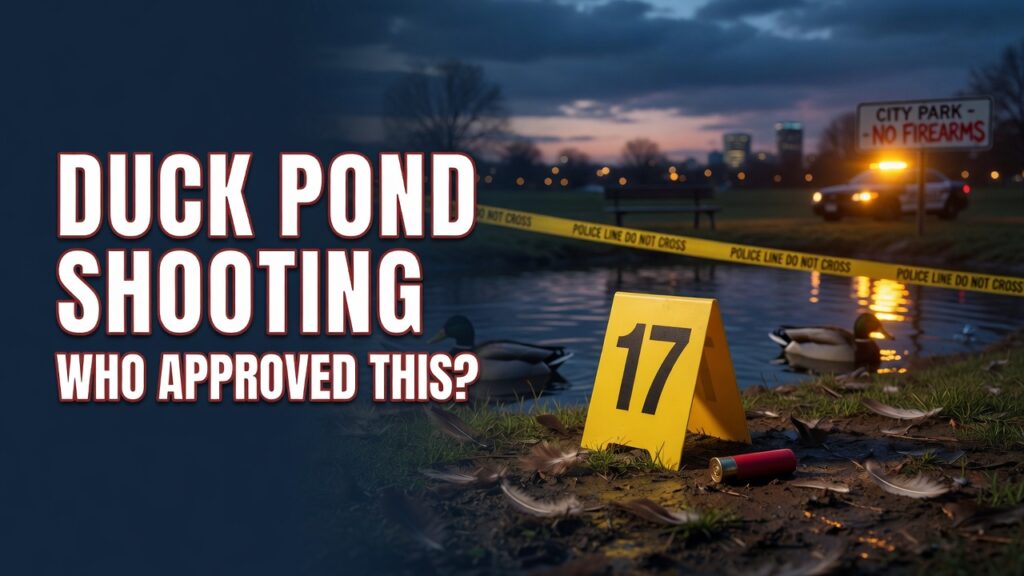
When gunshots replace laughter at a neighborhood duck pond on a Sunday evening, the question every parent deserves answered is a simple one: who is responsible — and what are they going to do about it?
A community park should be the safest acre in any American neighborhood. On the evening of June 7, 2026, for the families gathered at a local duck pond for what was supposed to be a joyful celebration of life, it was anything but. Around 7 PM, shots rang out. Children screamed. Parents grabbed their kids and ran. Cars peeled out of parking lots in blind panic. In a matter of seconds, a space meant for birthday bikes and evening walks became a crime scene — and the same local officials who permitted the event have, so far, had very little to say about it.
That silence is not good enough. Not this time.
Support Independent Local Journalism
TheTownHall.News is a non-profit reader-supported journalism. Just $5 helps us hire local reporters, investigate important issues, and hold public officials accountable across Alameda County. If you believe our community deserves strong, independent journalism, please consider donating $5 today to support our work.A Pattern No One in Authority Wants to Discuss
This incident did not happen in a vacuum. Across the United States in 2026, gun violence at public gatherings — parks, festivals, parking lots, and community events — has become a recurring, documented crisis. According to Wikipedia’s tracked list of mass shootings in the United States in 2026, a shooting in Fort Worth, Texas on June 6 injured four people, including a child and a police officer, during a community event being hosted at a park. One day earlier, a woman was killed and five others were injured during a trail ride gathering in Jackson, Mississippi. On May 3, a woman was killed and 22 others were wounded at a park near Arcadia Lake in Edmond, Oklahoma, when a fight broke out during a party being held there. On May 8 in Brownsville, Tennessee, a shooting during a pre-prom photo session at a park killed a student and injured six others.
These are not isolated tragedies. They are part of a pattern — and the communities that have suffered have one thing in common: they were blindsided because those responsible for public safety were not asking the right questions before an event, only after one.
94 Mass Shootings in 90 Days. The Question No One Wants to Answer Is Why.
94 mass shootings were recorded in just the first quarter of 2026, according to the Gun Violence Archive — a number that climbed compared to the same period in 2025. [Gun Violence Archive, 2026] The question no one in local government wants to answer directly: how many of those occurred at permitted public events, and what, if anything, was done to prevent them?
The broader national trend does offer some genuine reason for cautious optimism — shooting deaths in Q1 2026 stood at 3,103, the lowest first-quarter figure in over a decade, and a decline of nearly 500 deaths from the same period in 2025, according to The Trace’s Gun Violence Data Hub. [Gun Violence Archive via The Trace, April 2026] That progress is real and should be acknowledged. But progress at the macro level does not comfort the mother who watched her child dive behind a park bench at 7 PM on a Saturday evening. Trends are not the same as accountability.

“When shots ring out at a duck pond during a family celebration, the issue is not statistics — it is whether someone in authority asked the hard questions before issuing the permit.”
Are Park Rental Policies Putting Children at Risk?
The incident raises a specific and uncomfortable question about the nature of the event itself. Community parks across America operate on permit systems — written policies that are meant to govern who can use public space, under what conditions, and with what oversight. Those policies exist for a reason.
If this happened at your neighborhood park during a permitted event, would anyone be held accountable — or would officials simply express condolences and move on?
The city of Davis, California found itself grappling with this exact question in April 2025, when a shooting at Davis Community Park during Picnic Day left three people injured. Within days, city leaders voted to create a subcommittee to review permit policies in the direct aftermath of the incident, according to KCRA News. That is the appropriate institutional response. The question now before every city whose parks have been the site of gun violence is whether they will wait for the next tragedy to prompt a review — or act before it arrives.
Permit reform does not mean banning public gatherings. It means applying common sense: verifiable event organizer accountability, clear capacity limits, and the authority for parks departments to deny or revoke permits when risk indicators are present. These are not radical ideas. They are basic governance.
What Do Supporters of the Current System Actually Believe?
It is fair to ask whether those who defend open, minimally regulated park rental policies have a legitimate point — and they do, in part. Proponents argue that over-policing community events disproportionately affects minority and working-class neighborhoods, where public parks are often the only affordable gathering space. They contend that placing excessive bureaucratic burdens on event organizers would effectively price out legitimate community celebrations and drive gatherings to less supervised private venues. These are arguments grounded in real social equity concerns and should not be dismissed.
Support Independent Local Journalism
TheTownHall.News is a non-profit reader-supported journalism. Just $5 helps us hire local reporters, investigate important issues, and hold public officials accountable across Alameda County. If you believe our community deserves strong, independent journalism, please consider donating $5 today to support our work.However, that argument — important as it is — does not resolve the fundamental question of oversight. Accountability and accessibility are not mutually exclusive. A well-designed permit review process can preserve open access while requiring basic safety planning: designated parking management, event organizer contact information, and clear capacity limits. What that process cannot be is a rubber stamp. When a celebration of life at a neighborhood duck pond can descend into a shooting within minutes, the system that permitted it without apparent precaution has failed — not the principle of public gatherings, but the specific execution of the oversight that governs them.
Is This the Accountability Moment Communities Have Been Waiting For?
Every American neighborhood has a breaking point — a moment when residents who have historically accepted vague assurances of “we’re looking into it” decide they want more than that. The evening of June 7 may be that moment for this community. And it should be, because the families who were there deserve more than a press release.
City councils and parks departments across the country should take note: the public is not asking for the elimination of community events. They are asking for a clear-eyed review of what was permitted, who reviewed the application, what safety provisions were required, and what changes will be made before the next permit is issued. Those are not politically divisive questions. They are the questions of basic civic stewardship.
Disagreements used to end with words. When they now end with gunfire at a duck pond while children feed ducks, something has broken — and elected officials own part of that responsibility.
The data tells us shooting deaths overall are declining. [The Trace/GVA, Q1 2026] The culture of conflict resolution, however — the instinct to reach for a weapon in a crowd of children rather than walk away — is a problem that laws and permits alone cannot fully solve. It requires community leadership, parental guidance, and a renewed social expectation that public spaces are sacred ground where the norms of civil society apply absolutely.
What Happens If No One Speaks Up?
The answer to that question is already written in the national data. Without community pressure, park permit policies remain unchanged. Without engaged residents attending city council meetings and demanding a formal review, officials have little political incentive to absorb the controversy that reform always carries. Without parents, neighbors, and community leaders standing up and saying “not here, not again,” the pattern repeats — in another city, at another park, at another celebration of life that becomes something no family should ever have to survive.
This community has always been one where children ride bikes in the evening and families feel safe. Preserving that — not as nostalgia, but as a daily lived reality — requires active civic participation. It requires showing up.
Key Questions This Story Raises:
- What specific safety conditions, if any, were attached to the park permit for the June 7 celebration event, and who signed off on it?
- Will local officials commission a formal review of park rental policies in the wake of this incident, and if so, when will that review be made public?
- What accountability measures exist for event organizers when a permitted gathering results in gun violence — and are those measures currently enforced?
The real question is not whether your neighborhood park is safe in theory. It is whether the people responsible for keeping it safe are doing their jobs — and whether you are willing to demand it if they are not.
What do you think — is it time for your city council to review park permit policies before the next incident? Share this article and let your neighbors know.
Still have questions? Stay informed — subscribe for daily coverage of community safety and local government accountability.
Think others need to hear this? Share the article so your neighborhood has this conversation now, not after the next incident.
Want to make your voice count? Contact your city council representative or parks department directly and ask for a formal review of park rental and event permitting policies. To find your local representative, visit usa.gov/local-governments.