White Phosphorus on Civilian Areas Confirmed: Who Is Accountable Under International Law?
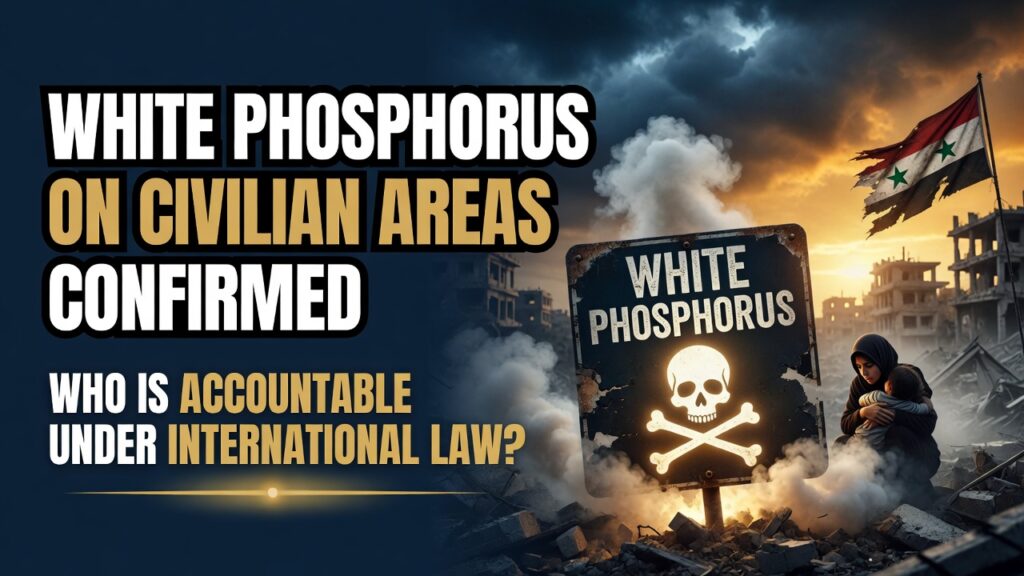
As the New York Times and Human Rights Watch confirm the use of a weapon that burns to the bone in populated areas, a damning question emerges: when no one is held accountable, does the law of war mean anything at all?
The images do not lie. On June 6, 2026, the New York Times published a landmark visual investigation confirming what human rights organizations had been documenting for months: white phosphorus munitions have been deployed over populated areas of Lebanon. This is not a contested allegation. It is a verified, geolocated, expert-confirmed fact — and the absence of any meaningful accountability response from governments capable of acting is a civic and legal crisis that demands a direct answer.
This matters right now because accountability is the foundation upon which civilized governance rests. Whether you believe in the rule of law domestically or internationally, the principle is the same: no actor — individual, corporation, or military — should operate above the law without consequence. When governments that fund and arm military forces look the other way as those forces deploy incendiary weapons over residential neighborhoods, citizens in every democracy connected to that chain of decisions have a right — and an obligation — to ask hard questions.
Support Independent Local Journalism
TheTownHall.News is a non-profit reader-supported journalism. Just $5 helps us hire local reporters, investigate important issues, and hold public officials accountable across Alameda County. If you believe our community deserves strong, independent journalism, please consider donating $5 today to support our work.What Exactly Is White Phosphorus, and Why Does It Matter?
White phosphorus is not a conventional explosive. When exposed to oxygen, it spontaneously ignites, burning at 815 degrees Celsius. It cannot be easily extinguished. When it contacts human skin, it burns through flesh, muscle, and bone. According to Human Rights Watch, burns covering just 10 percent of a human body are often fatal. Survivors frequently face a lifetime of contractures — the permanent tightening of muscles and tissue — along with organ damage, respiratory harm, and severe psychological trauma. The World Health Organization has documented that its smoke causes serious damage to the eyes and respiratory tract through the formation of phosphoric acids.
It spreads. When delivered via airburst — the method documented in Lebanon — a single 155mm M825-series artillery shell disperses 116 burning felt wedges impregnated with the substance across an area between 125 and 250 meters in diameter. There is no surgical precision in that. There is no way to fire it over a residential neighborhood and credibly claim it poses no risk to the people living there.
White phosphorus burns at 815 degrees Celsius, cannot be easily extinguished, and kills at just 10% body coverage. This is what was confirmed over civilian neighborhoods in Lebanon.
What Did the Investigations Actually Find?
The evidence trail is substantial and comes from multiple independent sources, each using verified methodology. The NYT investigation confirmed white phosphorus use as recently as May 30, 2026, over Nabatieh — a city of approximately 40,000 people — as well as near the coastal city of Tyre and the towns of Qlayaa, Khiam, and Yohmor. The footage was geolocated, verified by weapons experts, and cross-referenced with aid group testimony.

Human Rights Watch, publishing its findings on March 9, 2026, confirmed the unlawful use of artillery-fired white phosphorus over homes in Yohmor on March 3. Investigators verified and geolocated eight separate images, identified the munition type as consistent with U.S.-manufactured M825-series shells, and documented civil defense workers extinguishing fires on residential rooftops and a car within 160 meters of the airburst location. HRW’s Lebanon researcher Ramzi Kaiss stated plainly: “The Israeli military’s unlawful use of white phosphorus over residential areas is extremely alarming and will have dire consequences for civilians.”
A separate OSINT study by Ahmad Baydoun of Delft University of Technology, mapping 248 white phosphorus strikes across southern Lebanon between October 2023 and November 2024, found that 39 percent of all documented strikes occurred over civilian areas and 16 percent over agricultural land.
248 documented white phosphorus strikes. 39 percent over civilian areas. The question is not whether this happened — it is who answers for it.
Is International Law Equipped to Handle This?
This is where the legal framework reveals its most serious structural weakness. White phosphorus is not classified as a chemical weapon because it operates primarily through heat and flame rather than toxicity. It is governed instead by Protocol III of the Convention on Conventional Weapons — and that protocol contains two critical loopholes that have allowed its continued use with legal ambiguity.
First, Protocol III restricts some but not all ground-launched incendiary weapons in areas with concentrations of civilians. Second, the protocol’s definition of incendiary weapons covers only those “primarily designed” to set fires, which means that if white phosphorus is officially described as a smokescreen agent — even when deployed over residential streets — it may technically fall outside the protocol’s prohibition. Lebanon is a signatory to Protocol III. Israel is not. That means even this weakened legal instrument does not formally bind the party deploying the weapon.
Support Independent Local Journalism
TheTownHall.News is a non-profit reader-supported journalism. Just $5 helps us hire local reporters, investigate important issues, and hold public officials accountable across Alameda County. If you believe our community deserves strong, independent journalism, please consider donating $5 today to support our work.“When the rules of war contain loopholes that allow burning agents to be dropped over residential neighborhoods — legally — the rules of war have failed. The question is whether democratic governments choose to enforce norms their own laws cannot.”
Customary international humanitarian law still applies, however. It requires all parties to take all feasible precautions to avoid civilian harm — and airburst white phosphorus over a town of 40,000 people does not meet that standard under any reasonable interpretation. HRW, Amnesty International, and leading international law scholars have consistently concluded the use documented in Lebanon is unlawful under existing customary law.
What Do Supporters of This Policy Actually Believe?
Defenders of the policy — including the Israeli government and some allied officials — advance several arguments worth engaging directly. First, they argue that white phosphorus is a legitimate smokescreen agent used to protect ground forces during combat operations, not an offensive weapon targeting civilians. The Israeli military has stated it uses white phosphorus in compliance with international law. Second, they point to the security context: Hezbollah operates within civilian infrastructure and uses populated areas, making it operationally necessary to obscure troop movements. Third, some legal scholars note that because Israel has not ratified Protocol III, it bears no formal treaty obligation under that specific instrument.
These are not frivolous arguments. The legal ambiguity is real, and the operational pressure Israeli forces face is documented. However, the evidence directly undermines the core claim. The OSINT study by Baydoun found that 91 percent of documented white phosphorus strikes occurred before Israeli ground forces had entered southern Lebanon in October 2024 — meaning the “smokescreen for ground troops” rationale does not apply to the vast majority of documented cases. Furthermore, customary international law is not optional for treaty non-signatories; it binds all states. The airburst delivery over populated residential neighborhoods, as documented in Yohmor and Nabatieh, does not satisfy the feasible precautions standard regardless of stated intent. And Israel’s own High Court of Justice was told in 2013 that white phosphorus use in populated areas would be an “extreme exception in highly particular circumstances” — a commitment the current pattern of use appears to contradict.
Who Is Paying for the Weapons — and Who Is Responsible?
This is the question that connects every American taxpayer directly to the documented facts on the ground. According to the Quincy Institute for Responsible Statecraft and Brown University’s Costs of War Project, the United States has provided at least $21.7 billion in military aid to Israel since October 7, 2023 [Quincy Institute / Costs of War Project, peer-reviewed research]. The M825-series white phosphorus artillery shell confirmed in the Yohmor attack is a U.S.-manufactured munition. A Washington Post investigation previously confirmed that U.S.-supplied white phosphorus munitions were used in a 2023 Lebanon attack that injured civilians.
$21.7 billion in U.S. military aid since October 2023. If American-manufactured white phosphorus is confirmed over civilian homes, are American taxpayers owed a straight answer about what their money funded?
The Trump administration has accelerated military assistance, notifying Congress of arms sales to Israel totaling at least $10.1 billion since January 2025, including artillery shells and guidance systems. No formal review of whether U.S.-origin munitions were used in confirmed unlawful strikes has been made public. The Leahy Law — which prohibits U.S. military assistance to foreign security force units credibly implicated in gross human rights violations — exists precisely for situations like this. Its enforcement in this context remains an open and unanswered question.
What Happens If No One Speaks Up?
The standard of accountability that applies to a soldier in any domestic law enforcement context — that excessive force with foreseeable civilian harm creates liability — does not disappear because the theater of action is international. The rule of law is not a geographic variable. It is either a principle or it is not. The silence of governments capable of acting is itself a form of complicity, however legally constructed. When institutions empowered to uphold the law choose procedural avoidance over enforcement, they do not preserve the law — they hollow it out.
If the confirmed use of an incendiary weapon over a city of 40,000 people produces no accountability, what exactly does it take to trigger the international rule of law?
HRW has called on the United States, United Kingdom, and Germany to suspend military assistance. Lebanon’s government has been urged to accede to the International Criminal Court’s Rome Statute. As of the date of publication, none of these steps have been taken. The war in Lebanon continues. The death toll has surpassed 3,600 people, including at least 245 children and 131 paramedics [Lebanese Ministry of Public Health, June 2026]. More than 1.2 million people have been displaced.
Key Questions This Article Raises:
- If U.S.-manufactured white phosphorus munitions are confirmed over civilian residential areas, does the Leahy Law require a formal suspension of related military aid — and why hasn’t that review been made public?
- International law requires “all feasible precautions” to avoid civilian harm: given that 91 percent of documented white phosphorus strikes predate any Israeli ground incursion, what is the legal justification for their use?
- When verified evidence of unlawful incendiary weapon use accumulates across multiple credible institutions — the NYT, HRW, Amnesty International, and peer-reviewed OSINT research — and no government acts, what is left of the enforcement architecture of international humanitarian law?
The real question this moment demands is not political. It is not partisan. It is foundational: if the rule of law means anything, who enforces it — and when? Every documented report, every geolocated image, every verified airburst over a residential rooftop without consequence is a data point in an argument that accountability is selective, enforceable only when convenient. That should alarm anyone who believes that laws exist to be applied equally, that governments must answer for how public funds are used, and that the protection of civilians is not a value that expires at a national border.
The rule of law is not self-executing. It requires people, institutions, and governments to demand it. The evidence is now public, verified, and undeniable. The silence that follows is a choice.
What do you think — when confirmed evidence meets institutional silence, is it time for citizens to demand answers? Share this article and tell us where the line is.
Still have questions? Stay informed — subscribe for daily coverage of international law, accountability reporting, and foreign policy.
Think others need to hear this? Share the article — the facts are verified, the questions are urgent.
Want to make your voice count? Contact your congressional representative and ask them directly: Has the administration conducted any Leahy Law review of U.S. military aid in connection with confirmed white phosphorus use in Lebanon? You can find your representative and their contact information at congress.gov/members.