California Gay Certification Program: How the CPUC Awards Contracts Based on Sexual Identity
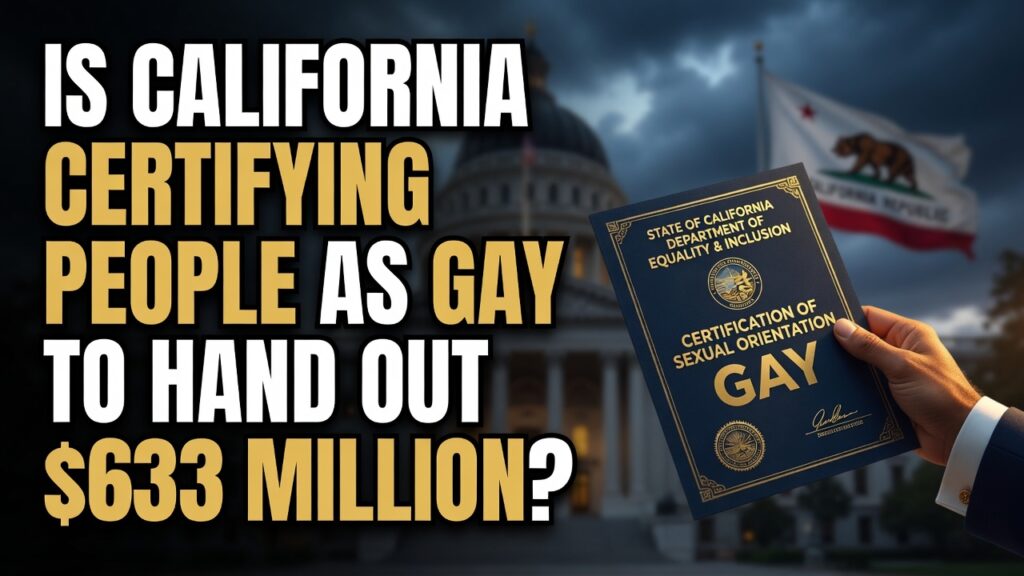
California’s utility regulator has a formal process for determining whether a business owner is gay enough to qualify for preferential contracts — and now the Department of Justice wants answers.
Imagine submitting a letter from your friends to prove your sexual identity to the state of California. Not for a background check. Not for a security clearance. For a utility contract. That is not a hypothetical. It is current California policy, and it is directing hundreds of millions of dollars in energy spending based on the sexual orientation of business owners — with jail time for anyone who lies about it.
The Policy Nobody Voted For
The California Public Utilities Commission (CPUC) regulates privately owned utility companies and sets procurement goals for how those companies spend their money. In 2024 alone, California utilities spent more than $43 billion on outside contractors — engineers, surveyors, fuel suppliers, and others who keep the power on and the water running. A portion of that spending is subject to CPUC’s Supplier Diversity Program, which sets explicit percentage targets for contracts awarded to companies based on the identity characteristics of their owners.
Support Independent Local Journalism
TheTownHall.News is a non-profit reader-supported journalism. Just $5 helps us hire local reporters, investigate important issues, and hold public officials accountable across Alameda County. If you believe our community deserves strong, independent journalism, please consider donating $5 today to support our work.The current goals are 15 percent for minority-owned firms, 5 percent for women-owned firms, 1.5 percent for disabled-veteran-owned firms, and 1.5 percent for LGBT-owned firms. If the LGBT target alone were fully met in a single year, that would route approximately $633 million in utility contracts toward businesses certified by the state as gay-owned.
California’s utility regulator is setting a $633 million procurement target based on business owners’ sexual orientation — and you’re paying for it on your energy bill.
How Do You Prove You’re Gay?
This is the question the program was always going to have to answer, and the answer is exactly as strange as you’d expect. The Supplier Clearinghouse, the CPUC-authorized body that handles certification, lists several accepted forms of documentation. Applicants can submit a letter from an LGBT organization attesting to their sexual preferences. They can provide a news article in which they are publicly identified as LGBT. Or they can submit three letters from personal contacts, written on company letterhead, confirming their homosexual orientation.
The National LGBTQ+ and Allied Chamber of Commerce, whose certification letters are also accepted, maintains its own list of qualifying documents — including HR complaints or police records citing LGBT discrimination. The chamber describes the process on its website with the phrase, “Certification is a journey, not a destination.”

Any corporate official who falsely claims LGBT status to obtain certification faces up to a year in county jail.
“The state of California has created an official process for certifying sexual identity — and made lying about it a criminal offense. At what point did this become the government’s business?”
Who Is Really Paying for This?
CPUC insists its procurement targets are voluntary goals, not quotas. In practice, the distinction is difficult to maintain. Regulated utilities are required to collect detailed demographic data, file annual reports on their progress toward the targets, submit plans for increasing procurement from favored categories, and explain in writing any failure to meet the goals. That is the structure of a mandate, whatever it is called on paper.
The cost of administering this system — and the premium that can come with directing contracts based on identity rather than competitive price — is ultimately passed through to ratepayers. In California, those ratepayers are among the most burdened in the country, already dealing with some of the highest electricity costs in the nation.
$633 million. The question no one at the CPUC wants to answer: what does any of this do for the reliability or affordability of California’s power grid?
DOJ Opens an Inquiry
The program moved from a regulatory curiosity to a federal matter this week. U.S. Assistant Attorney General Harmeet Dhillon announced that the Department of Justice has opened an inquiry into the CPUC’s Supplier Diversity Program. Speaking on a podcast on June 17, 2026, Dhillon stated directly: “I don’t know how who somebody sleeps with is relevant to their provision of utilities-related support services. That’s rhetorical. I think we know it isn’t. It’s nonsense, it needs to stop, and it’s illegal.”
Support Independent Local Journalism
TheTownHall.News is a non-profit reader-supported journalism. Just $5 helps us hire local reporters, investigate important issues, and hold public officials accountable across Alameda County. If you believe our community deserves strong, independent journalism, please consider donating $5 today to support our work.Dhillon also raised the economic argument, noting that set-asides create inflationary pressure because “people know that their status is a commodity that they can actually sell, because it’s being forced on the state and on the ratepayers.” The inquiry follows an investigative report by Manhattan Institute senior fellow Christopher Rufo and journalist Austen Hufford, published in City Journal on June 16, 2026.
If the government can certify your sexual identity for financial benefit, and jail you for lying about it, what principle exactly is being defended here?
Is the Program Even Working?
The data suggests the answer is no — even on the program’s own terms. In 2024, large utilities’ procurement from LGBT-certified businesses actually declined by 5 percent. The Supplier Clearinghouse lists approximately 3,750 minority-certified businesses, but only 451 LGBT-certified firms. The gap signals limited industry enthusiasm for a certification process many business owners likely find invasive or unnecessary.
The program also raises a question that supporters rarely engage with directly: gay men, as a demographic group, earn higher average incomes than most other categories recognized under the program. The rationale for including sexual orientation alongside racial minorities and disabled veterans — groups with documented income disadvantages — has never been clearly articulated in policy terms.
What Do Supporters of This Program Actually Believe?
Supporters argue that CPUC’s diversity goals serve a legitimate public interest by broadening the contractor pool, countering documented discrimination, and ensuring that historically excluded groups can access large institutional contracts. CPUC spokeswoman Terrie Prosper has stated that the program “encourages utilities to purchase at least 23 percent of their total procurement from diverse suppliers,” arguing that competitive access for diverse firms “assists utilities into reaching new markets, increasing shareholder value, and controlling costs.”
These are not frivolous arguments. Supplier diversity programs have demonstrated real economic benefits in some contexts, and the original 1986 program had a defensible rationale in addressing documented barriers for minority-owned businesses. The question is whether expanding that framework to include sexual orientation — a characteristic that is self-reported, difficult to verify, and not correlated with income disadvantage in this sector — follows the same logic, or whether it represents something different: identity politics applied to infrastructure spending.
The program also faces a direct legal challenge from California’s own voters. Proposition 209, passed in 1996, prohibits the state from granting preferences based on race, sex, or ethnicity in public contracts and employment. California voters rejected repealing it as recently as 2020. Whether a sexual orientation preference falls within that prohibition is now a question the DOJ inquiry may force into the courts.
Key Questions
- Who has legal authority to challenge CPUC’s procurement targets, and has anyone filed suit?
- If the DOJ inquiry finds the program illegal, what happens to contracts already awarded under it?
- Why has LGBT certification declined 5 percent even as CPUC increases regulatory pressure on utilities to hit targets?
What Happens Next?
The DOJ inquiry changes the trajectory of this story. What had been a state-level regulatory oddity is now a federal legal question. If Dhillon’s office concludes the program violates federal anti-discrimination law or conflicts with constitutional equal protection principles, California will face pressure to dismantle a structure it has spent more than a decade building.
The deeper issue is not about any one certification program. It is about what utility regulators are for. California’s grid has faced real, documented failures — wildfires ignited by failing power lines, rolling blackouts, some of the highest residential electricity rates in the country. The core function of a utility regulator is to ensure that electricity, gas, and water are delivered reliably and affordably. The question of whether the business owner who surveyed the transmission line is gay is not, by any conventional standard, part of that mission.
The real question isn’t whether California has the right to set procurement policy — it does. The question is whether certifying sexual identity as a condition of government contracting, backing that certification with criminal penalties, and directing hundreds of millions of dollars accordingly is something California’s ratepayers ever asked for, or whether it is something that happened to them while no one was paying attention.
What do you think — is it time for federal oversight to step in, or should California voters be the ones to end this? Share this article and weigh in.
Still have questions about how your utility bills are being spent? Subscribe to The Town Hall for daily coverage of government accountability stories like this one.