Livermore Tesla Fire 2026: What the Northern California Blaze Reveals About Wildfire Preparedness
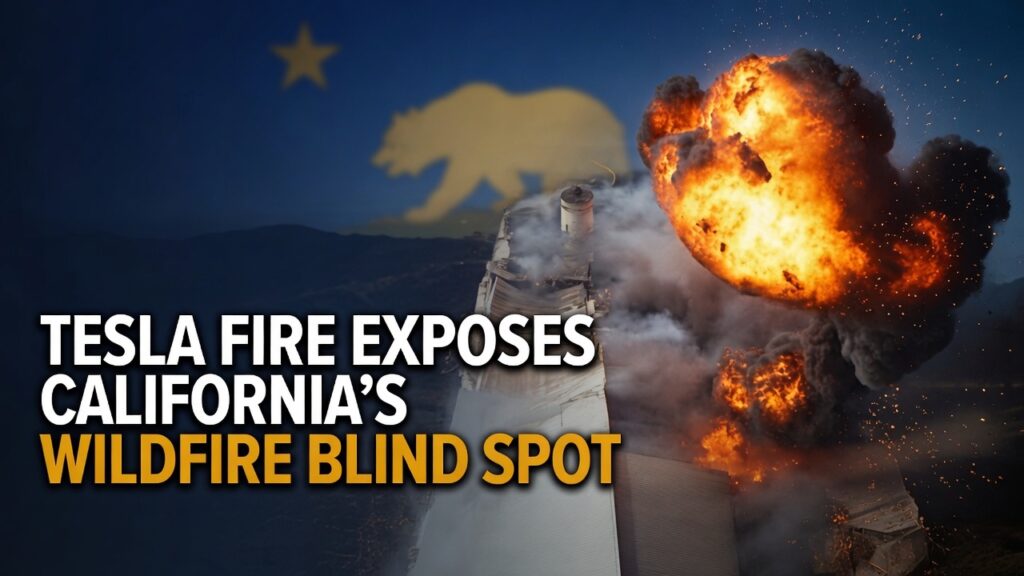
A fireball erupted over Livermore Wine Country on May 27 — and nearly four weeks later, no one has officially explained why. As California enters its most dangerous fire season in years, that silence should concern every property owner in the state.
A barn exploded. Thick black smoke blotted out the sky over wine country. And by the time crews finally contained the blaze, nearly five and a half acres of Northern California’s agricultural heartland had burned. The Tesla Fire — named for the Tesla and Cross Roads intersection where it ignited — was dramatic enough to capture national attention for a news cycle. Then the cameras moved on. The investigation is still open. And fire season has barely started.
That combination should alarm anyone paying attention.
Support Independent Local Journalism
TheTownHall.News is a non-profit reader-supported journalism. Just $5 helps us hire local reporters, investigate important issues, and hold public officials accountable across Alameda County. If you believe our community deserves strong, independent journalism, please consider donating $5 today to support our work.What Actually Happened Near Livermore on May 27?
The fire broke out around 2:30 p.m. on a property adjacent to multiple Livermore Valley wineries, including near Leisure Street Winery and immediately south of Bodegas Aguirre Winery. Crews from CAL FIRE and the Alameda County Fire Department arrived to find two large barns and surrounding dry vegetation fully engulfed in flames. What they faced next was not a routine structure fire.
Vehicles, propane tanks, and welding equipment stored inside one of the barns triggered multiple explosions during the firefight, sending a fireball into the sky visible for miles and producing what neighbors described as a rapid succession of loud pops. CAL FIRE Battalion Chief Alex Mikesell acknowledged on scene that smoke conditions were so severe crews could not attack the fire from the inside. “What we had to do was attack it from the outside,” he said. The fire burned for approximately five hours before crews brought it under control just before 8 p.m.
Two barns were completely destroyed. One family, the Davises, lost thirty years of personal possessions stored in the structures — collectibles, heirlooms, and a wedding dress among them. No injuries were reported, a fact that owes much to the speed of the response and a measure of good fortune.
A fireball erupted over California wine country in broad daylight — and weeks later, the official cause is still listed as “under investigation.”

Why Does the Timing Make This Story More Urgent?
The Tesla Fire did not occur in a vacuum. It broke out at precisely the moment forecasters were warning that California’s 2026 fire season was shaping up to be among the worst in recent memory. Most central and southern California locations received well below normal rainfall in May. Northern California’s snowpack — a critical buffer against early-season fire danger — collapsed from 45–65% of normal at the end of January to just 5–20% of normal by March 30, according to the National Interagency Fire Center’s 2026 outlook.
“The window in which wind, lightning, or human ignition sources can produce significant fires may open sooner and across a broader footprint than is typical.” — National Interagency Fire Center, April 2026 Outlook
That is not a warning issued in hindsight. It was published weeks before the Tesla Fire ignited. The question worth asking is simple: if the risk signals were this clear this early, why are rural agricultural properties in known fire corridors still storing vehicles, propane, and welding equipment in aging wooden barns without apparent safeguards — and why isn’t anyone in Sacramento asking?
Are Rural Property Owners Being Left Without Guidance?
The structures that burned were not abandoned. They were actively used for storage, and they sat adjacent to multiple working vineyards and an equestrian center, near the private Meadowlark Field airstrip. In other words, this was not an isolated patch of empty scrubland. It was a busy agricultural corridor where a fire starting on one property could — and did — threaten adjacent livelihoods within minutes.
California spends billions on wildfire response every year. Who is responsible for ensuring that combustible storage practices in high-risk corridors don’t create the next catastrophe?
CAL FIRE’s 2026 incident data confirms what fire behavior specialists have been warning about: Northern California is expected to experience a steady warming and drying trend through early summer, with above-normal significant fire potential forecast from May through July. That assessment was made before the Tesla Fire. The Tesla Fire appears to have validated it on day one of the forecasted high-risk window.
Support Independent Local Journalism
TheTownHall.News is a non-profit reader-supported journalism. Just $5 helps us hire local reporters, investigate important issues, and hold public officials accountable across Alameda County. If you believe our community deserves strong, independent journalism, please consider donating $5 today to support our work.5.4 acres. The question no one at the state level seems prepared to answer: when will California translate its fire-risk forecasts into enforceable preparedness requirements for rural property owners?
What Do Supporters of California’s Current Wildfire Policy Actually Believe?
Defenders of the state’s approach argue that CAL FIRE is underfunded relative to the scale of the problem, and that placing additional regulatory burdens on rural property owners — farmers, vintners, ranchers — is both impractical and punitive. They point out that California has invested heavily in aerial assets, mutual aid agreements, and community notification systems, and that the Tesla Fire’s outcome — no injuries, containment within five hours — is evidence that those investments are working.
That argument deserves a fair hearing. Emergency response in California has improved meaningfully over the past decade, and the crew performance at the Tesla Fire was genuinely effective under difficult conditions. Battalion Chief Wylie’s decision to keep crews on scene through the night to monitor structural collapse and smoldering hot spots reflects exactly the kind of disciplined risk management that prevents small fires from becoming regional disasters.
But responsive firefighting is not the same as prevention. The question is not whether California can contain fires after they start. The Tesla Fire proved it can. The question is whether the state is doing anything meaningful to reduce the conditions that allow a single ignition point — a dry patch of grass, a spark from welding equipment — to become a fireball visible from miles away in under an hour.
Is California’s Fire Season Already Outpacing Its Safeguards?
AccuWeather forecasts 65,000 to 80,000 wildfires will ignite across the United States in 2026 — above historical averages — with California’s fire danger expected to build steadily through summer and become most acute in autumn when wind events return. CAL FIRE’s own incident forecasting confirms that above-normal large fire activity is anticipated for both Northern and Southern California by July and August. The Tesla Fire occurred in late May. It was, in the grim arithmetic of wildfire season, an early warning shot.
The Livermore Valley is not a remote wilderness. It is one of California’s most celebrated wine-producing regions, home to dozens of wineries, established communities, and substantial private property investment. The fact that a fire sparked by combustible materials stored in a barn — materials that any fire inspector would recognize as hazardous — can escalate to a multi-explosion event within minutes raises a legitimate question about what baseline preparedness standards exist for agricultural properties in high-risk zones, and whether they are being enforced.
If a fireball over wine country in late May doesn’t prompt Sacramento to take rural fire preparedness seriously, what will it take?
Key Questions
- Why has the cause of the Tesla Fire not been publicly released nearly four weeks after the incident — and when will CAL FIRE investigators provide an update?
- What standards govern the storage of vehicles, propane tanks, and welding equipment in agricultural outbuildings in California’s designated high-risk fire zones, and are they enforceable?
- Given that federal fire forecasters issued above-normal risk warnings for Northern California weeks before the Tesla Fire ignited, what proactive steps — if any — did state agencies take to reduce ignition risk in known fire corridors?
The Real Question California Has to Answer
The Tesla Fire will not be the last fire to erupt in the Livermore Valley or anywhere else along California’s agricultural corridors this summer. Forecasters are not predicting that possibility — they are forecasting it as a near-certainty. What remains genuinely uncertain is whether the state will treat each fire as an isolated event to be suppressed, or as data points in a pattern that demands a more honest reckoning with how rural properties, combustible storage, and fire-season realities intersect.
The firefighters who held the line on May 27 did their jobs. The property owners who lost thirty years of memories in a matter of hours did not deserve what happened to them. The vineyards that came dangerously close to being consumed did not earn that risk.
Someone decided — by policy, by neglect, or by assumption — that the current system was adequate. The Tesla Fire suggests it is not.
The real question isn’t whether California’s wildfire risk is real — every forecast in 2026 confirms that it is. The question is whether anyone in power will act before the next fireball appears on someone else’s aerial video.
Still have questions about California’s wildfire preparedness? Stay informed — subscribe to The Town Hall for daily coverage. Think others need to hear this? Share the article and let us know what you think in the comments. Want to make your voice count? Contact your California state representative and ask what steps are being taken to enforce fire-safety standards in agricultural fire zones before peak season arrives.