Tyson Foods Lab-Grown Meat Investments: What America’s Largest Meat Company Isn’t Telling You About Lab-Grown Chicken
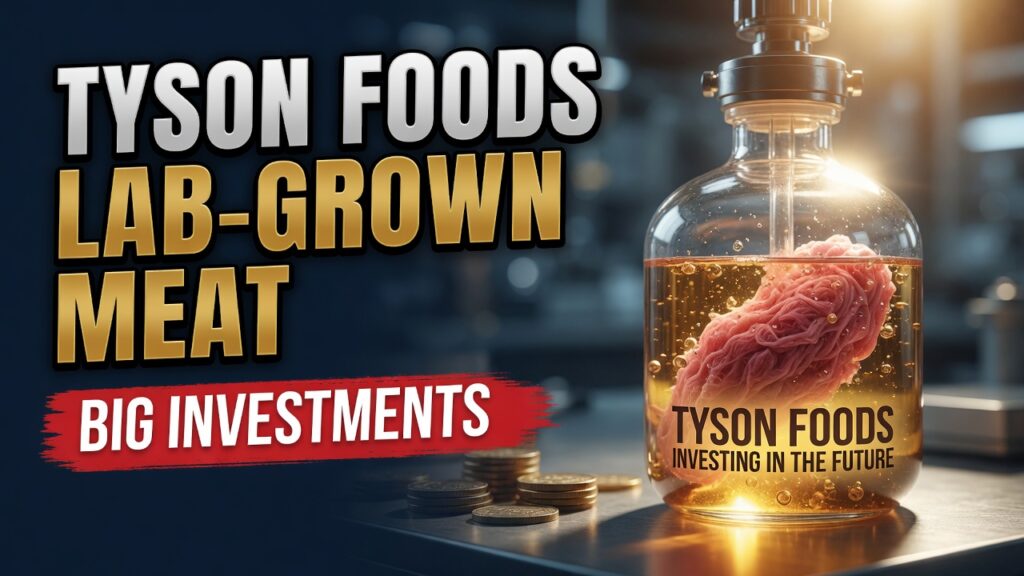
The country’s dominant chicken supplier has been quietly funding lab-grown meat startups since 2018. Federal regulators have already cleared two companies to sell it. And the average American has no idea.
Tyson Foods supplies chicken to McDonald’s, KFC, Taco Bell, Walmart, and Kroger. It processes more American chicken than any other company. It is also, through its venture capital arm, one of the earliest and most significant corporate backers of cultivated meat — meat grown not on a farm, but from animal cells in a laboratory bioreactor.
The investments are real. The regulatory approvals are real. What has been notably absent is a direct conversation with American consumers about what this means for their food, their choices, and their right to know exactly what they are buying.
Support Independent Local Journalism
TheTownHall.News is a non-profit reader-supported journalism. Just $5 helps us hire local reporters, investigate important issues, and hold public officials accountable across Alameda County. If you believe our community deserves strong, independent journalism, please consider donating $5 today to support our work.How Did Tyson Get Into the Lab-Grown Meat Business?
Tyson Ventures, the venture capital arm of Tyson Foods, first invested in Memphis Meats — now known as UPSIDE Foods — in 2018. That early-stage bet placed America’s largest chicken processor at the center of what was then a fringe scientific concept. It did not remain fringe for long. WATTPoultry
In a subsequent Series C funding round totaling $400 million, Tyson Foods and Cargill joined investors including Singapore’s state-owned Temasek fund, the Abu Dhabi Growth Fund, and Bill Gates to back UPSIDE Foods as it moved from research toward commercial production. The round pushed UPSIDE’s valuation past $1 billion. WATTPoultry
Tyson also invested in Future Meat Technologies, an Israeli biotech startup that produces meat directly from animal cells — its first investment in an Israeli company. Future Meat later rebranded as Believer Meats and completed construction of what it describes as the world’s only large-scale cultivated meat production facility, located in Wilson, North Carolina. Food DiveNational Hog Farmer
Tyson Foods has placed strategic bets on the future of lab-grown meat — while simultaneously remaining the dominant supplier of conventional chicken to every major American fast-food chain. Is that a conflict of interest, or just smart hedging?

What Has the Federal Government Actually Approved?
In 2022, the FDA provided premarket review and approval for two companies — GOOD Meat and UPSIDE Foods — to sell cell-cultivated chicken in U.S. markets. In June 2023, the USDA’s Food Safety and Inspection Service issued the first-ever grants of inspection to the two companies. Congress.gov
This made the United States one of the first major economies to formally clear lab-grown meat for sale. The process involved FDA conducting a pre-market consultation with UPSIDE Foods, concluding it had no further questions about the company’s conclusion that their foods are safe. The agency’s scientific memo describes the process in which cells are isolated either from adult chickens or from mid-stage fertilized chicken eggs. SupplySideFBJ
Supporters frame this as a scientific breakthrough. Critics ask a harder question: was the regulatory process sufficiently transparent, and were the right stakeholders consulted?
“The average American buying chicken at Walmart doesn’t know that the company processing it has a financial stake in replacing that chicken with something grown in a steel tank. That’s not a conspiracy — it’s a disclosure gap.”
As of mid-2025, lab-grown meat from these companies has only appeared in a small number of select restaurants — not in grocery stores, not in fast-food chains, and not in any of the private-label products Tyson produces for major retailers. The viral social media claim that your McNuggets might already be lab-grown is inaccurate. But the infrastructure is being built, the regulatory pathway is open, and the corporate funding is in place. National Hog Farmer
Are States Starting to Fight Back?
The policy backlash has been swift and, in some cases, sweeping. The development and sale of lab-grown meat are now banned in seven states: Florida, Alabama, Mississippi, Montana, Indiana, Texas, and Nebraska. The Hill
Support Independent Local Journalism
TheTownHall.News is a non-profit reader-supported journalism. Just $5 helps us hire local reporters, investigate important issues, and hold public officials accountable across Alameda County. If you believe our community deserves strong, independent journalism, please consider donating $5 today to support our work.Many of these restrictions arrived in 2025, and the Department of Health and Human Services lists them on its website as examples of Secretary Robert F. Kennedy’s movement to “Make America Healthy Again.” U.S. News & World Report
The arguments behind the bans vary. Some governors have framed it as a cultural and sovereignty issue. When Florida Governor Ron DeSantis signed that state’s ban, he described it as “fighting back against the global elite’s plan to force the world to eat meat grown in a petri dish.” Others have anchored the case in consumer transparency: without mandatory, clear labeling, consumers cannot make an informed choice. U.S. News & World Report
A much larger group of states — including Iowa, Kansas, North Dakota, South Dakota, and Tennessee — have taken narrower approaches, requiring qualifying language on packaging or restricting public institutions from purchasing cultivated protein. Factually
Seven states have now banned lab-grown meat outright. The question is whether Washington will act — or leave Americans to navigate a patchwork of rules that differs by zip code.
What Do Supporters of Lab-Grown Meat Actually Believe?
The case for cultivated meat is not frivolous, and intellectual honesty requires engaging with it directly. Proponents argue that traditional livestock agriculture is inefficient, land-intensive, and a significant contributor to greenhouse gas emissions. They contend that a growing global population will require protein sources that conventional farming cannot sustainably supply.
Advocates note that as the global population is expected to surpass 9 billion by 2050, the demand for meat is forecast to double — and that lab-grown meat represents one possible answer to meeting that demand in an environmentally responsible way. Technology Magazine
The food safety regulators who cleared UPSIDE Foods and GOOD Meat maintain that the products underwent rigorous review. UPSIDE argues that its cultivated chicken is subject to similar inspections and food safety standards as conventionally produced poultry, given that it is grown directly from real chicken cells. PR Newswire
These are legitimate arguments. But accepting them does not require accepting a process in which a corporation with billions invested in the outcome also shapes the supply chain, distribution network, and public narrative — while consumers are left to sort out the facts from viral misinformation on their own.
Who Is Really Driving This Industry — and Who Stands to Benefit?
Tyson Foods has integrated cultivated meat and alternative proteins directly into its long-term corporate growth strategy via its venture capital arm, leveraging its global supply chain, industrial cold-storage network, and existing distribution channels to eventually deploy these products at commercial scale. Insider Monkey
In other words: Tyson doesn’t just want to sell lab-grown meat someday. It wants to be the company that processes and distributes it — using the same infrastructure it already owns. The vertical integration that made Tyson dominant in conventional chicken could make it equally dominant in whatever replaces it.
$400 million. That is how much a single funding round for UPSIDE Foods raised — with Tyson, Cargill, Abu Dhabi sovereign wealth, and Bill Gates all at the table. The question Americans should be asking: when this many powerful interests align behind a single food technology, who is advocating for the consumer?
Policymakers enforcing state bans have been backed by powerful meat industry lobbyists, including Tyson Foods and JBS USA — which raises its own question. Tyson invests in lab-grown meat while simultaneously lobbying to restrict its labeling competition. Whether that reflects a corporation protecting its conventional business until lab-grown is ready to scale, or something more cynical, is a question worth asking loudly. The Hill
Is This the Accountability Moment Consumers Have Been Waiting For?
The answer depends on what citizens and legislators demand next. The USDA proposed the FAIR Labels Act of 2024, which, if passed, would federally require mock meat companies to clearly label their products as “imitation” or “lab-grown.” That proposal has not yet become law. Statecapitallobbyist
Legal battles over these state bans are already underway — UPSIDE Foods has challenged Florida’s and Texas’s bans, arguing they violate the Dormant Commerce Clause of the U.S. Constitution. Courts have not yet resolved these cases, and outcomes will be decisive for the future of the industry. Factually
If a corporation can invest in a food technology, control its distribution, lobby on related regulations, and face no requirement to tell consumers any of it — has disclosure become optional in America?
KEY QUESTIONS
- Should Tyson Foods be required to disclose its financial stake in lab-grown meat companies on conventional product packaging?
- Does the federal regulatory approval process for cultivated meat provide sufficient public notice and comment before clearing novel food technologies for sale?
- If states have the right to ban lab-grown meat outright, why does the federal government not have a minimum national labeling standard that applies everywhere?
The fundamental issue is not whether lab-grown meat is safe. Regulators say it is. The issue is whether the American consumer — who trusts the label, who feeds the family, who pays the bill — is being treated as a participant in this transformation or merely a recipient of it. Tyson has made its bet on the future of protein. The question is whether you got a vote.
What do you think — should corporations be required to disclose their alternative protein investments on the products you buy today? Share this article and let us know.
Think others need to hear this? Share with someone who buys Tyson products. Still have questions? Subscribe to The Town Hall News for daily coverage of the policies reshaping American food, farming, and consumer rights. Want your voice to count? Contact your U.S. representative and ask where they stand on mandatory lab-grown meat labeling at the federal level — you can find their contact information at congress.gov.