Is the One Big Beautiful Bill Already Breaking Its Promise to Taxpayers?
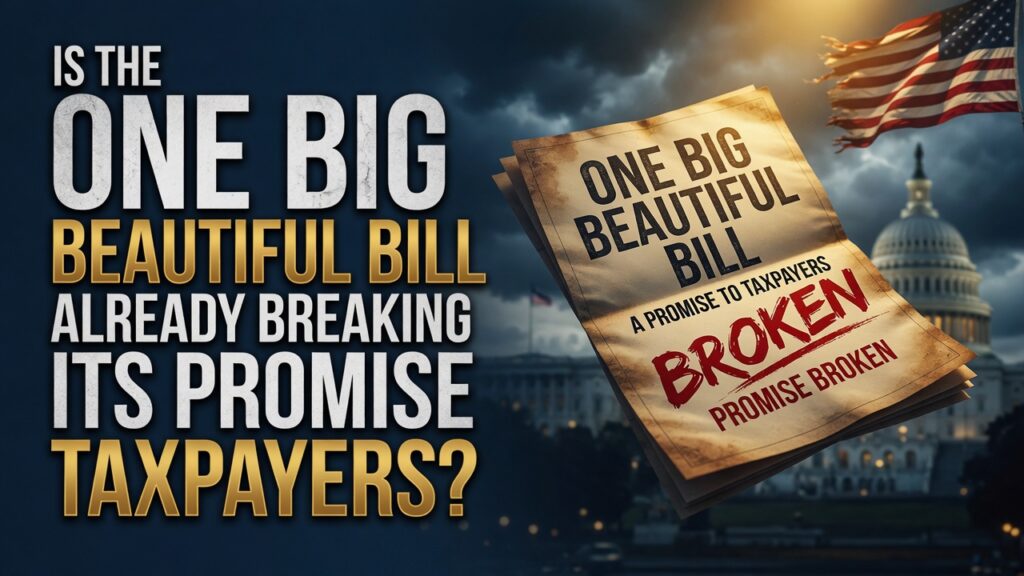
One year after its signing, the numbers are in — and fiscal conservatives have serious questions Congress hasn’t answered.
On July 4, 2025, President Donald Trump signed the One Big Beautiful Bill Act into law from the White House, calling it a historic win for American workers, border security, and economic revival. One year later, the nonpartisan Congressional Budget Office has delivered a verdict that every taxpayer deserves to read — and Washington would prefer you didn’t.
What Does the One Big Beautiful Bill Actually Cost?
The answer is stark. The CBO estimates the One Big Beautiful Bill will increase budget deficits by $4.1 trillion over the fiscal year 2025–2034 budget window and push federal debt held by the public to 127 percent of GDP — up from 100 percent at the end of fiscal year 2025. That is not a Democratic talking point. It is a score from Congress’s own nonpartisan accounting office. American Action Forum
Support Independent Local Journalism
TheTownHall.News is a non-profit reader-supported journalism. Just $5 helps us hire local reporters, investigate important issues, and hold public officials accountable across Alameda County. If you believe our community deserves strong, independent journalism, please consider donating $5 today to support our work.The One Big Beautiful Bill Act will cost $3.4 trillion in primary deficits over the next 10 years, and more than $4 trillion when accounting for additional interest owed on the national debt. To put that in plain terms: Congress authorized spending it does not have, borrowed the difference, and handed the bill to future generations. Bipartisan Policy Center
$4.1 trillion. That is what the CBO says the One Big Beautiful Bill adds to the national debt — and Washington has gone remarkably quiet about it.
The law does deliver real wins. It extends the 2017 tax cuts that were set to expire, creates new deductions for tip income and overtime wages, and dramatically expands ICE funding — from $10 billion to over $100 billion by 2029 — to support the administration’s mass deportation agenda. The administration has deported more than 605,000 individuals, with an additional 1.9 million self-deporting, and reports negative net migration in 2025, the first time in at least half a century. These are measurable results that supporters of the law point to with justification. White House
But results have costs. And those costs deserve honest scrutiny from the same voters who elected Republicans on a platform of fiscal discipline.

Is This What Fiscal Conservatism Looks Like?
For decades, the Republican Party built its brand on a simple promise: government spends too much, taxes too much, and borrows too much. Limited government, balanced budgets, and personal responsibility were not just campaign slogans — they were a governing philosophy. The question worth asking one year later is whether that philosophy survived the reconciliation process.
If the bill’s 10 temporary provisions — including No Tax on Tips and No Tax on Overtime — were made permanent by a future Congress, the total cost rises to $5 trillion, and the national debt would reach 129 percent of GDP by the end of fiscal year 2034. Those provisions are popular. They are also set to expire in 2028, creating a political dynamic where Congress will face enormous pressure to extend them without offsetting the cost. American Action Forum
If a bill that adds $4 trillion to the national debt qualifies as fiscal conservatism, someone needs to update the definition.
The law was passed through budget reconciliation, a process that allows simple majority passage but limits the scope of provisions that can be included. The Senate passed the bill 51 to 50, with Vice President JD Vance casting the tie-breaking vote, and the support of all Senate Republicans except Senators Susan Collins, Rand Paul, and Thom Tillis. Three Republican senators, including Rand Paul — one of the Senate’s most consistent fiscal hawks — voted against it. That detail has received far less attention than it deserves. PwC
Who Is Really Paying — And What Are They Losing?
The bill’s spending cuts are real, but they are smaller than its tax reductions. The law’s net spending cuts of $1.1 trillion are outstripped by $4.5 trillion in decreased revenue, compared with if the measure had not passed. The gap between what is cut and what is lost in revenue is what drives the deficit. NBC News
Support Independent Local Journalism
TheTownHall.News is a non-profit reader-supported journalism. Just $5 helps us hire local reporters, investigate important issues, and hold public officials accountable across Alameda County. If you believe our community deserves strong, independent journalism, please consider donating $5 today to support our work.The spending reductions fall heavily on Medicaid and the Supplemental Nutrition Assistance Program. SNAP — which serves over 42 million Americans — faces $186 billion in cuts through 2034 under the OBBBA. Medicaid work requirements take effect by January 1, 2027, with states able to implement them earlier. Six-month eligibility redeterminations begin December 31, 2026 — this month. The downstream effects are already beginning to materialize. Snapeligibilitycalculator
“If we are serious about limited government and fiscal responsibility, we cannot celebrate a $4 trillion addition to the national debt and call it a win for the taxpayer.”
The CBO estimated that the OBBBA will cut federal spending on Medicaid and CHIP benefits by $1.02 trillion, due in part to eliminating at least 10.5 million people from those programs by 2034. Supporters argue that work requirements and eligibility verification will remove only those who should not be on the rolls — a defensible position. Critics counter that administrative complexity historically removes eligible recipients alongside ineligible ones. Center for American Progress
Are millions of working-class Americans being asked to carry the fiscal weight of tax cuts that primarily benefit higher earners — and is that really the deal voters were promised?
What Do Supporters of This Policy Actually Believe?
Defenders of the One Big Beautiful Bill make a serious case, and it deserves a fair hearing. The law’s architects argue that the CBO’s models systematically underestimate the economic growth unleashed by tax cuts. The CBO’s own dynamic score estimates that H.R. 1 would increase GDP by an average of 0.5 percent over the next decade, with the effect peaking at 0.9 percent in 2026. Higher economic output, in theory, generates higher tax revenues that partially offset the bill’s headline cost. Tax Foundation
Supporters also note that allowing the 2017 tax cuts to expire would have constituted a massive tax hike on middle-class Americans — an outcome any Republican Congress was obligated to prevent. Republican leaders argued that passing the bill was essential to averting a tax hike at the end of 2025, when much of Trump’s 2017 tax law was set to expire. That argument has merit. The question is not whether the tax cuts should have been extended, but whether $3 to $4 trillion in new borrowing was the only way to do it. CBS News
The answer, based on what three Republican senators decided on July 1, 2025, is plainly: no.
What Happens to a Nation That Borrows Without Limit?
In the long run, real GDP growth slows because the debt load from the OBBBA raises interest rates and results in crowding out private investment. Researchers at the Yale Budget Lab estimate that by 2054, the level of GDP could be nearly 3 percent smaller than it would have been if the bill had not passed. That projection spans three decades and is subject to uncertainty — but it reflects a basic economic reality that higher debt eventually costs more than it saves. The Budget Lab at Yale
The CBO estimates that enacting H.R. 1 would increase debt held by the public at the end of 2034 to 124 percent of GDP, up from the agency’s January 2025 baseline projection of 117 percent of GDP. Interest payments alone will consume an ever-larger share of the federal budget, crowding out precisely the spending on defense, border security, and infrastructure that the bill’s supporters say they value. Congressional Budget Office
The civic tradition of fiscal responsibility is not a partisan abstraction. It is a generational compact — the idea that this generation should not consume resources that belong to the next. That compact is being tested in real time.
KEY QUESTIONS
- If the temporary tax provisions in the One Big Beautiful Bill are made permanent by a future Congress, the total debt addition could reach $5 trillion — who is accountable for that decision?
- With Medicaid work requirements and six-month eligibility redeterminations now taking effect in late 2026, which states will report the first significant coverage losses — and will Congress be watching?
- Three Republican senators voted against the bill on fiscal grounds — did their warnings deserve more attention from voters who elected a party on a platform of limited government?
Is This the Accountability Moment Fiscal Conservatives Have Been Waiting For?
The One Big Beautiful Bill is not a story about villains. It is a story about trade-offs that were made quickly, with enormous numbers, in the middle of the night, under a self-imposed July 4 deadline. The border wins are real. The tax relief for workers is real. The debt is also real.
What the law’s one-year anniversary demands is the same thing fiscal conservatives have always demanded of Democratic administrations: honest accounting. The CBO has provided it. The question is whether voters, commentators, and elected officials on the right will apply the same standard to their own side that they have always applied to the left.
The real question isn’t whether Washington will ever get serious about the debt — it’s whether the voters who said they cared most about it will hold the line when their own party is the one borrowing.
Think this story deserves wider attention? Share it and start the conversation. Still have questions about what the One Big Beautiful Bill means for your community? Subscribe to The Town Hall News for daily accountability coverage. Want to make your voice count on federal spending? Contact your representative through congress.gov and let them know where you stand.