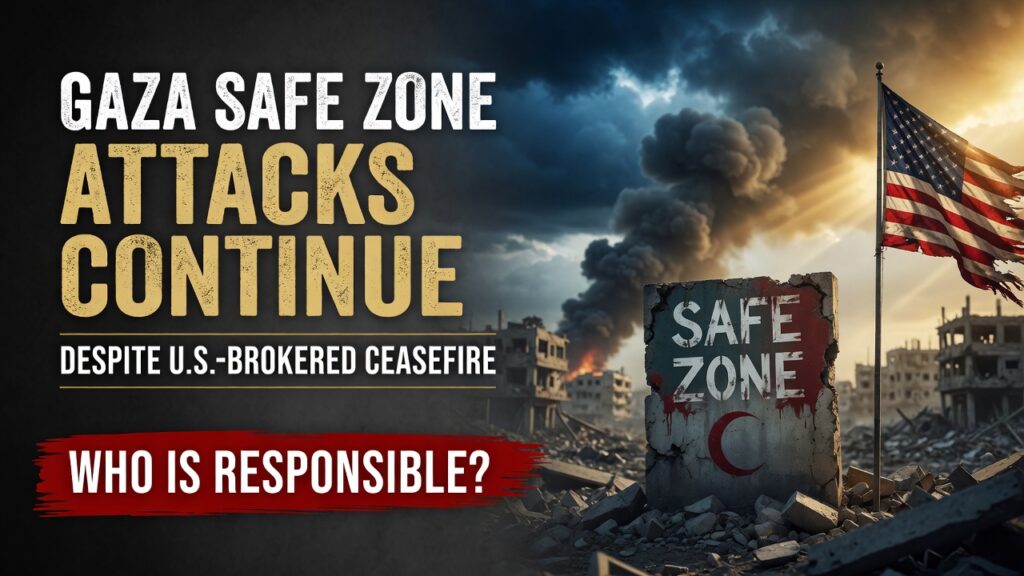
Gaza Safe Zone Attacks Continue Despite U.S.-Brokered Ceasefire — Who Is Responsible?
A U.S.-brokered ceasefire was supposed to end the bloodshed in Gaza. Instead, strikes keep hitting the places civilians were told to go — and no one with the power to stop it seems willing to act.
The promises were clear. Civilians had somewhere safe to go. They were told this. They moved there. They are still dying there.
That is the central crisis now playing out in al-Mawasi, a narrow coastal strip in western Khan Younis that Israeli military authorities designated as a humanitarian “safe zone” and to which hundreds of thousands of displaced Palestinians have been directed during one of the most devastating conflicts in the region’s modern history. The question of who bears accountability — and whether American diplomatic leverage is being applied with anything like the urgency the situation demands — has never been more pressing.
Support Independent Local Journalism
TheTownHall.News is a non-profit reader-supported journalism. Just $5 helps us hire local reporters, investigate important issues, and hold public officials accountable across Alameda County. If you believe our community deserves strong, independent journalism, please consider donating $5 today to support our work.What Is Actually Happening in Al-Mawasi?
The Israeli military continues to target tents sheltering displaced Palestinians in al-Mawasi in western Khan Younis, killing entire families, while simultaneously ordering Palestinians from other parts of Gaza to move to the same area — even though it lacks basic infrastructure including shelter, water and sewage systems, and medical facilities. United Nations
Since the ceasefire ended on March 18, 2025, al-Mawasi’s population more than tripled, rising from approximately 115,000 to over 425,000 by mid-June — with nearly all residents living in makeshift tents assembled from basic materials. That translates to more than 47,700 people per square kilometer, a density that strains the imagination. United Nations
These are not abstract numbers. These are people who followed instructions — who were told by military authorities to move to a designated location — and who then became targets in that same location.
When a government designates a “safe zone” and then bombs it, the word “safe” has lost all meaning. Someone needs to answer for that.

What Do the Numbers Actually Tell Us?
Between March 18 and June 16, 2025, the UN Human Rights Office recorded 112 attacks in al-Mawasi killing 380 people, including at least 158 women and children. Among those killed, there were 64 documented cases where entire nuclear families — parents and their children — were wiped out in a single strike. United Nations
380 deaths in a designated safe zone over roughly 90 days. The question accountability demands is simple: what exactly is a safe zone for?
In one verified incident on May 19, a strike on a tent belonging to the Kasab family killed a 34-year-old woman and six of her children — four girls aged 5, 7, 10, and 13, and two boys aged 11 months and 11 years. The Israeli military provided no public justification for that specific strike. United Nations
As recently as July 6, 2026, two people were killed and 15 injured when Israel struck a tent housing displaced Palestinians in al-Mawasi. The strikes have not stopped. Democracy Now!
“When a government tells civilians to go somewhere safe and then bombs that location repeatedly — with no public military justification — the burden of proof shifts entirely. Where is the accountability?”
Is the U.S.-Brokered Ceasefire Functioning at All?
The United States invested significant diplomatic capital in negotiating a ceasefire framework. The Gaza peace plan, officially the Comprehensive Plan to End the Gaza Conflict, was announced by President Trump on September 29, 2025, signed on October 9, and endorsed by the UN Security Council on November 17. Wikipedia
Support Independent Local Journalism
TheTownHall.News is a non-profit reader-supported journalism. Just $5 helps us hire local reporters, investigate important issues, and hold public officials accountable across Alameda County. If you believe our community deserves strong, independent journalism, please consider donating $5 today to support our work.Since the start of the ceasefire’s second phase, Israel has continued near-daily strikes in Gaza targeting what it describes as Hamas threats. The Hamas-run Gaza health ministry estimates the death toll in Gaza now tops 72,000 Palestinians. Council on Foreign Relations
A bipartisan letter signed by 49 members of Congress told President Trump that Israel had violated the ceasefire agreement more than 700 times since it was signed less than three months earlier, including the killing of two brothers aged 8 and 10 in a drone strike after they crossed into an Israeli-controlled area of Gaza — children the IDF initially described as “suspects.” Congressman Mark Pocan
If 700 ceasefire violations cannot trigger a meaningful diplomatic response, what exactly is American leverage worth?
What Does Israel Say — and Is That Explanation Sufficient?
Israeli authorities have stated that strikes on al-Mawasi target what they describe as “significant Hamas terrorists” operating command and control centers embedded inside the humanitarian zone, and that prior to strikes, “numerous steps were taken to mitigate the risk of harming civilians, including the use of precise munitions, aerial surveillance, and additional means.” Al Jazeera
That is the official position, and it deserves a fair hearing. Hamas has denied that fighters were present in targeted areas, accusing Israeli authorities of perpetuating justifications for what Hamas calls deliberate attacks on civilians. Al Jazeera
The core problem is evidentiary. Of the 112 documented attacks on al-Mawasi between March and June 2025, the Israeli military did not publicly provide justification for any of them. In only one exceptional case — a May 30 strike — did the IDF claim to have killed a named Hamas figure, without specifying the location. United Nations
The international legal standard is clear: parties to a conflict bear responsibility for proportionality, distinction between combatants and civilians, and precaution. UN Secretary-General António Guterres stated that “the use of heavy weapons in densely populated areas is unconscionable.” That statement, made in response to an earlier Mawasi strike, applies with equal or greater force today. Al Jazeera
What Do Supporters of This Military Campaign Actually Believe?
Those who defend Israel’s military posture in Gaza make substantive arguments that cannot simply be dismissed. Hamas did commit a mass atrocity on October 7, 2023. The group has used civilian infrastructure for military purposes, a documented practice that creates genuine targeting complexity under the laws of war. The IDF has accused Hamas of attacking and killing its soldiers in numerous separate instances and of crossing ceasefire withdrawal lines. Israel also argues — reasonably — that a terrorist organization cannot be allowed to reconstitute itself in territory it controls by exploiting civilian cover. Council on Foreign Relations
These are real considerations. But accountability does not disappear in complex environments. The argument that a military campaign cannot be held to any standard because the adversary is embedded among civilians is not a legal or moral pass. It is precisely the condition under which the laws of armed conflict were designed to operate. The question is not whether Israel has legitimate security interests — it clearly does. The question is whether the specific pattern of strikes in a formally designated civilian safe zone, with no public justification for the vast majority of attacks, meets the threshold of proportionality and precaution that international law requires. That question remains unanswered.
What Happens If No One Speaks Up?
The pattern here is not ambiguous. A safe zone is designated. Civilians are directed to it. Strikes hit it repeatedly. No official justification is provided. The cycle repeats.
An independent analysis published in The Economist estimated that accounting for undercounting, the total Palestinian death toll could range from 77,000 to 109,000, representing 4 to 5 percent of Gaza’s pre-war population. A classified IDF database cited in the same reporting listed approximately 8,900 Palestinian fighters as dead or likely dead — suggesting that roughly 83 percent of those killed were civilians, a ratio that, among conflicts since 1989, has been exceeded only by the Srebrenica massacre, the siege of Mariupol, and the Rwandan genocide. WikipediaWikipedia
Those are not Hamas statistics. Those are independent analytical estimates drawn from multiple methodologies.
The United States has more leverage in this conflict than any other outside actor. It provides military assistance, diplomatic cover, and has brokered the very ceasefire agreement being violated. The argument that this leverage is being applied forcefully is not supported by the fact that strikes on designated safe zones — with civilian families as documented casualties — are still occurring as of this week.
Is the United States the guarantor of a ceasefire agreement, or just the author of one?
Key Questions
- If a “safe zone” designation carries no enforcement mechanism, what obligation does the designating military have to civilians who follow its instructions?
- The U.S. brokered this ceasefire and maintains significant leverage over Israel. At what point does failure to enforce the agreement make Washington a party to its collapse?
- Independent analysts estimate that the civilian share of casualties in Gaza may be among the highest in any modern conflict. What accountability mechanism — domestic, international, or diplomatic — is actually capable of responding to that finding?
The real question is not whether this conflict is complicated — it is. The question is whether “complicated” has become a substitute for accountability, and whether American foreign policy has the discipline to demand that a ceasefire it negotiated, signed, and endorsed before the United Nations means something. The answer to that question will determine not just what happens in Gaza, but how seriously any future U.S.-brokered agreement is taken by anyone.
What do you think — is it time for Congress to demand enforcement, or has American leverage in this conflict already been spent? Share this and make your voice heard.
Still have questions? Subscribe to The Town Hall News for daily accountability coverage. Think others need to hear this? Share this article. Want your voice to count? Contact your representative’s office and ask where they stand on ceasefire enforcement.