Damascus Bombings During Macron Visit Raise Questions About Syria ‘s Stability
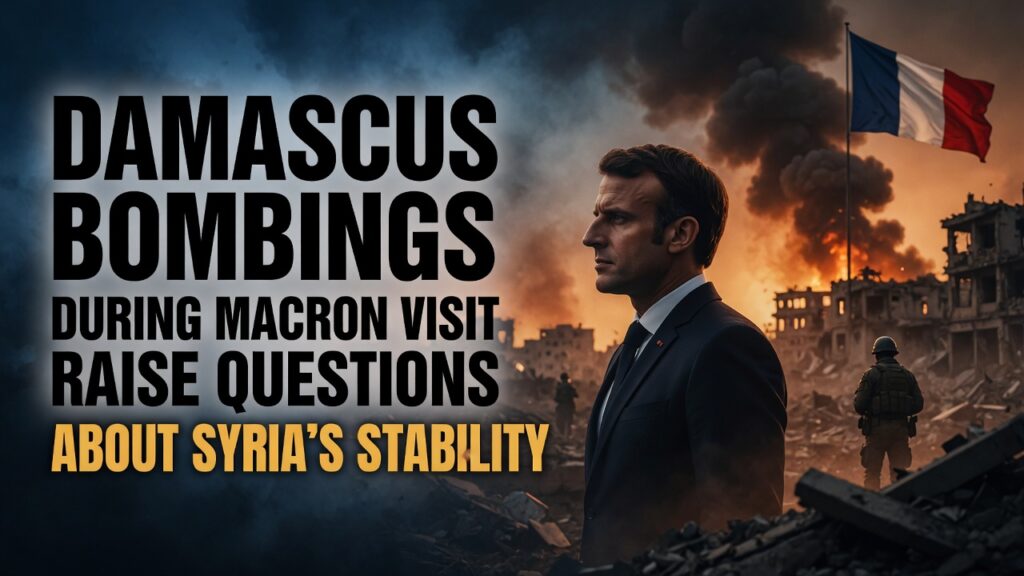
As France rushes to lock in billion-dollar deals with Syria’s new government, two bombs went off steps from where Emmanuel Macron slept — and the world moved on by lunch.
Syria is open for business. That is the message French President Emmanuel Macron carried to Damascus on July 7, 2026, arriving with an economic delegation and a stack of partnership agreements in hand. But before the ink was dry, improvised explosive devices detonated near his hotel, wounding 18 people and sending plumes of smoke into the Damascus sky. The question no one in Paris seems eager to answer: when bombs go off during a presidential visit, is that a diplomatic inconvenience — or a serious intelligence failure that should give Western governments pause?
This was not a random bad day. It was the second attack to rock the Syrian capital in a single week and a direct setback for President Ahmad al-Sharaa as he sought to project stability while hosting the first major Western leader to visit Syria since the ouster of Bashar al-Assad in late 2024. The optics were striking and the underlying message was unmistakable: the forces that want Syria to fail are still very much active. France 24
Support Independent Local Journalism
TheTownHall.News is a non-profit reader-supported journalism. Just $5 helps us hire local reporters, investigate important issues, and hold public officials accountable across Alameda County. If you believe our community deserves strong, independent journalism, please consider donating $5 today to support our work.What Actually Happened on the Streets of Damascus?
Two bombs exploded near a hotel in Damascus where Macron had spent the night, but his office said he did not hear the explosions and he met Syrian President Ahmed al-Sharaa soon afterward on Tuesday. The Interior Ministry confirmed the two blasts in the heart of the capital were caused by explosive devices — one placed in a garbage bin and the other in a parked car. WHBL
Syria’s Interior Ministry said 18 people were injured, including four police officers, with the blasts occurring near the Ministry of Tourism and the Four Seasons Hotel, where Macron had stayed the night before. The Syrian Interior Ministry said security forces had actually identified the two bombs and were preparing to defuse them when they detonated, describing the devices as crudely made. Al JazeeraWHBL
That last detail deserves scrutiny. Security forces knew the bombs were there, were moving to neutralize them, and they went off anyway. That is not a clean bill of health — that is a near-miss wrapped in a press release.
Who Is Behind the Attacks — and Why Won’t Anyone Say?
There was no immediate claim of responsibility for the attack. But the silence did not stop investigators from drawing early conclusions. A member of Syria’s security apparatus with knowledge of the investigation said Syria’s General Intelligence forces have been seizing “large amounts of explosive materials” daily and described the most active terror cells in central and southern Syria as linked to the Iranian Revolutionary Guard Corps. The source said the attack was carried out by a Palestinian-Syrian linked to Iranian-backed cells. WHBLAl Jazeera

If that assessment holds, it would fit a broader pattern. Islamic State, an adversary of al-Sharaa during the civil war, has claimed a series of attacks on government forces in Syria since February 2026, when the jihadist group announced what it described as a new phase of operations against his government. Meanwhile, Assad loyalists, remnants of the former regime, and Iran-linked proxies all have compelling motives to destabilize a transitional government that is actively courting the West. WHBL
No group claimed credit for bombing the street outside a Western leader’s hotel — and that silence may be more revealing than any manifesto.
“The more Syria attains stability, the more there are those who want to damage it.” — Damascus Governor Maher Marwan al-Idlibi
Is This the Accountability Moment Syria’s New Government Cannot Afford to Fumble?
Interior Ministry spokesperson Nureddin al-Baba said the explosions posed no direct threat to Macron and confirmed authorities had already identified possible perpetrators, without elaborating. “A short while ago, we discovered an initial lead pointing to those responsible,” he said. Al Jazeera
That vague assurance followed a week of escalating violence. On July 2, an explosive device detonated at a café near Damascus’s main judicial complex in the Midan neighbourhood, killing ten people and injuring 21 others. No group claimed responsibility for that attack, though many Syrians blamed loyalists of the former al-Assad government. Six of the dead were lawyers, professionals who worked near the courthouse where high-profile cases tied to Syria’s post-Assad transition are being heard. WikipediaThe Media Line
Two attacks in five days, targeting a judicial hub and then a Western leader’s hotel. This is not a coincidence. It is a campaign. And the Syrian government’s ability to stop it will determine whether the country’s transition succeeds or collapses.
Support Independent Local Journalism
TheTownHall.News is a non-profit reader-supported journalism. Just $5 helps us hire local reporters, investigate important issues, and hold public officials accountable across Alameda County. If you believe our community deserves strong, independent journalism, please consider donating $5 today to support our work.18 people wounded in a bombing steps from a Western presidential motorcade. The question al-Sharaa’s government must answer now: if you cannot protect the street outside a foreign leader’s hotel, what exactly are you selling to investors?
What Do Supporters of This Diplomatic Push Actually Believe?
The case for Macron’s visit — and for Western engagement with Syria — is not without merit. Proponents argue that economic isolation is precisely what allows radical actors to flourish. A Syria integrated into Western trade networks, they contend, has far more to lose from instability than one left to regional proxies and Iran. Macron himself made this argument forcefully: “It is necessary that the dictatorship be succeeded by a genuine rule of law,” Macron said at a joint press conference with al-Sharaa, adding that only the rule of law could help build a prosperous new Syria. Gulf News
The two leaders announced the restoration of full diplomatic ties and signed a sweeping package of economic, security, and infrastructure agreements, including a Framework Declaration for Comprehensive Cooperation and a major maritime, air transport, and logistics agreement with French shipping giant CMA CGM. One agreement initiated the process of returning some 51 million euros ($58.3 million) in illicit assets that had belonged to Rifaat Assad, the late uncle of the deposed dictator. Other agreements covered rebuilding destroyed water and electricity infrastructure in Homs and providing technical assistance to Syria’s Central Bank. i24NEWSThe Hill
The optimistic reading is that diplomatic momentum and economic incentives will outpace the violence. The skeptical reading — grounded in recent history across Libya, Afghanistan, and Iraq — is that investment pledges made before a country has achieved basic security tend to enrich contractors and embolden corrupt officials while ordinary citizens remain exposed to bombs.
Are Western Taxpayers and Businesses Being Set Up to Subsidize an Unstable State?
If a bomb goes off near your president’s hotel on the day he signs a dozen economic deals, it is fair to ask who is doing the risk assessment.
Security researcher Navvar Saban of the Arab Center for Contemporary Studies in Syria warned that checkpoints and patrols may help people feel safer, but preventing this type of attack requires intelligence work, mapping networks, monitoring explosive materials, improving information sharing, and building cooperation with local communities. That is a sophisticated counterterrorism architecture that Syria’s transitional government — still integrating former regime personnel and Kurdish fighters into a new military structure — is years from fully building. Al Jazeera
Previous deals already in place include a 30-year contract with CMA CGM and an offshore oil and gas exploration agreement involving TotalEnergies, ConocoPhillips, and QatarEnergy. Those are serious, long-term commitments from serious companies. They deserve serious security guarantees, not reassurances delivered at a press conference hours after bombs went off two blocks away. Gulf News
The principle of fiscal accountability does not stop at the water’s edge. If European governments and state-backed development funds are channeling money into Syria’s reconstruction — and they are — then taxpayers in Paris, Berlin, and Brussels have every right to demand rigorous vetting, transparent contracting, and measurable security benchmarks before a single euro clears a Damascus bank.
What Happens If the Violence Keeps Escalating?
The back-to-back attacks have deeply rattled people in Damascus, challenging the narrative of a peaceful transition. The Syrian government is working hard to project an image of a functional, modern state capable of attracting international reconstruction funds and cementing Western partnerships. But projection and reality are two different things, and sophisticated investors — and voters back home — will eventually demand evidence of the latter. Al Jazeera
Syria’s new rulers have wrestled with outbreaks of violence as they assert control. While the capital had been largely peaceful during the transition period, the twin bombings represent a significant breach. What happens to the diplomatic momentum — and the investment agreements — if a third attack follows? Or a fourth? France 24
The West must decide whether it is engaging Syria’s transition or underwriting it — because those two things carry very different risks and very different price tags.
Key Questions
- Who is actually behind the Damascus bombings — Iranian-backed cells, Assad loyalists, ISIS, or some combination — and why has no group claimed responsibility for either the July 2 café attack or the July 7 hotel bombing?
- What security guarantees, if any, did France and other Western partners extract from al-Sharaa’s government before signing more than a dozen economic agreements on the same day bombs went off in the capital?
- At what point does persistent violence in Damascus become a disqualifying factor for Western investment — and are European governments being transparent with their own citizens about the risks they are accepting on their behalf?
The real question is not whether Syria deserves a chance at stability — it does. The real question is whether Western leaders are being honest with their own citizens about what that chance actually costs, and who will pay when the next bomb goes off.
Think this story deserves more scrutiny than it is getting? Share it and tell us: is the West moving too fast in Syria — or not fast enough?
Still have questions? Subscribe to The Town Hall News for daily accountability journalism. Want to make your voice heard? Contact your representative and ask what oversight provisions govern U.S. and allied investments in Syria’s reconstruction.