Iran Breaks Ceasefire With Missile Strikes on Northern Israel — What Happens Next?
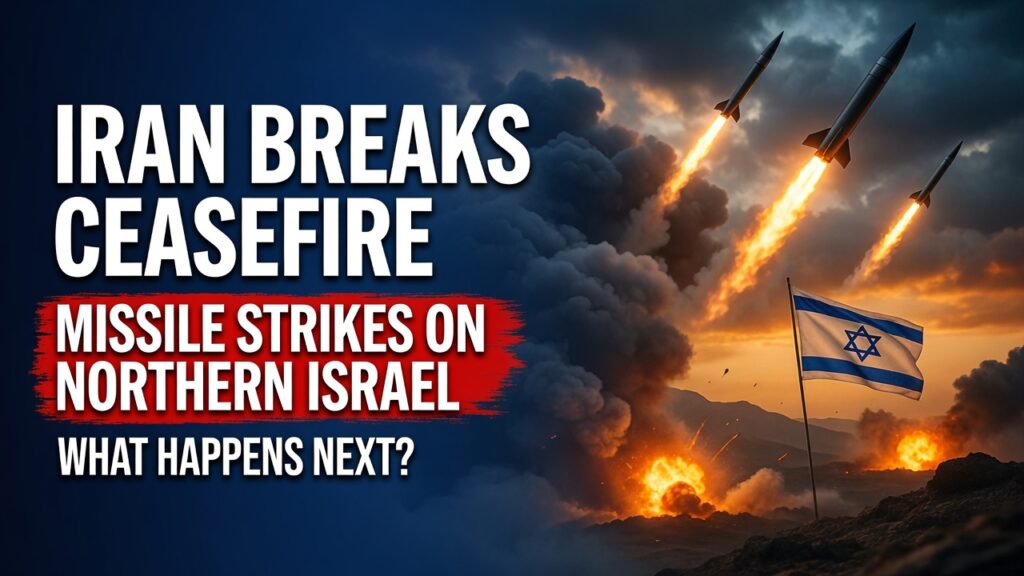
The ink on a fragile peace deal is barely dry — and Iran has already fired ballistic missiles at northern Israel. With Hezbollah still in the fight and diplomats scrambling, millions are now asking who is actually in charge of this ceasefire, and what happens if no one is.
The ceasefire was supposed to hold. It didn’t.
On June 7, 2026, Iran launched ballistic missiles at Israel — the first such bombardment since a fragile ceasefire took effect in early April — raising the immediate possibility of a return to heavy fighting and complicating diplomatic efforts to end the war. The attack targeted northern Israel, sent air raid sirens wailing across the country, and forced millions of Israelis back into bomb shelters. Whether this marks a temporary flare-up or the collapse of a painstakingly negotiated peace is the question every government in the region — and in Washington — is now frantically trying to answer. NPR
Support Independent Local Journalism
TheTownHall.News is a non-profit reader-supported journalism. Just $5 helps us hire local reporters, investigate important issues, and hold public officials accountable across Alameda County. If you believe our community deserves strong, independent journalism, please consider donating $5 today to support our work.How Did We Get Here? The War That Reshaped the Middle East
Since February 28, 2026, the United States and Israel have been at war with Iran and its regional allies. Hostilities broke out after U.S.-Israeli airstrikes killed several Iranian officials, including Supreme Leader Ali Khamenei. Iran responded with waves of ballistic missiles and drone attacks aimed at Israel, American military bases, and U.S.-aligned Arab states across the region. The confrontation was the most significant direct military clash between Iran and the West in decades, and it reshaped the strategic map of the Middle East almost overnight. Wikipedia
A ceasefire brokered in early April 2026 halted the most intense phase of the fighting. During the conflict, Iran had launched a total of 525 ballistic missiles toward Israel. American and Israeli forces spent weeks degrading Iran’s missile launch capabilities — joint U.S.-Israeli efforts worked to eliminate as many as three-quarters of Iranian missile launchers, including those that had been rebuilt after earlier conflicts. By the tenth day of the war, Iranian missile and drone attacks had dropped by more than 90%. The ceasefire that followed was never airtight. It was a truce born of exhaustion, not resolution. WikipediaWikipedia
What Triggered the June 7 Attack on Northern Israel?
Tehran warned of retaliation after Israel struck Beirut’s southern suburbs without warning earlier that Sunday, in defiance of Washington’s request days earlier to stand down. Israel said the Iranian-backed Hezbollah had fired at northern Israel first, and called its Beirut strike a retaliatory response. In other words, within a single day, the chain of action-and-response that had defined the prior months of war was back in motion — and the ceasefire was the first casualty. NPR
If a ceasefire can be shattered in a single afternoon by a chain of proxy-driven escalation, what exactly did the ceasefire ever guarantee?

The Iranian Revolutionary Guard Corps stated that the missile attacks were a “warning” of a broader response that would encompass all U.S. and Israeli targets in the region if “aggressions” are repeated. That is not the language of a party committed to de-escalation. That is a declaration of conditional war — a threat framework designed to constrain Israeli decision-making indefinitely. The Jerusalem Post
What Do the Numbers Actually Tell Us About Iran’s Capabilities?
Iran’s missile inventory has been significantly degraded — but not destroyed.
525 ballistic missiles launched toward Israel during the 2026 war. The question every defense analyst is asking: how many does Iran still have, and what is stopping it from using them? Wikipedia
Analysts noted that the number of Iranian missiles aimed at Israel was far lower than during the 2025 Twelve-Day War, when Iran commonly launched large barrages intended to overwhelm Israeli defenses. The reduction was credited to Israeli and U.S. success in targeting launchers and storage locations. But degraded is not eliminated. Iran demonstrated on June 7 that it retains both the capability and the will to strike — and that it views the ceasefire as a tactical pause, not a strategic commitment. Wikipedia
In the early hours of June 8, Israel unleashed retaliatory missile strikes on Iran, with dozens of Israeli warplanes targeting Iranian air defenses being restored after earlier fighting. Iranian citizens reported explosions in Tehran, Isfahan, and Tabriz. The exchange underscored that neither side has accepted a permanent end to hostilities — and that the April ceasefire was, at best, a reset button that both parties are ready to unpush at a moment’s provocation. NPR
Support Independent Local Journalism
TheTownHall.News is a non-profit reader-supported journalism. Just $5 helps us hire local reporters, investigate important issues, and hold public officials accountable across Alameda County. If you believe our community deserves strong, independent journalism, please consider donating $5 today to support our work.“If Iran can break a ceasefire with impunity — launching ballistic missiles at a U.S. ally while diplomats scramble for a deal — then the ceasefire itself was never a deterrent. It was a delay.”
Is Washington’s Influence Over This Crisis Real — Or an Illusion?
The United States negotiated the April ceasefire. It brokered talks. It sent diplomatic messages. And on June 7, Israel ignored Washington’s explicit request to stand down before striking Beirut.
U.S. President Donald Trump, in an interview with NBC’s “Meet the Press” that aired on June 7, said he would like to see “a more surgical attack on Hezbollah.” He also said he was “not demanding” that Lebanon be part of an overall ceasefire deal. Those two statements alone reveal the contradictions at the heart of American policy in this conflict: the U.S. wants a deal, but it is also distancing itself from key demands its own ceasefire partners consider non-negotiable. PBS
Iran continues to assert its grip on the Strait of Hormuz, and the U.S. continues its blockade of Iranian ports, with shipments of oil, natural gas, and fertilizer affected, and the global economy under ongoing strain. American consumers are not insulated from this conflict. Every day it continues, the economic pressure compounds — in energy prices, in supply chains, in market volatility. The war is not happening somewhere abstract. Its costs land on kitchen tables in Ohio and California just as surely as missiles land in Haifa. PBS
Bold the following for tweetability:
Iran fired ballistic missiles at northern Israel just weeks after a ceasefire — and the world is learning what happens when deterrence becomes optional.
The April ceasefire was supposed to end a war. Instead, it handed Iran a blueprint for how much it could escalate before anyone would respond.
What Do Supporters of the Iran Ceasefire Actually Believe?
Proponents of diplomacy — including many in the foreign policy establishment and international community — argue that the April ceasefire, however imperfect, was a necessary brake on a conflict that was dragging the entire region toward catastrophe. They point to the genuine human cost on all sides: the war’s economic impact has included the largest supply disruption of the global oil market in history, with widespread disruptions to natural gas, aviation, and tourism industries. Diplomats backing the truce argue that any ceasefire, even a fragile one, saves lives that active combat would have taken. Wikipedia
Mediators from Pakistan, Qatar, Egypt, and Turkey have all invested significant effort in bridging U.S.-Iran differences. Pakistan’s interior minister was in Tehran on June 7 itself, delivering a message to Iranian leadership, even as missiles were being launched at Israel. These advocates argue that sustained diplomatic engagement — however slow and frustrating — is the only path to a durable settlement, and that returning to full-scale war would produce outcomes far worse than an imperfect peace. NPR
These are serious arguments that deserve engagement. But they rest on an assumption that both parties are acting in good faith toward an eventual deal. Iran’s decision to fire missiles at a sovereign nation on the same day mediators were on the ground arguing for de-escalation calls that assumption directly into question. A ceasefire that one party treats as a strategic convenience is not a peace process — it is a countdown.
Is the Civilian Cost of Inaction Being Ignored?
A 79-year-old man was struck by stone debris from the shockwave of an Iranian ballistic missile that hit the northern Israeli town of Kiryat Ata. Several cluster munition impact sites were reported in the Haifa area, with damage to roads and vehicles. These are not statistics in a war game. They are real people — elderly civilians knocked down by shockwaves in their own neighborhoods, families sheltering in stairwells, children forced out of school. JNS.org
The June 8 attacks forced the nationwide closure of Israeli schools for the first time in two months, as millions of Israelis rushed to bomb shelters. The ceasefire that was supposed to restore normalcy had, in a single day, stripped it away again. The human toll of a conflict that never fully ends is cumulative — measured not only in casualties but in a generation of children being raised in a permanent state of alert. The Times of Israel
Is there a point at which the “fragile ceasefire” framing itself becomes a moral failure — a way of normalizing a situation that should never have been allowed to persist?
What Happens If No One Draws a Clear Line?
The pattern emerging from this conflict is one that should alarm anyone who values rule of law and deterrence as foundations of international order. Iran fires. Diplomats protest. A ceasefire is brokered. Iran fires again. The cycle repeats. Without a credible enforcement mechanism — without consequences that actually cost Iran more than the aggression benefits it — this loop can continue indefinitely.
Trump urged Iran to “get back to the table” after the June 7 missile strikes, saying: “You’ve shot your missiles, that’s enough. Get back to the table and make a deal.” The sentiment is understandable. But a regime that has just proven it can break a ceasefire and receive only a request to negotiate does not have strong incentives to negotiate seriously. The Jerusalem Post
Key Questions This Story Raises:
- If Iran can breach a U.S.-brokered ceasefire without triggering automatic consequences, what credibility does American diplomatic power have in future negotiations?
- With Hezbollah still operating freely in Lebanon and rejecting ceasefire terms, can any deal between Iran and the U.S. actually hold?
- How long can Israel’s civilian population absorb the psychological and economic toll of an unresolved conflict before the political pressure for a full resumption of war becomes overwhelming?
The real question this conflict demands is not whether another round of diplomacy is possible. It is whether a ceasefire that both sides treat as temporary is actually preventing war — or simply deferring it long enough for the next provocation to arrive.
Think others need to hear this? Share the article and weigh in: Is a fragile ceasefire better than no deal at all — or does it just give bad actors room to reload? Subscribe to The Town Hall News for daily accountability coverage, and contact your representative to demand a clear U.S. policy on Iran enforcement.